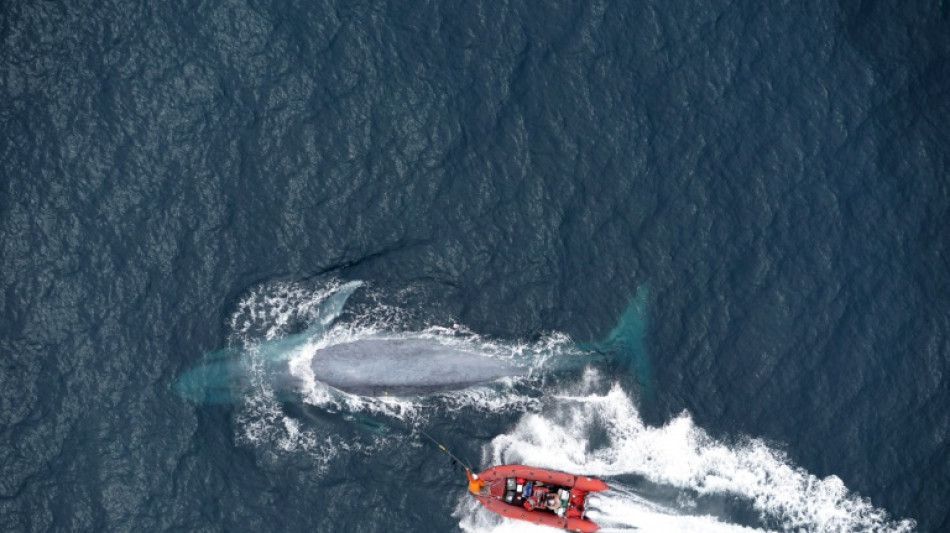
Blue whales eat 10 million pieces of microplastic a day: study / Photo: - - Goldbogen Laboratory/AFP/File

 Rahm reaches separation deal with LIV in bankruptcy court

 UN chief urges nations to end 'war on nature'

 Newcastle boss Jaissle says Fernandez-Pardo just needs a goal

 Infantino offers apology but 'no answers' at FIFA meeting over World Cup plan

 Don't exclude Turkey from 'Made in Europe' plan: minister to AFP

 French duo Justice to score 'GTA VI': game maker

 El Nino a 'terrifying' threat to coral reefs: UN biodiversity expert

 Barcola must get used to Liverpool highs and lows, says Iraola

 Versus Trade Wins Best ECN/STP Broker APAC 2026, Marking Third UF Awards Recognition

 Three dead as Istanbul sees heaviest rainfall in 80 years

 US producer prices see biggest jump since 2022 in added challenge to Trump

 Swiatek avoids seed exodus to breeze into Wuhan last eight

 PM condemns 'chaos' as violent protests grip Albania

 'I couldn't breathe', Russell Brand's alleged rape victim says

 Pope's cancer operation already reshaping papacy

 Zverev cruises past De Minaur to reach Shanghai semi-finals

 Ukraine's Zelensky defies Trump with Russian refinery strikes

 Holders Australia edge New Zealand 24-22 to open Rugby league World Cup

 'Ocarina of Time': Nintendo gives Zelda classic a modern makeover

 France charges teen shooter citing revenge for bullying in school

 Martinez blames 'anger' for dig at Man Utd hierarchy

 Crowds build as Albanian PM tours protest aftermath
 China-North Korea bridge opens, 12 years late

 Asian Cup in Saudi Arabia could be postponed but 'no hurry' to decide: AFC

 Conrad wields axe after South Africa loss to Australia

Blue whales consume up to 10 million pieces of microplastic every day, research estimated Tuesday, suggesting that the omnipresent pollution poses a bigger danger to the world's largest animal than previously thought.
The tiny fragments of plastic have been found everywhere from the deepest oceans to the highest mountains, and even inside human organs and blood.
Now a modelling study published in the journal Nature Communications has estimated how much is being ingested by whales.
A US-led research team put tags on 191 blue, fin and humpback whales that live off the coast of California to observe their movements.
"It's basically like an Apple Watch, just on the back of a whale," said Shirel Kahane-Rapport, a researcher at California State University, Fullerton and the study's first author.
The whales mostly fed at depths of between 50 to 250 metres (165-820 feet), which is home to the "greatest concentration of microplastics in the water column," Kahane-Rapport told AFP.
The researchers then estimated the size and number of mouthfuls the whales had daily and what was filtered out, modelling three different scenarios.
Under the most likely scenario, the blue whales ate up to 10 million microplastic pieces a day.
Over the 90-120 day annual feeding season, that represents more than a billion pieces a year.
The largest animal ever to live on Earth is also likely the biggest microplastic consumer, eating up to 43.6 kilogrammes a day, the study said.
"Imagine carrying around an extra 45 kilogrammes -- yes, you're a very big whale, but that will take up space," Kahane-Rapport said.
Humpback whales were estimated to eat around four million pieces a day.
While it is easy to imagine whales sucking in vast amounts of microplastics as they gulp their way through the ocean, the researchers found that was not the case.
Instead, 99 percent of the microplastics entered the whales because they were already inside their prey.
"That's concerning for us," Kahane-Rapport said, because humans eat that prey.
"We also eat anchovies and sardines," she said, adding that "krill is the basis of the food web".
Previous research has shown that if krill are in a tank with microplastic, "they will eat it," Kahane-Rapport said.
Now that the researchers know how much microplastic is being consumed by whales, next they aim to determine how much harm it could be doing.
"The dose defines the poison," Kahane-Rapport said.
C.Hamad--SF-PST