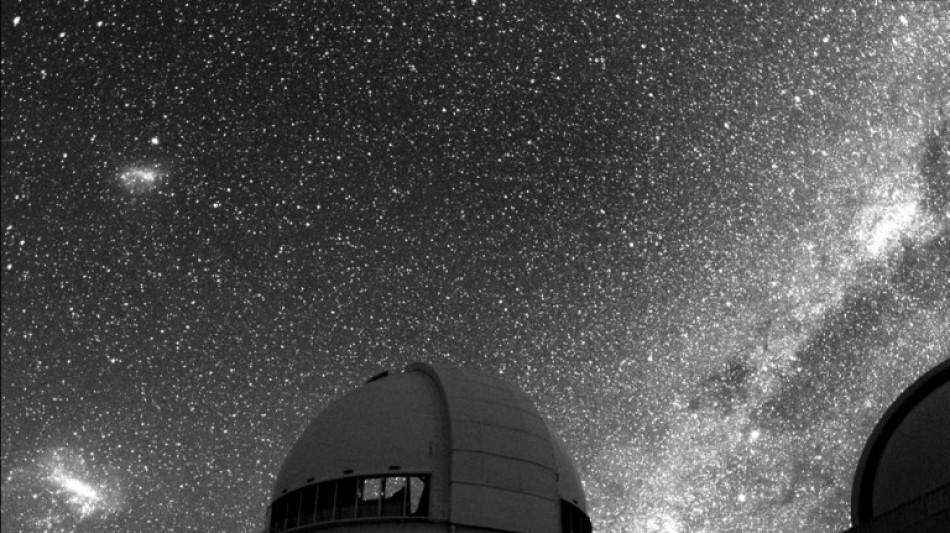
New potentially hazardous asteroid discovered / Photo: ROGER SMITH, AURA, NOAO, NSF - ROGER SMITH, AURA, NOAO, NSF/AFP

 Rahm reaches separation deal with LIV in bankruptcy court

 UN chief urges nations to end 'war on nature'

 Newcastle boss Jaissle says Fernandez-Pardo just needs a goal

 Infantino offers apology but 'no answers' at FIFA meeting over World Cup plan

 Don't exclude Turkey from 'Made in Europe' plan: minister to AFP

 French duo Justice to score 'GTA VI': game maker

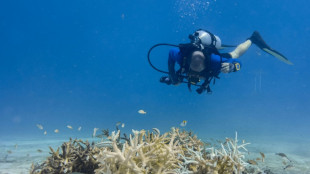 El Nino a 'terrifying' threat to coral reefs: UN biodiversity expert
 Barcola must get used to Liverpool highs and lows, says Iraola

 Versus Trade Wins Best ECN/STP Broker APAC 2026, Marking Third UF Awards Recognition

 Three dead as Istanbul sees heaviest rainfall in 80 years

 US producer prices see biggest jump since 2022 in added challenge to Trump
 Swiatek avoids seed exodus to breeze into Wuhan last eight
 PM condemns 'chaos' as violent protests grip Albania

 'I couldn't breathe', Russell Brand's alleged rape victim says

 Pope's cancer operation already reshaping papacy

 Zverev cruises past De Minaur to reach Shanghai semi-finals

 Ukraine's Zelensky defies Trump with Russian refinery strikes

 Holders Australia edge New Zealand 24-22 to open Rugby league World Cup

 'Ocarina of Time': Nintendo gives Zelda classic a modern makeover

 France charges teen shooter citing revenge for bullying in school

 Martinez blames 'anger' for dig at Man Utd hierarchy

 Crowds build as Albanian PM tours protest aftermath
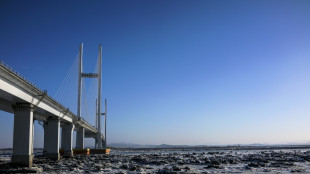 China-North Korea bridge opens, 12 years late

 Asian Cup in Saudi Arabia could be postponed but 'no hurry' to decide: AFC

 Conrad wields axe after South Africa loss to Australia

An international team of astronomers on Monday announced the discovery of a large asteroid whose orbit crosses that of Earth, creating a small chance far in the future of a catastrophic collision.
The 1.5 kilometer- (0.9 mile-) wide asteroid, named 2022 AP7, was discovered in area notoriously difficult to spot objects due to the glare from the Sun.
It was found along with two other near-Earth asteroids using a high-tech instrument on the Victor M. Blanco telescope in Chile that was originally developed to study dark matter.
"2022 AP7 crosses Earth’s orbit, which makes it a potentially hazardous asteroid, but it currently does not now or anytime in the future have a trajectory that will have it collide with the Earth," said lead author of the findings, astronomer Scott Sheppard of the Carnegie Institution for Science.
The potential threat comes from the fact that like any orbiting object, its trajectory will be slowly modified due to myriad gravitational forces, notably by planets. Forecasts are therefore difficult on the very long term.
The newly-discovered asteroid is "the largest object that is potentially hazardous to Earth to be discovered in the last eight years," said NOIRLab, a US-funded research group that operates multiple observatories.
2022 AP7 takes five years to circle the Sun under its current orbit, which at its closest point to Earth remain several million kilometers away.
The risk is therefore very small, but in case of a collision, an asteroid of that size "would have a devastating impact on life as we know it," said Sheppard. He explained that dust launched into the air would have a major cooling effect, provoking an "extinction event like hasn’t been seen on Earth in millions of years."
His team's results were published in the scientific journal The Astronomical Journal. The two other asteroids pose no risk to Earth, but one is the closest asteroid to the Sun ever found.
Some 30,000 asteroids of all sizes -- including more than 850 larger than a kilometer wide -- have been catalogued in the vicinity of the Earth, earning them the label "Near Earth Objects" (NEOs). None of them threaten Earth for the next 100 years.
According to Sheppard, there are "likely 20 to 50 large NEOs left to find," but most are on orbits that put them in the Sun's glare.
In preparation for a future discovery of a more threatening object, NASA conducted a test mission in late September in which it collided a spacecraft with an asteroid, proving that it was possible to change its trajectory.
G.AbuGhazaleh--SF-PST