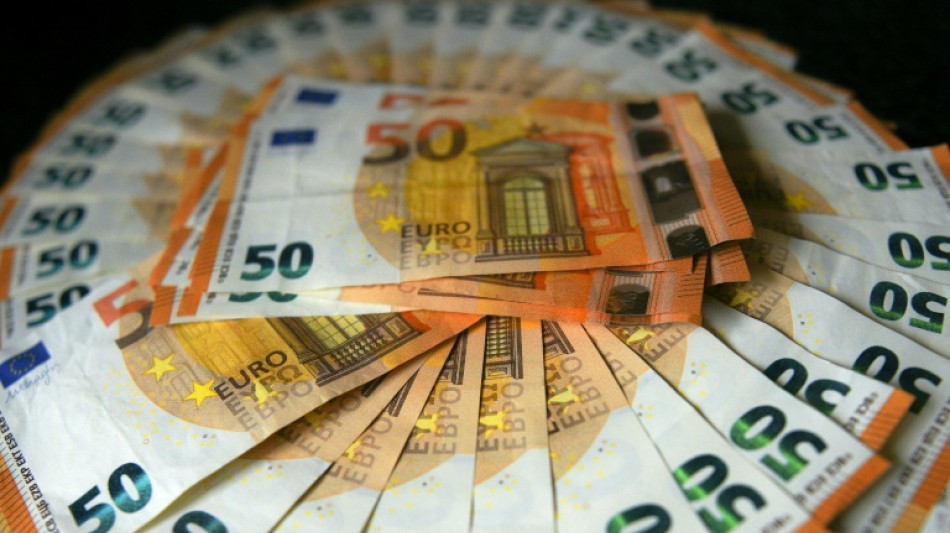
New Italian government seeks to raise cash ceiling / Photo: DENIS CHARLET - AFP/File

 Rahm reaches separation deal with LIV in bankruptcy court
 UN chief urges nations to end 'war on nature'
 Newcastle boss Jaissle says Fernandez-Pardo just needs a goal

 Infantino offers apology but 'no answers' at FIFA meeting over World Cup plan
 Don't exclude Turkey from 'Made in Europe' plan: minister to AFP

 French duo Justice to score 'GTA VI': game maker
 El Nino a 'terrifying' threat to coral reefs: UN biodiversity expert
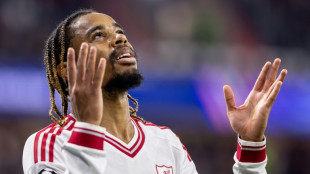 Barcola must get used to Liverpool highs and lows, says Iraola

 Versus Trade Wins Best ECN/STP Broker APAC 2026, Marking Third UF Awards Recognition
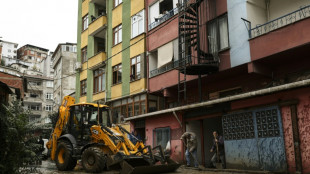 Three dead as Istanbul sees heaviest rainfall in 80 years

 US producer prices see biggest jump since 2022 in added challenge to Trump
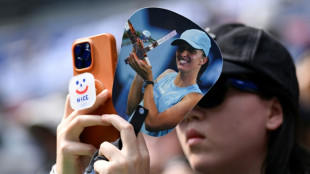 Swiatek avoids seed exodus to breeze into Wuhan last eight

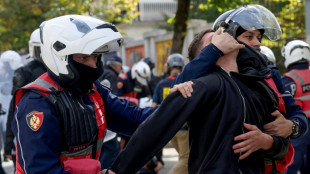 PM condemns 'chaos' as violent protests grip Albania
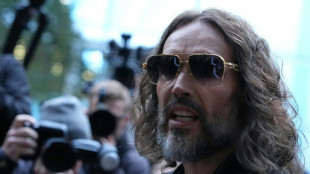 'I couldn't breathe', Russell Brand's alleged rape victim says
 Pope's cancer operation already reshaping papacy

 Zverev cruises past De Minaur to reach Shanghai semi-finals
 Ukraine's Zelensky defies Trump with Russian refinery strikes
 Holders Australia edge New Zealand 24-22 to open Rugby league World Cup
 'Ocarina of Time': Nintendo gives Zelda classic a modern makeover
 France charges teen shooter citing revenge for bullying in school

 Martinez blames 'anger' for dig at Man Utd hierarchy
 Crowds build as Albanian PM tours protest aftermath

 China-North Korea bridge opens, 12 years late
 Asian Cup in Saudi Arabia could be postponed but 'no hurry' to decide: AFC

 Conrad wields axe after South Africa loss to Australia

Cash is king in Italy, and the debate over limiting payments in notes and coins is heating up again under the country's new right-wing government.
A new bill introduced this week by the League party, a member of Prime Minister Giorgia Meloni's coalition, would raise the cash payment ceiling for Italians to 10,000 euros from 2,000 euros today.
The ceiling was already scheduled to decrease further to 1,000 euros as of January 1.
Credit card use has been steadily on the rise throughout the eurozone in recent years, but Italy has doggedly persisted in its preference for cash despite numerous incentives to encourage electronic payments.
Italians used cash for 82 percent of transactions, versus the 73 percent eurozone average, according to a 2020 study by the European Central Bank.
Defenders cite high card fees for shopkeepers and the preference among the elderly for cash.
However, critics say its use contributes to tax evasion and money laundering -- two problems that have long dogged the Italian economy.
"Mafia and (tax) evaders thank you," tweeted Andrea Orlando, labour minister under former premier Mario Draghi, about the League's bill.
- Helps the poor -
Meloni -- who has sought to reassure the EU that she will be fiscally prudent -- told the Senate Wednesday she will support a higher cash ceiling, although reports suggest she will back a lower level than proposed by the League.
She denied any link between high cash limits and the shadow economy, saying the higher ceiling "helps the poor".
Cash is preferred by low earners in the centre and south of Italy, where unemployment is higher, and among women and the self-employed, according to a Bank of Italy analysis of European Central Bank surveys published in March.
In a May report, the ECB estimated there were 13.5 million people in the eurozone with no bank account or access to financial services, arguing that cash needed to be remain accessible and accepted.
However, an October 2021 Bank of Italy research paper found a direct correlation between the use of cash and the shadow economy, noting that restrictions on cash use "are an effective instrument to tackle tax evasion".
- Tax evasion -
A 2016 decision to raise Italy's ceiling from 1,000 euros to 3,000 euros to boost spending raised the share of the shadow economy by about 0.5 percentage points, the Bank of Italy report found.
Italy's cash ceiling has gradually been lowered over the past three decades, although it rose to a high of 12,500 euros under two governments of then-premier Silvio Berlusconi, whose Forza Italia party is also part of Meloni's coalition.
Elsewhere in Europe, Greece has the most stringent cash limit, at 500 euros, while the ceiling rises above 10,000 euros in countries such as Malta, the Czech Republic and Croatia.
Germany, Sweden and Ireland, among others, have no limits, but restrictions exist.
Italy's largest business association, Confcommercio, said that as soaring inflation eats into household budgets, "it does not appear appropriate to impose new limitations on forms of payment".
It said that lowering merchants' credit card processing fees was a priority.
Massimo Vidiri, 51, who runs a Rome tobacco shop, said clients increasingly wanted to use credit cards, although he himself likes carrying cash.
"If something happens, like a blackout, what do I do?" he asked. "If the internet goes down throughout Italy, what do we do?"
He complained about high fees, a view shared by another shopkeeper nearby, Angelo Bruno.
Bruno, 71, denied small merchants like himself were a problem, telling AFP: "The big cases of tax evasion are the politicians, the only ones who get picked on are the little shopkeepers."
The Bank of Italy report found that because small business owners were more susceptible to bureaucratic burdens and high taxes, they were "more prone to shifting into the shadow economy".
Digital payments accelerated in Italy during the Covid-19 pandemic, when shops were shut and online shopping spiked.
A "cashback" scheme put in place in 2021 by then-prime minister Giuseppe Conte to encourage consumer spending and fight tax evasion through refunds on credit card purchases was considered inefficient and costly, and suspended by Draghi.
G.AbuGhazaleh--SF-PST