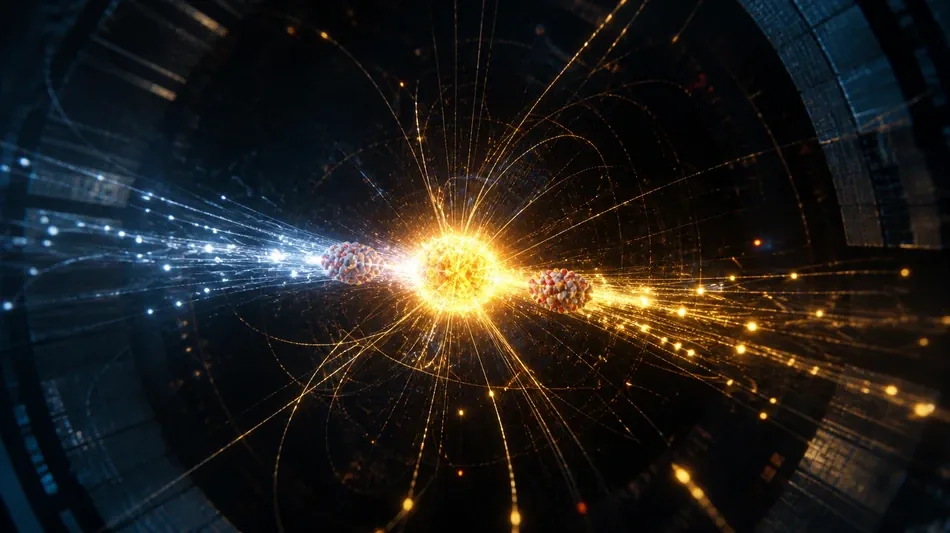
CERN creates quark-gluon plasma with smaller atomic nuclei

 New four-lane bridge opens between China, North Korea

 Tech stocks lead rout after US inflation fuels rate hike bets

 'No time to recover': UNDP chief sounds alarm on growing poverty after Iran war shock

 Australia says won't let big tech have 'unfettered' access to kids

 Mobile clinics battle Mongolia's childhood dental 'disaster'

 Wallabies back Meredith as playmaker for second New Zealand Test

 Messi's Inter Miami book playoffs with 2-0 win over New York City

 Oil-rich Alberta tests Canada's unity with secession vote

 EU leaders head for showdown over bloc budget

 All Blacks make three changes for second Wallabies Test

 Mourinho blasts 'shameless' timing of Vinicius ban decision

 PSG beat Man City in Champions League thriller, Barcola hits Liverpool hat-trick

 US Treasury chief urges stronger IMF role against 'distortionary policies'

 Giant-killers Bodo sink Dortmund in Champions League

 PSG outgun embattled Man City in six-goal Champions League thriller

 In Chicago, pope's hometown, Catholics express shock and support

 Musk suggests US govt behind any slowdown in Ukraine's Starshield system

 Chiclayo prays for recovery and return of the 'Peruvian pope'

 Barcola scores hat-trick as Liverpool hit LASK for six

 Healthy corals help bleached neighbors regain color: study

 Hope ton helps West Indies level T20 series at 2-2 in India

 Ukraine war reaches shores of Bulgarian fishing village

 Brazil probing 'criminal' origin of forest fires: minister to AFP

 Sally Rooney books cannot be sold in UK amid Palestine Action ban: publisher

 Italian ski stars Goggia and Brignone to miss season opener

CERN researchers produced signs of quark-gluon plasma in collisions involving oxygen-16 and neon-20, pushing down the known size threshold for the primordial state of matter.
An international CERN experiment has generated evidence of quark-gluon plasma using oxygen-16 and neon-20 nuclei, both less than one-tenth the mass of lead atoms previously used in many collider studies. The results were reported in Physical Review Letters.
Quark-gluon plasma is the extremely hot state thought to have filled the universe roughly a millionth of a second after the big bang. In that period, quarks had not yet become confined inside protons and neutrons, while gluons carried the force binding quarks together. As the universe expanded and cooled, those particles formed the matter observed today.
The smaller CERN collisions produced signals consistent with a tiny drop of material expanding collectively like a fluid before cooling into particles. Study co-author You Zhou of the Niels Bohr Institute said the experiment narrows the conditions under which matter can enter this state. Researchers are testing how far collision systems can be reduced while retaining fluid-like behaviour. Such experiments provide a laboratory route to studying primordial matter that no longer exists naturally in an accessible form.
Z.Ramadan--SF-PST


