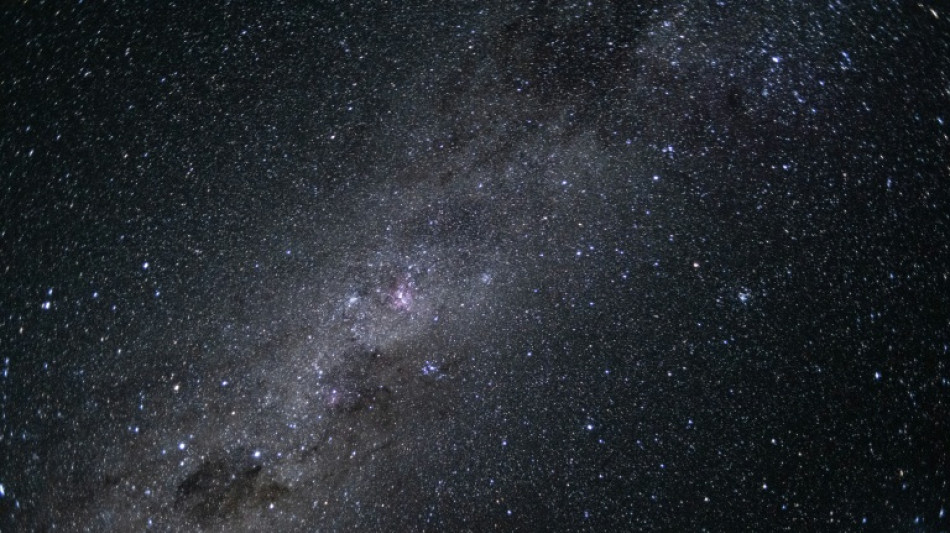
Milky Way's fastest star discovered spinning around black hole / Photo: Handout - NASA/AFP/File

 Tech stock lead rout after US inflation fuels rate hike bets

 Al-Fayed survivors say UK police missing 'bigger picture'

 Online 'witch hunt' sweeps up Asians misidentified as US rape accused

 Prospect of Bolsonaro win looms large over Brazil's Indigenous

 Freed from Belarus, founder of Lady Gaga's biggest fan site tells his story

 Behind AI's carbon footprint, a potential climate tool

 Trump's new press secretary faces scrutiny over credentials

 PSG 'got lucky' to win Man City thriller, says Luis Enrique

 Real Madrid comeback stuns Roma as Mourinho enjoys happy reunion

 Shakhtar make winning start at new Champions League 'home'

 Hat-trick hero Barcola primed to shine for Liverpool: Iraola

 Villa put six past Fenerbahce in record rout

 US stocks fall after hot inflation report as leading AI shares tumble

 Government buildings torched in violent Albanian protests

 Wall Street grills Bank of America over money laundering fine

 Mekies extends contract as Red Bull team principal until 2031

 Indonesia rescues starved orangutan from fires: officials

 Real Madrid's Vinicius banned for Clasico after red card

 Restrictions expose Ukraine's Starlink dependency in Russia war: observers

 Espada out as Astros manager while Mattingly stays with Phillies

 Houthis say targeted Saudi oil giant Aramco, vow more attacks

 Govt takes control of Turkey's most-watched news channel

 FIFA to offer members $6.35-billion development fund windfall

 US consumer inflation hotter than expected as midterms loom

 INmune Bio Inc. and Quantum Computing Inc. Partner to Apply Quantum Optimization and AI to Advance Alzheimer’s Drug Research and Explore New Applications for XPro

Astronomers have discovered the fastest star in the Milky Way zooming at 25,000 kilometres a second around the supermassive black hole at the centre of our galaxy.
The star, named S301, orbits so dangerously close to the black hole that scientists believe it can shed light on this unimaginably powerful cosmic monster -- and test out Albert Einstein's theory of relativity.
"Decades carefully tracking stars orbiting our galaxy's central black hole, Sagittarius A*, have led to this breakthrough discovery," Reinhard Genzel of the Max Planck Institute for Extraterrestrial Physics in Germany said in a statement.
"Because it orbits so close to Sagittarius A*, S301 opens a new window to the fundamental properties of spacetime in this extreme black-hole environment," added Genzel, who shared a 2020 physics Nobel prize for discovering the black hole.
To spot S301 -- which is two billion times fainter than the star Betelgeuse in our sky -- the team of astronomers used the European Southern Observatory's Very Large Telescope in the Chilean desert.
They first noticed the star in 2023, and have been tracking its orbit since.
"What is special about this star is that it's orbiting Sagittarius A* on a very tight orbit, taking just 8.7 years to complete it," explained Felix Mang, a co-author of a new study describing the discovery.
The star gets roughly as close to the black hole as Saturn gets to our Sun, which is "unprecedented", the PhD student emphasised.
- Torn from its partner -
When the star gets closest to the immense suck of the black hole, it is travelling around 25,000 kilometres per second (15,500 miles per second).
That is 100,000 times faster than a commercial airplane, or more than eight percent of the speed of light, making it the fastest star ever detected in our galaxy.
Scientists believe that S301 was once part of a binary star system that was torn apart by the almighty pull of the black hole.
While S301 became trapped in the black hole's gravity, its partner star was blasted out with such force it likely left the galaxy entirely.
The astronomers will get another good look at the star when it makes its next closest approach to the black hole in 2031.
The team hopes that data from two complete orbits will allow them to determine the star's trajectory with enough precision they can also directly measure the black hole's rotation.
Like most objects in the universe, black holes are thought to spin.
Einstein's theory of general relativity predicted that a spinning black hole would drag spacetime along with it, twisting it in a way that changes the orbits of the surrounding stars.
Within the next 10 years, the astronomers hope to use S301 to measure the black hole's spin for the first time.
"Without this star, we would need to measure the motion of other stars for several more decades to get anywhere close to measuring the spin of the black hole," explained French astronomer and study co-author Juan Osorno.
The study was published in Nature on Wednesday.
L.Hussein--SF-PST


