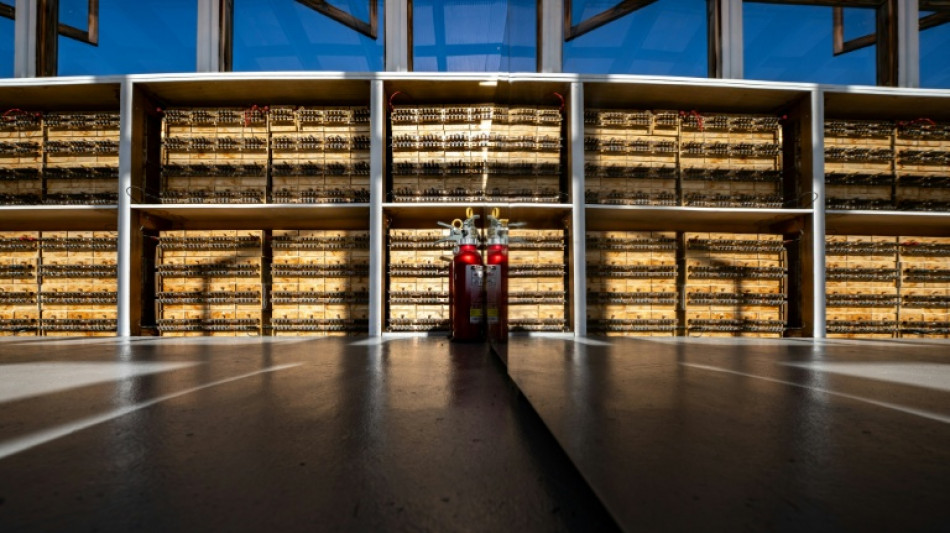
Tiny light, big dream: Harvesting power from soil in Japan / Photo: Philip FONG - AFP

 New four-lane bridge opens between China, North Korea

 Tech stocks lead rout after US inflation fuels rate hike bets

 'No time to recover': UNDP chief sounds alarm on growing poverty after Iran war shock

 Australia says won't let big tech have 'unfettered' access to kids

 Mobile clinics battle Mongolia's childhood dental 'disaster'

 Wallabies back Meredith as playmaker for second New Zealand Test

 Messi's Inter Miami book playoffs with 2-0 win over New York City

 Oil-rich Alberta tests Canada's unity with secession vote

 EU leaders head for showdown over bloc budget

 All Blacks make three changes for second Wallabies Test

 Mourinho blasts 'shameless' timing of Vinicius ban decision

 PSG beat Man City in Champions League thriller, Barcola hits Liverpool hat-trick

 US Treasury chief urges stronger IMF role against 'distortionary policies'

 Giant-killers Bodo sink Dortmund in Champions League

 PSG outgun embattled Man City in six-goal Champions League thriller

 In Chicago, pope's hometown, Catholics express shock and support

 Musk suggests US govt behind any slowdown in Ukraine's Starshield system

 Chiclayo prays for recovery and return of the 'Peruvian pope'

 Barcola scores hat-trick as Liverpool hit LASK for six

 Healthy corals help bleached neighbors regain color: study

 Hope ton helps West Indies level T20 series at 2-2 in India

 Ukraine war reaches shores of Bulgarian fishing village

 Brazil probing 'criminal' origin of forest fires: minister to AFP

 Sally Rooney books cannot be sold in UK amid Palestine Action ban: publisher

 Italian ski stars Goggia and Brignone to miss season opener

Glinting in the night, halfway up a hill in Japan, the greenhouse-like "Ku-An" test lab is lit by electricity harnessed from 1,500 wooden boxes of soil and compost.
Designer Satoshi Nakagawa has long battled sceptics, but believes that the technology powering the 800 LEDs has a role to play in solving humanity's energy conundrum.
And, failing that, it at least looks nice -- and gets people thinking.
"As the population moves toward 10 billion, energy issues will become just as critical as food issues," said Nakagawa, chief executive of design firm Tripod Design.
"Even if it's just a small contribution, I want people to be able to produce their own electricity using the soil around them," the Japanese product designer and engineer told AFP.
The 72-year-old said he has pioneered "micropower collection (MPC)" -- a way to source tiny dribbles of electrical current from everything from wine to French bread.
His system uses the same mechanism as the voltaic pile, the world's first electrical battery giving a continuous current invented in 1799 by Alessandro Volta.
It involves inserting electrodes made of materials such as zinc and copper into substances that contain moisture or ions, and then collecting the small but steady electrical currents.
Within eyeshot of the glass-covered "Ku-An", which he has rigged up in the remote town of Hitachi-ota, is "Lu-An", which opened last year.
"Lu-An" has some 2,000 plastic cylinders of soil and compost to give 100 watts of output, enough to power a rice cooker and other appliances.
Nakagawa said the technology could be applied, for example, in places without power, including after natural disasters.
It could also provide enough electricity for off-grid devices requiring little power, such as sensors to detect pest damage to farmland, overflowing rivers, landslides or even burglar alarms.
Once installed, the technology produces no carbon dioxide, and unlike other renewables such as solar or wind power is not weather-dependent, Nakagawa said.
- 'Move our emotions' -
Prototype products include a "stand-alone node" -- a bollard-like object powered by soil which enables data communication with a satellite.
He has also used the technology for art installations with flexible rods that, when speared into the ground, have tips that glow in the dark like fireflies on tall grass.
Professional engineers have said Nakagawa's products can be aesthetically pleasing and thought-provoking, but that his system is not practical.
"Its output is significantly inferior compared with regular batteries or car batteries," said Masayuki Nakao, engineering professor emeritus at the University of Tokyo, who has known Nakagawa for years.
"But what is notable about Mr Nakagawa's works is that the light that he creates has the power to move our emotions. People are moved by it when they see the light. They are beautiful," said Nakao.
Nakagawa has shrugged off his sceptics and said engineers must build new products that benefit from MPC.
"I say it's micro power, so we have to think about what micro power can do," he said.
"We should look at the combination of various energy-harvesting technologies as crucial to our overall energy strategy," he said.
"Possibility is without limit."
G.AbuOdeh--SF-PST


