Meet the astronomer digging into the Milky Way's 'fossils' / Photo: - - EUROPEAN SPACE AGENCY/AFP

 'Vande Mataram': Why is India's freedom song in spotlight?

 Counterculture pop artist Peter Max dies at 88: US media

 Asian Games chief defends 'functional' rooms after backlash

 Leader's sister says only 'idiots' think N. Korea to give up nukes

 World's water cycle becoming more unpredictable, UN warns
 Where the US-China tariff row stands ahead of White House summit

 Croc-habitat gets green light for 2032 Olympic rowing

 Indonesia cash-for-photos scheme turns animal hunters into protectors

 'Left-field' life: Briton becomes Thailand's top foreign monk

 India's transgender amendment leaves many in limbo

 Trump to host Xi amid pomp, low expectations

 Harry set for UK public outings with security, royal status hazy

 NFL Chiefs' Kelce among investors bilked in Ponzi scheme

 Trump threatens EU over 'hostile' Canada association plan

 Argentine judge orders suspension of Falklands oil project

 Carrick takes the blame as troubled Man Utd suffer League Cup misery

 Barcelona hit seven in Racing Santander rout

 Amorim's Milan beaten by Benfica, Sunderland make dream European return

 US stocks fall, dollar gains after Fed lifts interest rates

 Seahawks rule out Darnold for Sunday game at Arizona

 Mbappe explains Ceuta shirt stance after criticism

 Improving Atletico cruise to comfortable win over Osasuna

 Candidate for UN chief calls for AI regulation akin to nuclear weapons

 O'Neill expects Celtic recovery after Old Firm misery

 Man City midfield trio backed to emulate Rodri and Silva

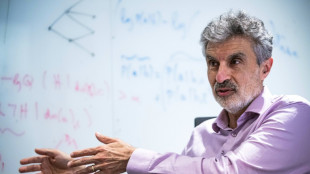
Amina Helmi's passion for the Milky Way is clear as soon as one steps into her small office at the University of Groningen, in the north of the Netherlands.
Alongside family photos and piled-up dissertations with impenetrable titles sits a bowl stacked with the chocolates named after the star system she has spent her career studying.
Digging into the Milky Way's violent past has earned this 55-year-old astronomer, originally from Argentina, the Kavli Prize, widely seen as the Nobel Prize of astrophysics.
Helmi is a world expert in a field known as galactic archaeology, which aims to decipher what has happened to our galaxy in the past and get a glimpse of its future by using stars as "cosmic fossils".
"We can measure, for example, the amount of chemicals in the stars," Helmi told AFP in an interview.
"This works as a kind of DNA of a star in the sense that they preserve information of where they were born and in which environment."
Forget the typical image of an astronomer with eyes glued to a telescope scanning the celestial sphere.
Helmi fixes her eyes on vast catalogues of data -- sometimes with two billion lines of information -- containing precious information about the stars.
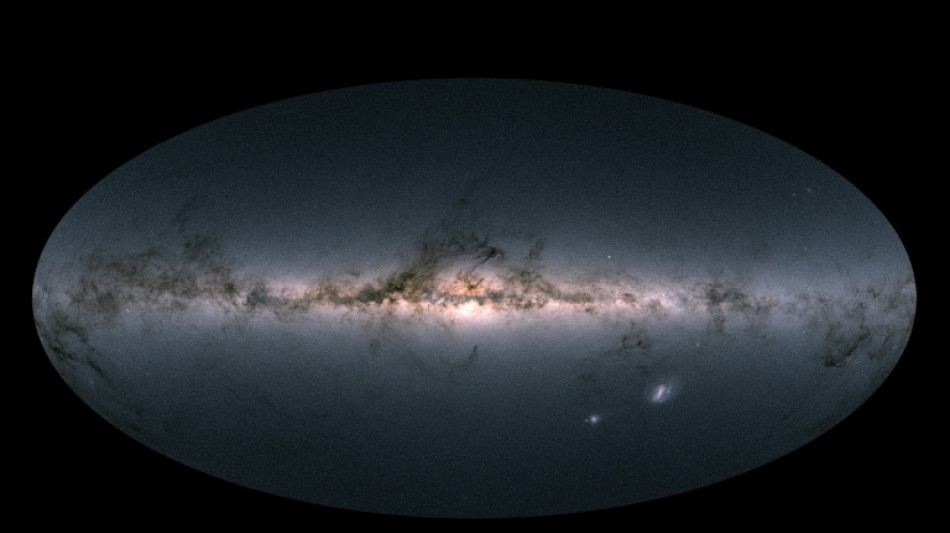
The European Space Agency's Gaia mission, which aimed to form a three-dimensional map of the Milky Way, was a key turning point for Helmi's research.
"That measured the motions of about one and a half billion stars over a much larger volume than before," said Helmi, who contributed to the mission herself.
"It wasn't just the huge number of objects, but also how accurately we could measure the motions, how precisely."
- 'Speechless' -
The data from the Gaia mission allowed Helmi and her team to piece together the events that changed our home galaxy forever.
Around 10 billion years ago, well before our Sun and the stars we can see today were born, a dwarf galaxy, Gaia-Enceladus, collided with what was the Milky Way at the time.
The two galaxies fused and the stars now present are part of a halo that surrounds our home galaxy.
New stars were also created as a consequence of the cosmic collision, creating a "puffed up" disk that is a feature of the Milky Way, she said.
The discovery proved that the Milky Way was formed from a series of crashes with other galaxies, not via a smooth and steady growth as previously thought.
The work earned Helmi a share of the Kavli Prize, along with Vasily Belokurov (University of Cambridge) and Rodrigo Ibata (University of Strasbourg).
Helmi also won a share of the $1 million prize fund, a medal, and a citation, due to be presented in September at a ceremony organised by the Norwegian Academy of Science and Letters in Oslo.
The trio of scientists were praised for "uncovering the fossil evidence of past mergers proving that the Milky Way galaxy was built through hierarchical accretion".
Helmi admitted to being "totally speechless" when she found out she was to receive the coveted award.
"To me, this is indeed the biggest there is. And it's just absolutely unbelievable," she told AFP.
"I think also for our field, which is relatively young but has grown enormously in the last years, this is also a very nice recognition."
What does the future hold? Helmi is looking forward to poring over more data from the Gaia mission as well as working on new ways to model the huge data sets.
And what does the Milky Way's turbulent past tell us about the future?
"Nothing much has happened" since then, said Helmi.
"So you could say it's been a wild youth and now a quiet, restful adulthood."
A.Suleiman--SF-PST