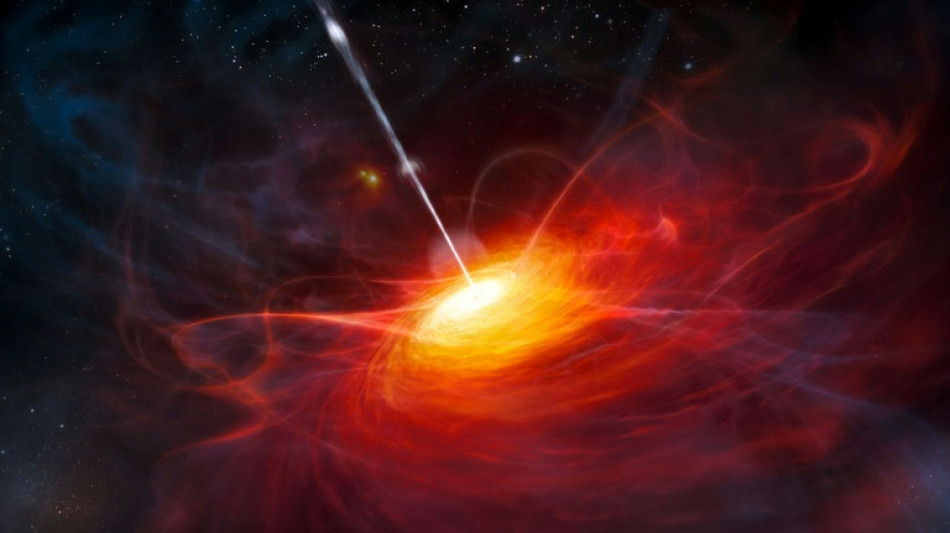
Oldest quasars ever discovered add to 'perplexing' space mystery / Photo: M. KORNMESSER - ESO/AFP/File

 California puts first US billionaire tax to the vote

 School headscarf ban meets resistance in Austria

 World's top cocoa producer aims for a climate-tough bean

 Why is Shell facing lawsuits over climate disasters in Brazil and the Philippines?

 New four-lane bridge opens between China, North Korea

 Tech stocks lead rout after US inflation fuels rate hike bets

 'No time to recover': UNDP chief sounds alarm on growing poverty after Iran war shock

 Australia says won't let big tech have 'unfettered' access to kids

 Mobile clinics battle Mongolia's childhood dental 'disaster'

 Wallabies back Meredith as playmaker for second New Zealand Test

 Messi's Inter Miami book playoffs with 2-0 win over New York City

 Oil-rich Alberta tests Canada's unity with secession vote

 EU leaders head for showdown over bloc budget

 All Blacks make three changes for second Wallabies Test

 Mourinho blasts 'shameless' timing of Vinicius ban decision

 PSG beat Man City in Champions League thriller, Barcola hits Liverpool hat-trick

 US Treasury chief urges stronger IMF role against 'distortionary policies'

 Giant-killers Bodo sink Dortmund in Champions League

 PSG outgun embattled Man City in six-goal Champions League thriller

 In Chicago, pope's hometown, Catholics express shock and support

 Musk suggests US govt behind any slowdown in Ukraine's Starshield system

 Chiclayo prays for recovery and return of the 'Peruvian pope'

 Barcola scores hat-trick as Liverpool hit LASK for six

 Healthy corals help bleached neighbors regain color: study

 Hope ton helps West Indies level T20 series at 2-2 in India

The Euclid space telescope has spotted the oldest quasars -- the brightest objects in the universe -- ever discovered, deepening a cosmic mystery that has been puzzling scientists.
Quasars are powered by supermassive black holes at the heart of early galaxies gobbling up surrounding matter in a colossal feeding frenzy that can shine trillions of times brighter than the Sun.
Because they are so incredibly bright -- and looking deep into space also means looking back in time -- scientists have been hunting for ancient quasars to learn more about the little-understood infancy of the universe.
In a study published on Monday, an international team of astronomers announced they had discovered 31 quasars, including the two oldest observed yet, using the European Space Agency's Euclid telescope, which is at a stable hovering spot around 1.5 million kilometres from Earth.
The light from the oldest pair comes from when the universe was roughly 670 million years old, just five percent of its current age of 13.8 billion years.
This beats the team's previous record for oldest -- and therefore most distant -- quasar announced in 2021 by around 20 million years.
Previous quasar hunts were mostly carried out with ground-based telescopes, but the launch of Euclid in 2023 "has transformed this field," Daming Yang, the lead author of the study in Astronomy & Astrophysics, told AFP.
In just two years, Euclid has doubled the number of ancient quasars known to science, added Yang, a PhD student at Leiden University in the Netherlands.
- Cosmic quandary -
The newly discovered quasars date back to what is known as the epoch of reionisation. This when the first stars and galaxies began to form, bringing an end to the cosmic dark ages.
"We can use quasars as a lighthouse to study the gas between us and them, so that we can trace how the universe was reionised through this cosmic history," Daming Yang said.
The quasars are also the latest example of a problem that has been increasingly baffling scientists.
As more powerful telescopes allow us to see further back in time, galaxies and other cosmic objects have turned out to be far bigger than had been thought possible at such an early age.
"Every step further back in time makes the puzzle more perplexing," study co-author Joseph Hennawi said in a statement about the newly discovered quasars.
"These monsters -- weighing billions of times the mass of our Sun -- somehow already existed when the universe was in its infancy," he said.
"We don't yet have a good understanding of how they grew so massive, so fast."
Hoping to find an answer, the scientists are searching for even older quasars.
The far-seeing James Webb space telescope also recently observed the newly announced quasars, Daming said, and the team will soon begin sifting through the data it collected.
The team eventually hope to stitch together "a quasar chronicle of the first billion years," Hennawi said.
J.AbuShaban--SF-PST