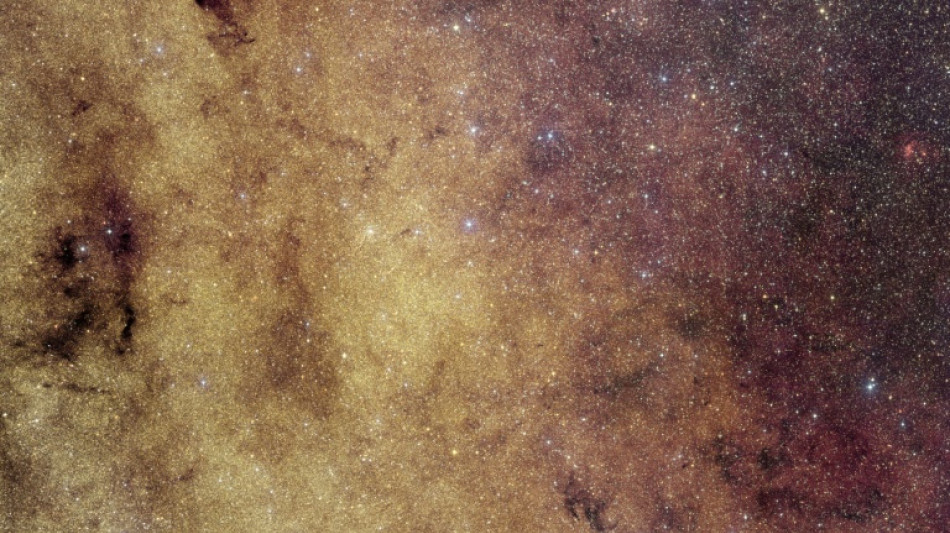
Euclid telescope snaps best photo yet of Milky Way's heart / Photo: - - EUROPEAN SPACE AGENCY/AFP

 California puts first US billionaire tax to the vote

 School headscarf ban meets resistance in Austria

 World's top cocoa producer aims for a climate-tough bean

 Why is Shell facing lawsuits over climate disasters in Brazil and the Philippines?

 New four-lane bridge opens between China, North Korea

 Tech stocks lead rout after US inflation fuels rate hike bets

 'No time to recover': UNDP chief sounds alarm on growing poverty after Iran war shock

 Australia says won't let big tech have 'unfettered' access to kids

 Mobile clinics battle Mongolia's childhood dental 'disaster'

 Wallabies back Meredith as playmaker for second New Zealand Test

 Messi's Inter Miami book playoffs with 2-0 win over New York City

 Oil-rich Alberta tests Canada's unity with secession vote

 EU leaders head for showdown over bloc budget

 All Blacks make three changes for second Wallabies Test

 Mourinho blasts 'shameless' timing of Vinicius ban decision

 PSG beat Man City in Champions League thriller, Barcola hits Liverpool hat-trick

 US Treasury chief urges stronger IMF role against 'distortionary policies'

 Giant-killers Bodo sink Dortmund in Champions League

 PSG outgun embattled Man City in six-goal Champions League thriller

 In Chicago, pope's hometown, Catholics express shock and support

 Musk suggests US govt behind any slowdown in Ukraine's Starshield system

 Chiclayo prays for recovery and return of the 'Peruvian pope'

 Barcola scores hat-trick as Liverpool hit LASK for six

 Healthy corals help bleached neighbors regain color: study

 Hope ton helps West Indies level T20 series at 2-2 in India

The Euclid space telescope has captured the largest and most detailed photo ever taken of our galaxy's crowded heart, a dazzling image packed with 60 million stars, the European Space Agency said Wednesday.
The new photo of the Milky Way's bright centre will help in the search for planets beyond our Solar System, the agency added.
At the centre of our spiral galaxy "lies the bulge -- a large bubble containing billions of stars", French astronomer Jean-Charles Cuillandre, who works on the Euclid mission, told AFP.
Euclid launched in 2023 on a mission to chart one-third of the sky in the hopes of shedding light on the enduring mysteries of dark matter and dark energy.
"Now we've decided to point Euclid at the brightest area of the sky -- and it works superbly, it's extraordinary," Cuillandre said.
Euclid, which is hovering 1.5 million kilometres (930,0000 miles) from Earth, captured the image with its visible light camera over 26 hours in March 2025.
The mosaic is composed of nine photographs, each covering an area of the sky larger than the Moon.
The original image was captured in black and white, but colour was added using observations from the Canada-France-Hawaii Telescope located in Hawaii.
However "we didn't do this just to produce a beautiful image", Cuillandre emphasised.
- 'Cosmic magnifying glass' -
In recent decades, scientists have identified thousands of planets outside our Solar System, which are known as exoplanets.
New exoplanets are unlikely to be identified within the Euclid image, but it will help the scientists measure the mass of planets already spotted -- and those that will be discovered in the future.
It can do this via a process called microlensing, which happens when one star crosses over another.
The closer star "acts like a cosmic magnifying glass, bending and brightening the background star's light", the ESA explained in a statement.
If a planet is orbiting the closer star, its gravity also slightly bends this light. This tiny change in brightness allows scientists to track the planet down.
"During the last 20 years, almost 300 exoplanets have been discovered using this technique, all with ground-based telescopes and all towards the centre of our galaxy," French astronomer Jean-Philippe Beaulieu said in the statement.
For example, Beaulieu said he led the team that discovered an icy planet "a bit like Hoth from Star Wars" 20 years ago.
The new image from Euclid "includes 51 known planetary systems -- and it will assist in studying many more that will be found", he added.
H.Nasr--SF-PST