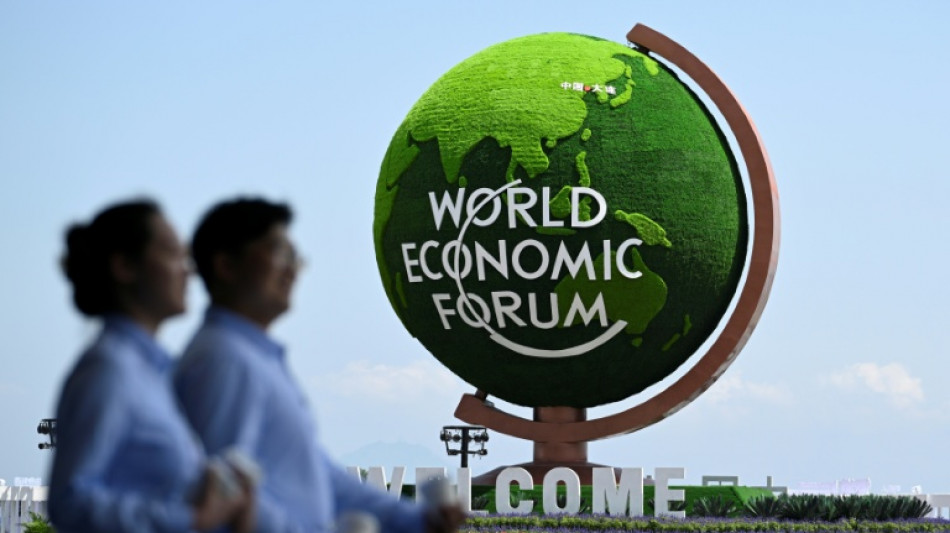
Geopolitics and AI in spotlight at China's 'Summer Davos' / Photo: WANG Zhao - AFP

 California puts first US billionaire tax to the vote

 School headscarf ban meets resistance in Austria

 World's top cocoa producer aims for a climate-tough bean

 Why is Shell facing lawsuits over climate disasters in Brazil and the Philippines?

 New four-lane bridge opens between China, North Korea

 Tech stocks lead rout after US inflation fuels rate hike bets

 'No time to recover': UNDP chief sounds alarm on growing poverty after Iran war shock

 Australia says won't let big tech have 'unfettered' access to kids

 Mobile clinics battle Mongolia's childhood dental 'disaster'

 Wallabies back Meredith as playmaker for second New Zealand Test

 Messi's Inter Miami book playoffs with 2-0 win over New York City

 Oil-rich Alberta tests Canada's unity with secession vote

 EU leaders head for showdown over bloc budget

 All Blacks make three changes for second Wallabies Test

 Mourinho blasts 'shameless' timing of Vinicius ban decision

 PSG beat Man City in Champions League thriller, Barcola hits Liverpool hat-trick

 US Treasury chief urges stronger IMF role against 'distortionary policies'

 Giant-killers Bodo sink Dortmund in Champions League

 PSG outgun embattled Man City in six-goal Champions League thriller

 In Chicago, pope's hometown, Catholics express shock and support

 Musk suggests US govt behind any slowdown in Ukraine's Starshield system

 Chiclayo prays for recovery and return of the 'Peruvian pope'

 Barcola scores hat-trick as Liverpool hit LASK for six

 Healthy corals help bleached neighbors regain color: study

 Hope ton helps West Indies level T20 series at 2-2 in India

Breakthroughs in technologies such as AI are touted as drivers of economic growth, but headwinds include concerns over job losses and geopolitical tensions, speakers told AFP at China's "Summer Davos" this week.
The annual conference organised by the Switzerland-based World Economic Forum (WEF) brings together policymakers and experts across sectors crucial to the global economy.
AI "is really changing industry and the economy", offering new opportunities in education, healthcare and other areas, Mirek Dusek, WEF's managing director, said Tuesday.
"We are blessed with a lot of technological advancements recently, but the main imperative for decision-makers around the world is really: how do you make sure this counts in the real economy?" Dusek told AFP.
There is also a "risk of a backlash against some of these technologies", he warned.
Fears are growing of AI-driven disruption to labour markets and the potential security risks it poses, from breaches of cyber defences to its use in conflict.
Adding to pressure on the international economic system is the US-Israeli war with Iran, which has stymied shipping from the oil-rich Middle East.
- 'Tepid environment' -
These shadows have spurred the World Bank to lower its global growth forecast for this year to its lowest level since the Covid pandemic.
The world economy is currently facing "a tepid environment", Dusek said.
"We all know that there is a threat of lost opportunity in terms of global growth if we really go into a state of severe fragmentation."
Chinese Premier Li Qiang was due Wednesday morning to deliver a closely watched speech at the WEF's "Annual Meeting of the New Champions", hosted this year in the northeastern port city of Dalian.
The occasion provides an opportunity for Beijing's number-two leader to deliver a message about the Chinese economy to the influential group of tech and business leaders in attendance.
China's economy -- second in size only to that of the United States -- has struggled in recent years to keep up with the breakneck pace of development it maintained in previous decades.
Despite a striking boom in exports and AI tech, sluggish household consumption and an entrenched property sector debt crisis have weighed on growth since the pandemic.
Complicating matters is Beijing's tumultuous relationship with Washington.
Graham Allison, professor at the Harvard Kennedy School and a frequent unofficial interlocutor with Chinese and US foreign policymakers, told AFP in Dalian that a potential war between the two great powers is very much on the table.
Allison is known for coining the term "Thucydides trap" -- which he defined Tuesday as "the dangerous dynamic that occurs when a rapidly rising power, like... China over the past generation impacts a major ruling power", such as the United States.
- Avoiding woes of history -
Thucydides, an ancient Greek historian, "warns us that business as usual, diplomacy as usual (and) statecraft as usual produces war" in such a situation, Allison said.
However, recent high-level engagement between the Chinese and US presidents is reason for optimism that a war can be avoided, he added.
At a summit in Beijing last month, Xi Jinping asked Donald Trump if the countries could "transcend the so-called 'Thucydides Trap' and forge a new paradigm for major-power relations".
Allison told AFP that Xi "clearly gets it" and that his mention of the obscure historical concept "wasn't by accident".
Trump, meanwhile, is "erratic in his own way", said Allison, calling the Iran war this year a "terrible" and "unnecessary mistake".
But he "understands China is different", he said.
Xi's response last year to sky-high tariffs imposed by Washington on China -- strangling US access to critical rare-earth minerals -- made Trump realise that he is "now up against somebody that is roughly (his) peer".
"These two presidents are clearly trying to redefine the relationship or reframe it in a way that'll overcome Thucydides's trap."
U.AlSharif--SF-PST


