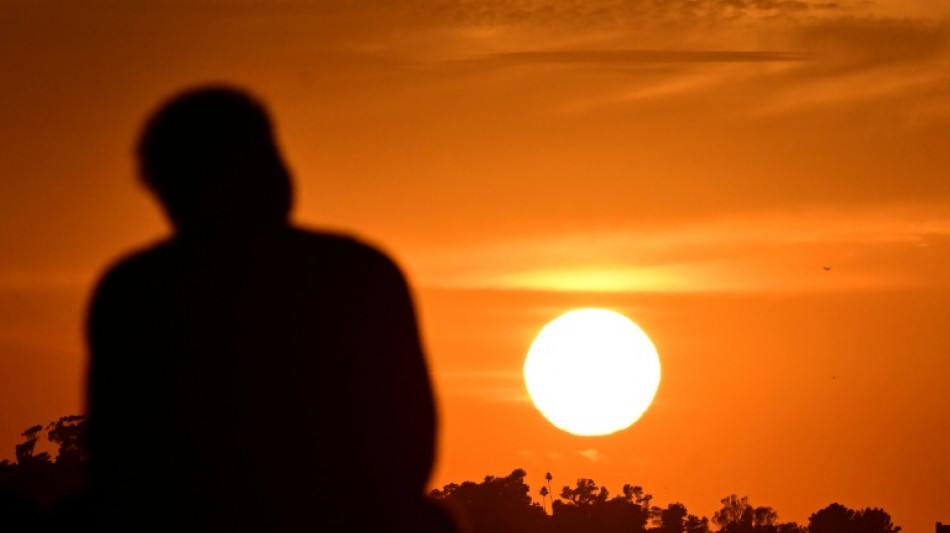
Dangerous 'heat stress' has surged worldwide, study shows / Photo: Frederic J. BROWN - AFP/File

 California puts first US billionaire tax to the vote

 School headscarf ban meets resistance in Austria

 World's top cocoa producer aims for a climate-tough bean

 Why is Shell facing lawsuits over climate disasters in Brazil and the Philippines?

 New four-lane bridge opens between China, North Korea

 Tech stocks lead rout after US inflation fuels rate hike bets

 'No time to recover': UNDP chief sounds alarm on growing poverty after Iran war shock

 Australia says won't let big tech have 'unfettered' access to kids

 Mobile clinics battle Mongolia's childhood dental 'disaster'

 Wallabies back Meredith as playmaker for second New Zealand Test

 Messi's Inter Miami book playoffs with 2-0 win over New York City

 Oil-rich Alberta tests Canada's unity with secession vote

 EU leaders head for showdown over bloc budget

 All Blacks make three changes for second Wallabies Test

 Mourinho blasts 'shameless' timing of Vinicius ban decision

 PSG beat Man City in Champions League thriller, Barcola hits Liverpool hat-trick

 US Treasury chief urges stronger IMF role against 'distortionary policies'

 Giant-killers Bodo sink Dortmund in Champions League

 PSG outgun embattled Man City in six-goal Champions League thriller

 In Chicago, pope's hometown, Catholics express shock and support

 Musk suggests US govt behind any slowdown in Ukraine's Starshield system

 Chiclayo prays for recovery and return of the 'Peruvian pope'

 Barcola scores hat-trick as Liverpool hit LASK for six

 Healthy corals help bleached neighbors regain color: study

 Hope ton helps West Indies level T20 series at 2-2 in India

The number of people exposed to dangerous heat stress worldwide has risen sharply over the last half century propelled by climate change, according to a study released on Monday as Europe sweltered through a punishing heatwave.
Heat stress -- the name given to the hazardous build-up of body heat caused by soaring temperatures, humidity and other factors -- is one of the most common ways that weather kills people.
The new study, published in the journal Nature Climate Change, tracked how heat stress levels surged between the 1970s and 2024.
"On every continent, strong to extreme heat stress is now more frequent," lead study author Rebecca Emerton, of the European Centre for Medium-Range Weather Forecasts, told AFP.
In the 1970s, for example, 16 percent of the world's population experienced at least one day of extreme heat stress -- when the "feels-like" temperature was at least 46C.
Fifty years later, the rate has risen to 22 percent.
"That might not sound like so much," Emerton said.
"But that's an extra approximately one billion people that are seeing at least some extreme heat stress now that wouldn't have done in the 1970s," she added.
The study used the Universal Thermal Climate Index (UTCI), which represents the temperature it "feels like", by including factors such as humidity, wind, radiation and how the human body responds to heat.
The daily average UTCI has been rising as heat stress events become more frequent, severe and longer-lasting due to human-driven global warming, the research found.
Some countries, including Spain, Portugal, Italy and France, are now experiencing "feels-like" temperatures up to five degrees hotter than they did in the 1970s, Emerton said.
In France on Monday, two children died during the country's second exceptionally intense heatwave of the year.
Heat stress is also "expanding into areas of the globe where historically it's not been experienced", Emerton said.
For example, very strong heat stress with a "feels-like" temperature of at least 38C has now reached parts of North America, the UK and Scandinavia, she said.
The researchers also tracked the global rise of unrelentingly hot nights.
During nights when "you can't get any relief, and your body can't cool down, that becomes very dangerous for people's health, particularly for vulnerable people", Emerton said.
Most of the world has seen increases in the number of tropical nights, when the "feels-like" temperature does not get below 20C, the researchers found.
The study only looked at data up to 2024, however Emerton said the heatwaves already pummelling Europe this year suggest the trend has been continuing.
D.Qudsi--SF-PST


