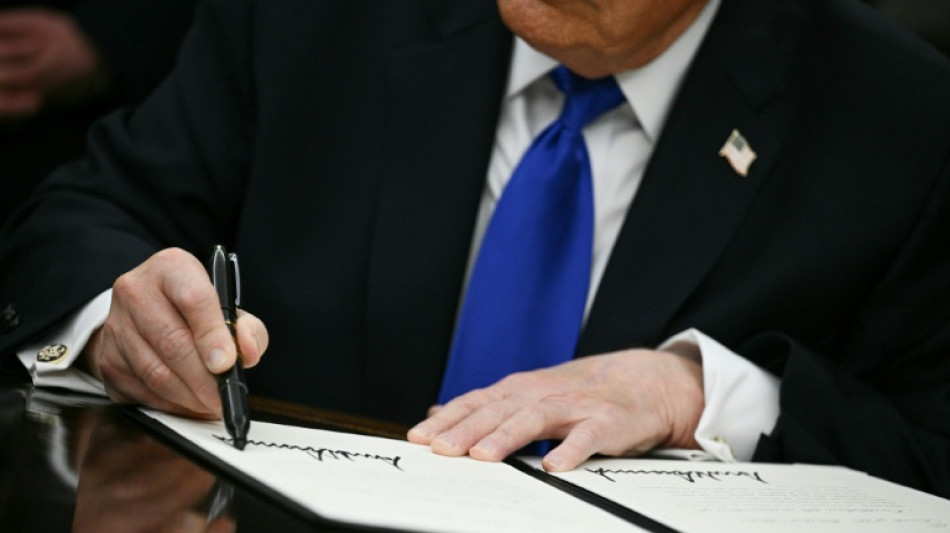
Trump signs AI order giving government access to powerful models / Photo: Brendan SMIALOWSKI - AFP/File

 Asian Cup in Saudi Arabia could be postponed but 'no hurry' to decide: AFC

 Conrad wields axe after South Africa loss to Australia

 School roof collapse kills teacher, 27 children in NW Pakistan

 Haze turns Indonesia skies orange, shuts schools in East Timor

 California puts first US billionaire tax to the vote
 School headscarf ban meets resistance in Austria

 World's top cocoa producer aims for a climate-tough bean

 Why is Shell facing lawsuits over climate disasters in Brazil and the Philippines?

 New four-lane bridge opens between China, North Korea

 Tech stocks lead rout after US inflation fuels rate hike bets

 'No time to recover': UNDP chief sounds alarm on growing poverty after Iran war shock

 Australia says won't let big tech have 'unfettered' access to kids
 Mobile clinics battle Mongolia's childhood dental 'disaster'
 Wallabies back Meredith as playmaker for second New Zealand Test

 Messi's Inter Miami book playoffs with 2-0 win over New York City

 Oil-rich Alberta tests Canada's unity with secession vote

 EU leaders head for showdown over bloc budget

 All Blacks make three changes for second Wallabies Test
 Mourinho blasts 'shameless' timing of Vinicius ban decision

 PSG beat Man City in Champions League thriller, Barcola hits Liverpool hat-trick

 US Treasury chief urges stronger IMF role against 'distortionary policies'

 Giant-killers Bodo sink Dortmund in Champions League

 PSG outgun embattled Man City in six-goal Champions League thriller

 In Chicago, pope's hometown, Catholics express shock and support

 Musk suggests US govt behind any slowdown in Ukraine's Starshield system

US President Donald Trump on Tuesday signed an executive order creating a voluntary framework under which AI developers will share advanced models with the government before public release.
The central provision allows companies such as OpenAI, Google or Anthropic to give the government access to their most powerful models for up to 30 days before planned release.
The order was triggered by concerns over Anthropic's Mythos model, which the AI startup has held back from the public due to its ability to expose vulnerabilities in computer systems, including those of banks, governments and hospitals.
The 30-day window represents a compromise. The original draft called for up to 90 days of pre-release government access, while tech companies had pushed to cut that figure to just 14 days.
For OpenAI chief Sam Altman, the executive order "gets the balance right."
"The US should lead on AI by continuing to develop the very best models, making sure they're safe, and getting cyber tools into the hands of trusted defenders," Altman said.
Kent Walker, Google's head of public affairs, called the order an "important step forward" that will ensure "defenders have the AI tools they need to keep America secure."
And Anthropic, which has repeatedly clashed with the Trump administration, called the order "an important step in strengthening America's leadership in AI."
- 'Unnecessary' -
The signing comes after a turbulent few weeks in which the White House appeared close to unveiling the measure, only to pull back abruptly.
According to Politico and other media, David Sacks, the Silicon Valley venture capitalist who served as Trump's AI and crypto czar, called the president to warn that the measure would slow innovation and hurt the United States in its AI race with China -- blindsiding White House staff who believed Sacks supported the order.
Sacks wrote on X last week that "unnecessary regulation is the biggest threat to innovation in America," adding that winning the AI race required clearing "bureaucratic hurdles" from state legislatures and "woke" Washington politicians.
The order also instructs the Treasury, the National Security Agency and the CISA cybersecurity agency to form an "AI cybersecurity clearinghouse" in voluntary collaboration with industry and critical infrastructure operators to identify software vulnerabilities and find ways to fix them.
Trump scrapped an AI oversight order from his Democratic predecessor Joe Biden on his first day back in the White House.
Biden's 2023 order required AI companies to share safety test results with the government and leaned heavily on voluntary commitments -- already a light-touch approach that fell short of what many experts had called for.
By contrast, the European Union's AI Act -- which entered into force in 2024 -- sets binding rules for high-risk AI systems, including mandatory transparency requirements and, for the most powerful models, obligations around safety testing and incident reporting.
"This is an important step in the right direction," said Anthony Aguirre, CEO of the Future of Life Institute, which advocates for AI safety.
"Voluntary frameworks are not enough, however" and the government must be empowered "to block the release of systems that pose an unacceptable national security risk," he added.
W.Mansour--SF-PST