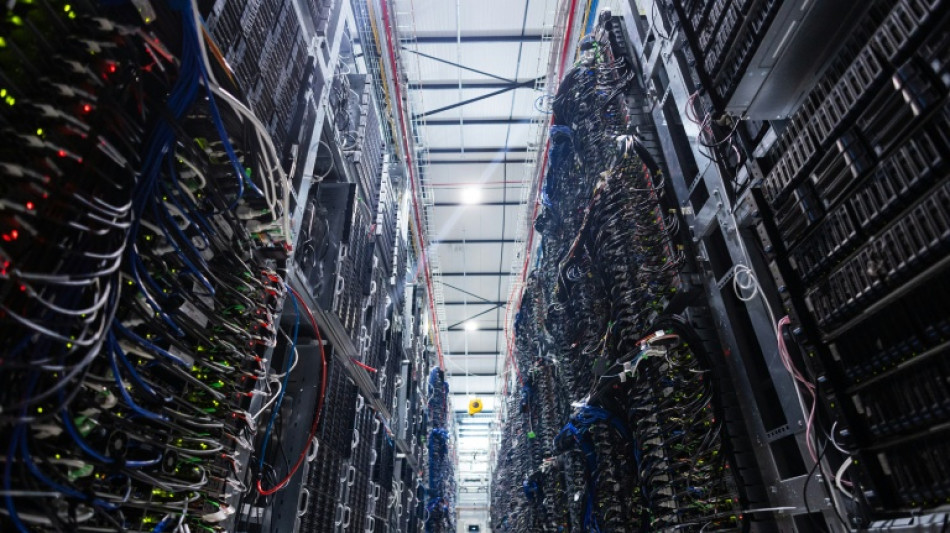
EU to unveil plan to wean itself off US, Asia tech / Photo: Sameer Al-DOUMY - AFP/File

 Asian Cup in Saudi Arabia could be postponed but 'no hurry' to decide: AFC

 Conrad wields axe after South Africa loss to Australia

 School roof collapse kills teacher, 27 children in NW Pakistan

 Haze turns Indonesia skies orange, shuts schools in East Timor

 California puts first US billionaire tax to the vote
 School headscarf ban meets resistance in Austria

 World's top cocoa producer aims for a climate-tough bean

 Why is Shell facing lawsuits over climate disasters in Brazil and the Philippines?

 New four-lane bridge opens between China, North Korea

 Tech stocks lead rout after US inflation fuels rate hike bets

 'No time to recover': UNDP chief sounds alarm on growing poverty after Iran war shock

 Australia says won't let big tech have 'unfettered' access to kids
 Mobile clinics battle Mongolia's childhood dental 'disaster'

 Wallabies back Meredith as playmaker for second New Zealand Test

 Messi's Inter Miami book playoffs with 2-0 win over New York City

 Oil-rich Alberta tests Canada's unity with secession vote

 EU leaders head for showdown over bloc budget

 All Blacks make three changes for second Wallabies Test

 Mourinho blasts 'shameless' timing of Vinicius ban decision

 PSG beat Man City in Champions League thriller, Barcola hits Liverpool hat-trick

 US Treasury chief urges stronger IMF role against 'distortionary policies'

 Giant-killers Bodo sink Dortmund in Champions League

 PSG outgun embattled Man City in six-goal Champions League thriller

 In Chicago, pope's hometown, Catholics express shock and support

 Musk suggests US govt behind any slowdown in Ukraine's Starshield system

The EU will set out on Wednesday how the 27-country bloc hopes to slash its dependence on American and Asian technology, and favour European digital alternatives.
The plans risk further angering the United States, which has pushed back hard at the European Union's fines and rules in recent years against American tech companies.
The bloc has in the past year ramped up its efforts to boost domestic manufacturing across different sectors, and catch up with rival companies in the United States and China.
EU tech tsar Henna Virkkunen will unveil the new "technological sovereignty" package in Brussels, including new rules on chips, cloud computing and AI.
The goal: to build digital ecosystems that ensure Europe retains control over services and data, and resists foreign interference.
Brussels worries its soft underbelly has been exposed after crises over chips and rare earths with China last year, coupled with fears an angry President Donald Trump could one day pull the plug on US cloud computing via a "kill switch".
In a draft strategy document seen by AFP, the EU said it is reliant on foreign providers for "over 80 percent of its digital products, services, infrastructure and intellectual property", based on an official 2023 report.
The EU, however, insists the push is aimed not at shutting out foreign providers, but at strengthening European industry and keeping itself in the AI race.
- US cloud domination -
Based on the text seen by AFP, the package will include:
-- a new law on cloud computing and artificial intelligence to encourage the construction of data centres in the EU. Brussels hopes the rules will triple the bloc's capacity in the next five to seven years;
-- boosting the demand for European-made semiconductors with a new chips law;
-- a push for the public sector to use more open-source software solutions that ensure greater control and flexibility, and avoid being locked in;
-- creating a common EU scheme to rate the sustainability of data centres.
Cloud computing is dominated by US platforms with the three biggest -- Microsoft's Azure, Amazon Web Services and Google Cloud -- making up 70 percent of the European market.
The EU is estimated to spend 264 billion euros ($307 billion) annually on US cloud software, according to a 2025 report by French consultancy Asteres.
Brussels is also expected to impose sovereignty criteria for public contracts in the cloud and AI sectors, and wants to force governments to undertake "sovereignty risk assessments" to identify European providers when needed.
The push is partly fuelled by worries over Europeans' data since the Trump-era 2018 Cloud Act allows Washington to demand access to data from US-based providers regardless of where the information is held.
- 'We set our rules' -
There are fears the new rules could provoke retaliation by Trump. But an EU lawmaker who has worked closely on tech sovereignty told reporters Tuesday Europe "should not bow down to pressure".
"We set our rules in Europe, according to the needs and the demands of the European citizens," said Matthias Ecke of the Socialists and Democrats, though he expects US providers to remain "dominant" despite the EU push.
Brussels is making clear its determination.
The European Commission said last week it wants to reserve for European firms a share of the mobile satellite frequencies currently used by US operators.
The latest moves reflect a change in Brussels, not just moving away from regulating Big Tech but favouring European technology.
Chips, cloud computing and AI "are the nervous system of the modern economy", powering everything from defence to healthcare, EU lawmaker Oliver Schenk said.
"Europe therefore cannot afford to remain merely a consumer of critical technologies developed elsewhere," the conservative MEP told AFP.
S.AbuJamous--SF-PST