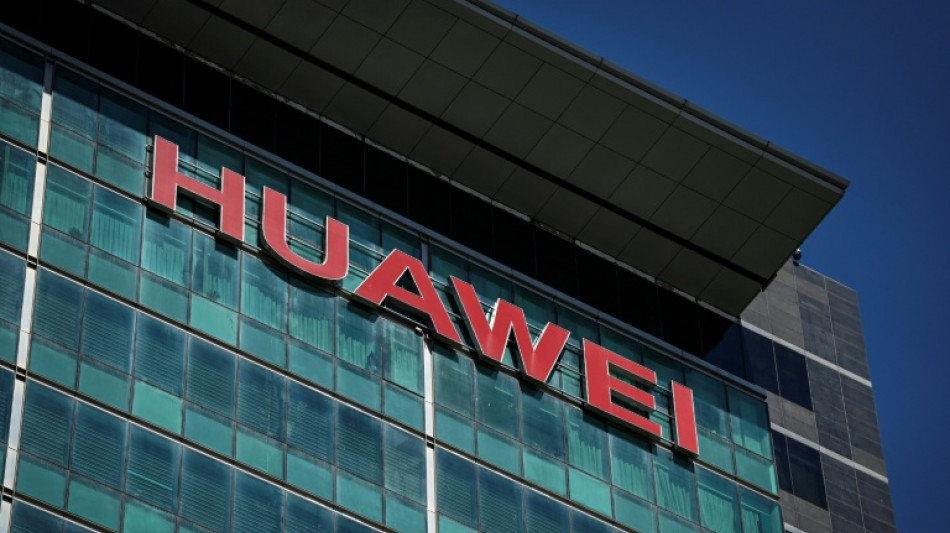
Huawei touts new chipmaking technology to sidestep US restrictions / Photo: Jade GAO - AFP

 Asian Cup in Saudi Arabia could be postponed but 'no hurry' to decide: AFC

 Conrad wields axe after South Africa loss to Australia

 School roof collapse kills teacher, 27 children in NW Pakistan

 Haze turns Indonesia skies orange, shuts schools in East Timor
 California puts first US billionaire tax to the vote

 School headscarf ban meets resistance in Austria

 World's top cocoa producer aims for a climate-tough bean

 Why is Shell facing lawsuits over climate disasters in Brazil and the Philippines?

 New four-lane bridge opens between China, North Korea

 Tech stocks lead rout after US inflation fuels rate hike bets

 'No time to recover': UNDP chief sounds alarm on growing poverty after Iran war shock

 Australia says won't let big tech have 'unfettered' access to kids
 Mobile clinics battle Mongolia's childhood dental 'disaster'

 Wallabies back Meredith as playmaker for second New Zealand Test

 Messi's Inter Miami book playoffs with 2-0 win over New York City

 Oil-rich Alberta tests Canada's unity with secession vote

 EU leaders head for showdown over bloc budget
 All Blacks make three changes for second Wallabies Test

 Mourinho blasts 'shameless' timing of Vinicius ban decision

 PSG beat Man City in Champions League thriller, Barcola hits Liverpool hat-trick

 US Treasury chief urges stronger IMF role against 'distortionary policies'

 Giant-killers Bodo sink Dortmund in Champions League

 PSG outgun embattled Man City in six-goal Champions League thriller

 In Chicago, pope's hometown, Catholics express shock and support

 Musk suggests US govt behind any slowdown in Ukraine's Starshield system

Chinese tech giant Huawei said on Monday it had developed a new way of making semiconductors that could get around its US-enforced lack of access to the most advanced chipmaking equipment.
Huawei has in recent years been at the centre of a geopolitical standoff after Washington warned its equipment could be used for espionage by the Chinese government, an allegation the firm denies.
Sanctions since 2019 have cut Huawei's access to components and technologies made by the United States and some of its allies -- including the lithography machines used to make the world's most advanced chips.
But on Monday the head of Huawei's semiconductor division He Tingbo said that the company will be able to produce next-generation 1.4-nanometre (1.4nm) chips by 2031.
Taiwan's TSMC, the industry leader, has projected it will be able to do the same by 2028.
Cutting-edge chips that can train and power artificial intelligence systems are a crucial and highly sensitive element of the technology rivalry between the United States and China.
The computing power of chips has increased dramatically over the decades as makers cram them with more microscopic electronic components.
Huawei's announcement suggests it might have sidestepped the need for extreme ultraviolet lithography (EUV) machines, which have been considered crucial for mass manufacturing chips of 5nm or under.
"Over the past six years, I have often been asked... how did you survive and come back on top?" He said in a presentation to the International Symposium on Circuits and Systems (ISCAS) in Shanghai.
She said the new technique came about through a shift in how chipmaking has historically been conceptualised.
"Moore's Law" is a principle developed by Intel co-founder Gordon Moore which states the number of transistors -- devices regulating the flow of electricity -- on a chip doubles every two years.
A higher density of transistors results in a smaller chip or one the same size with faster processing power.
He on Monday proposed "the Tau Scaling Law", or "Her's Law", by which instead of optimising for space, designers optimise for the time taken for the various elements making up a chip to communicate.
This overcomes a key challenge facing Moore's Law that Intel sums up as: "You can make something smaller and smaller and smaller... until you can't".
US sanctions have meant that "these challenges arrived earlier and are tougher" for Huawei, He said.
"Our solution is feasible and affordable. The performance of the new chip can fully compete with that of the other path," she said.
Huawei's next iteration of its Kirin chip, set to launch in the autumn, will be the first ever to fully adopt an architecture called "LogicFolding" based on the new principle, the company said.
The Tau Scaling Law "underscores the company's ambition to lead rather than follow in the global chip race", said George Chen, Partner and Chair of Digital Practice at The Asia Group.
"Even without a new product launch today, Huawei's intent is clear — and its trajectory will likely heighten US concerns."
Q.Jaber--SF-PST