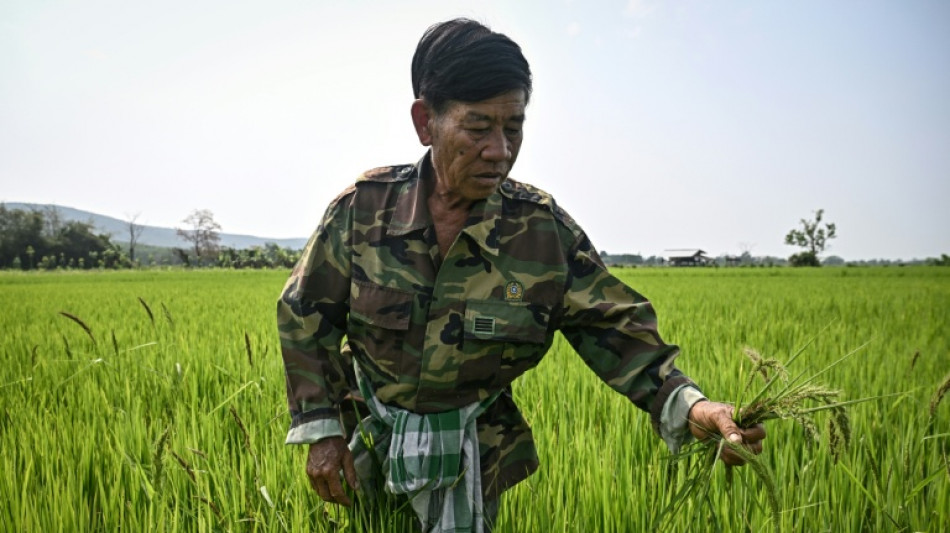
Thai farmers pin hopes on microbes to end annual burning crisis / Photo: Lillian SUWANRUMPHA - AFP

 Two dead as Istanbul endures heaviest rainfall in 80 years
 After latest Nepal flood, survivors fear for future

 EU leaders clash over budget as spectre of French elections looms
 'No place to breathe': life in Indonesia's fire epicentre

 'Can't sleep': Spain's housing crunch upends lives

 Musk calls on Ukraine's Zelensky to 'go' after satellite slowdown row

 Still smiling at 117, Albanian may be world's oldest woman
 Pope has 'good night' in hospital: Vatican
 China's economy seen missing target as global shocks bite: AFP poll

 Costa Rica opens jail inspired by El Salvador mega-prison

 Same-sex couple takes fight for equality to Slovakian court
 'High hopes' as Indonesian women get a football league, again

 'Expectations high' for Bordeaux-Begles' Champions Cup hat-trick bid, says Depoortere

 Rennie urges All Blacks to stay focused against 'hurting' Wallabies

 Palmeiras beat Fluminense 2-1 in Libertadores semi-final first leg

 Brewers blasts leave Dodgers on brink

 Tech stock lead rout after US inflation fuels rate hike bets
 Al-Fayed survivors say UK police missing 'bigger picture'

 Online 'witch hunt' sweeps up Asians misidentified as US rape accused

 Prospect of Bolsonaro win looms large over Brazil's Indigenous

 Freed from Belarus, founder of Lady Gaga's biggest fan site tells his story

 Behind AI's carbon footprint, a potential climate tool

 Trump's new press secretary faces scrutiny over credentials

 PSG 'got lucky' to win Man City thriller, says Luis Enrique

 Real Madrid comeback stuns Roma as Mourinho enjoys happy reunion

Rice farmers Siriporn and Amnat Taidee used to burn their paddy fields between plantings -- a common method of clearing crop residue partly blamed fortoxic smog that blankets much of Thailand every spring.
A quick and affordable way to prepare for a new growing cycle, the practice has long been seen as the only feasible option for millions of Thai rice farmers.
But for the couple from Chiang Rai, abandoning what Amnat called "the old way of doing things" for new microbial solutions has been a boon.
Thanks to the hungry bacteria that chew up post-harvest leftovers -- their soil is softer, their yields are up and their fertiliser bills are down.
"My life has changed," said Siriporn, 63, as she sloshed through a verdant paddy field in Chiang Rai. "I'm so happy... we don't have to burn anymore."
Every year between January and April, smoke from crop residue, forest fires and industrial emissions -- compounded by smog drifting over from neighbouring countries -- pushes Thailand's air quality to dangerous levels.
Bangkok has restricted burning for years, but a recent crackdown has put government environmental goals on a collision course with traditional agricultural practices.
The threat of heavy fines and even prison has frightened farmers -- but many feel they still have no alternative.
"It simply pushes the burden onto farmers," Witsanu Attavanich, an environmental economist at Kasetsart University, said of the ban on open burning.
- The price of change -
The Taidees were early converts, using a product called Soil Digest developed by a Thai scientist using five strains of Bacillus bacteria -- one of which is derived from traditional fermented soybeans.
Siriporn said the solution decomposed the "terrible" stubble on the fields in a matter of days and helped restore the soil.
"The rice is coming in great and the soil is healthy," she says. "This microbial stuff is a game-changer."
Last year, authoritiesin Chiang Rai -- one of Thailand's main rice-growing provinces -- began encouraging local farmers to try microbial solutions.
So far, around 2,000 have made the switch -- a fraction of the province's 100,000 rice farmers, but a start.
"If we are to stop the burning, we must provide them with multiple alternatives," said Orracha Wongsaroj, a provincial agricultural official.
Microbial products have long been used in Thai agriculture, but demand for newer formulations targeting straw decomposition has grown sharply since the burning crackdown intensified a few years ago.
The Thai government promotes free access to microbial products for farmers -- but officials told AFP that stocks had run out and they were struggling to scale up supply.
For those who cannot access government supplies, private market alternatives can be pricey.
In Pathum Thani, a rice-growing province in central Thailand, farmer Samart Atthong spent 1,200 baht ($37) hiring an agricultural drone to spray Soil Digest over his fields.
"People may only see the extra cost of the microbes, but they should look in the long run," Samart said.
"Once the soil heals, we won't need nearly as much fertiliser," he said. "Where I live, burning has dropped to nearly zero."
- Making microbes work -
Striding through air thick with dust from yeast, retired professor Wichien Yongmanitchai watches the whirring machines producing his microbial concoction.
He started by isolating local bacterial strains, convinced that native ones would work best in Thailand's tropical environment.
He hopes his invention -- sold as Soil Digest -- will fix Thailand's annual air crisis for good.
Without microbial treatment, rice straw takes around 30 days to soften enough to till -- his solution works in five to seven days.
Early trials show yield increases of up to 20 percent.
Wichien also said the bacteria can reduce methane emissions from paddy fields by at least 20 percent, helping Thailand meet its climate commitments.
"This is one of the biggest benefits to make (for achieving) carbon neutrality in the rice field."
But Wichien knows his small operation cannot reach Thailand's 20 million farmers alone. And without government and corporate backing, the gap may prove too wide.
Independent experts agree the technology shows promise -- but warn the system around it must change.
"The government wants to reduce straw burning -- but there is no one-size-fits-all solution," said Nipon Poapongsakorn, an agricultural policy expert at the Thailand Development Research Institute.
To start with he suggests conditional subsidies tied to a no-burn commitment, combined with machinery access and farmer education.
Wichien is already thinking beyond Thailand to paddy fields across Southeast Asia and ultimately Africa.
"I don't want anything else. I just want to make it work."
C.Hamad--SF-PST