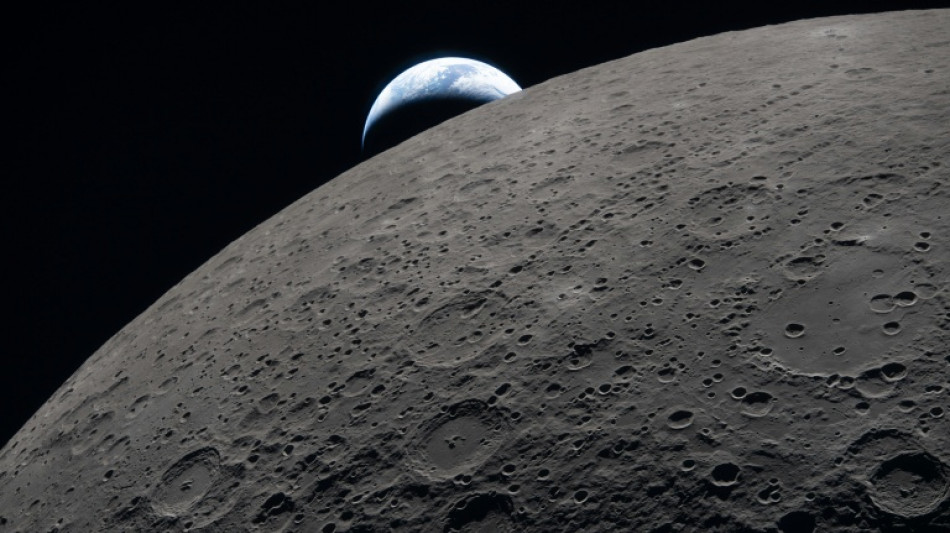
Houston, we have a problem ... with the toilet / Photo: Handout - NASA/AFP

 'Severe drought' declared in parts of UK

 IUX Announces New Web Client Portal Built for Enhanced Browser-Based Trading

 School roof collapse kills teacher, 32 children in NW Pakistan

 Inter skipper Martinez facing month out with thigh injury

 Spanish prosecutors back abuse probe into Julio Iglesias

 Tech sell-off deepens as US inflation sparks AI jitters

 Southgate does not forsee a return to management

 Two dead as Istanbul endures heaviest rainfall in 80 years

 After latest Nepal flood, survivors fear for future

 EU leaders clash over budget as spectre of French elections looms

 'No place to breathe': life in Indonesia's fire epicentre

 'Can't sleep': Spain's housing crunch upends lives

 Musk calls on Ukraine's Zelensky to 'go' after satellite slowdown row

 Still smiling at 117, Albanian may be world's oldest woman

 Pope has 'good night' in hospital: Vatican

 China's economy seen missing target as global shocks bite: AFP poll

 Costa Rica opens jail inspired by El Salvador mega-prison

 Same-sex couple takes fight for equality to Slovakian court

 'High hopes' as Indonesian women get a football league, again

 'Expectations high' for Bordeaux-Begles' Champions Cup hat-trick bid, says Depoortere

 Rennie urges All Blacks to stay focused against 'hurting' Wallabies

 Palmeiras beat Fluminense 2-1 in Libertadores semi-final first leg

 Brewers blasts leave Dodgers on brink

 Tech stock lead rout after US inflation fuels rate hike bets

 Al-Fayed survivors say UK police missing 'bigger picture'

After a successful trip around the Moon, everything has been going smoothly on the Orion spacecraft’s journey back to Earth – except for the $23 million toilet, which has gotten clogged.
The system designed to flush wastewater into space is malfunctioning, and NASA believes that a chemical reaction in the urine treatment system is the culprit.
The fecal disposal system, in a separate conduit, is working properly.
Astronaut Christina Koch said the so-called Universal Waste Management System was giving off "a burning heater smell."
Rick Henfling, flight director for the Artemis II mission, stressed Tuesday that "the toilet remains operational. The challenge that we're working through is evacuating the wastewater tank," he said. "So we're having to fall back to some other alternate means."
Under Plan B, the four astronauts are using personal reusable containers called "collapsible contingency urine disposal devices."
The toilet problem was reported just hours after liftoff from Cape Canaveral, Florida. Koch adjusted the system's controls, restarted them with the help of mission control, and that appeared to resolve the issue.
"I'm proud to call myself a space plumber,” Koch said in her first briefing from the spacecraft, which is to splash down in the Pacific Ocean on Friday. She called the toilet “probably the most important piece of equipment on board."
However, the problem has persisted. The astronauts are unable to flush the wastewater into space.
The issue has been a constant topic of discussion at press conferences held at the Johnson Space Center in Houston, Texas.
This is the same center that in 1970 received astronaut Jack Swigert's message: "Houston, we've had a problem," after an oxygen tank explosion aborted Apollo 13’s Moon landing, starting a harrowing emergency that eventually brought those three astronauts back to Earth safely.
- Chemicals, not ice -
NASA initially thought the toilet problem might be due to freezing in the filters.
But Henfling said that the problem was not ice. The spacecraft has been rotated to face the sun to "bake off any ice" and heaters have been activated, "and we still see blockage," he said.
"The latest theory is related to some of the chemistry that goes into ensuring that the wastewater doesn't develop any biofilms," or microorganisms, he said. The chemical reaction may be generating some debris that's "getting clogged in a filter.”
The toilet on board Orion is similar to the one on the International Space Station, but this is the first time it has been used on a crewed deep-space mission.
The Apollo astronauts didn't have a toilet and used special bags for waste.
On the Orion spacecraft, which is five meters in diameter and a little over three meters high, the toilet is located beneath the floor – the only place on board where the astronauts can be alone.
The cramped toilet space is very noisy inside, so they must protect their ears. It has suction systems to compensate for microgravity.
Feces are placed in disposable bags that compact and will be brought back to Earth.
Lori Glaze, associate administrator of NASA's Exploration Systems Development Mission Directorate, said that "as soon as we get this down on the ground, we'll be able to get inside and we will get to the root" of the problem.
B.Khalifa--SF-PST