Turkey in cultural diplomacy push to bring history home / Photo: Ozan KOSE - AFP

 El Nino a 'terrifying' threat to coral reefs: UN biodiversity expert
 Barcola must get used to Liverpool highs and lows, says Iraola

 Versus Trade Wins Best ECN/STP Broker APAC 2026, Marking Third UF Awards Recognition

 Three dead as Istanbul sees heaviest rainfall in 80 years
 US producer prices see biggest jump since 2022 in added challenge to Trump
 Swiatek avoids seed exodus to breeze into Wuhan last eight
 PM condemns 'chaos' as violent protests grip Albania

 'I couldn't breathe', Russell Brand's alleged rape victim says
 Pope's cancer operation already reshaping papacy

 Zverev cruises past De Minaur to reach Shanghai semi-finals

 Ukraine's Zelensky defies Trump with Russian refinery strikes

 Holders Australia edge New Zealand 24-22 to open Rugby league World Cup

 'Ocarina of Time': Nintendo gives Zelda classic a modern makeover

 France charges teen shooter citing revenge for bullying in school
 Martinez blames 'anger' for dig at Man Utd hierarchy
 Crowds build as Albanian PM tours protest aftermath

 China-North Korea bridge opens, 12 years late
 Asian Cup in Saudi Arabia could be postponed but 'no hurry' to decide: AFC
 Conrad wields axe after South Africa loss to Australia
 School roof collapse kills teacher, 27 children in NW Pakistan
 Haze turns Indonesia skies orange, shuts schools in East Timor

 California puts first US billionaire tax to the vote
 School headscarf ban meets resistance in Austria
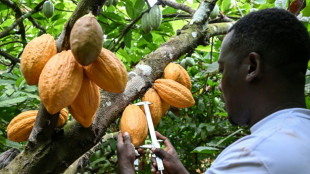 World's top cocoa producer aims for a climate-tough bean

 Why is Shell facing lawsuits over climate disasters in Brazil and the Philippines?

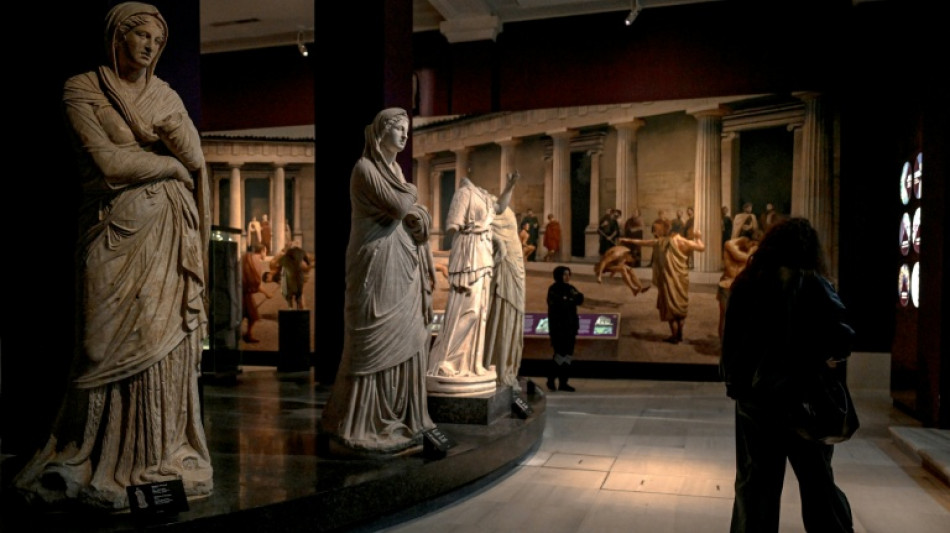
When an ancient bronze statue of Roman Emperor Marcus Aurelius landed back on Turkish soil after decades abroad, it was more than a symbolic homecoming.
It marked the latest victory in Turkey's increasingly assertive push to recover antiquities illegally taken abroad -- a campaign supported by a newly-developed AI tool for identifying cultural assets of Turkish origin.
The life-sized bronze, which dates back to the second- or third-century, was taken in the 1960s from the ancient city of Bubon near Turkey's southwestern Antalya resort.
After a years-long investigation involving research, scientific testing and statements from now elderly witnesses, the headless statue arrived back in Turkey last year.
Its repatriation from an Ohio museum involved cooperation with the US Department of Homeland Security and the Manhattan District Attorney's Office.
For Zeynep Boz, director of Turkey's department for combating the illicit trafficking of cultural property, one moment stands out.
"I clearly remember when the computer finally processed the data and we saw the match come together. It was an exciting moment," she told AFP at Istanbul's archaeology museum.
That the statue survived at all is exceptional: in antiquity, bronze was a valuable raw material routinely melted down for weapons, coins or everyday objects.
"For this reason, bronze statues of this scale have rarely been preserved until today," she said.
For years, Cleveland's Museum of Art had dragged its feet, claiming there was insufficient evidence to prove where it came from, Boz said.
But that changed after archaeometry expert Professor Ernst Pernicka concluded there was "no doubt whatsoever" the statue came from Bubon, where an imperial shrine housed bronze sculptures of Roman emperors.
Soil and lead samples provided crucial scientific evidence which convinced the museum, Boz said.
"It was a long struggle. We were determined and patient and we won," Culture Minister Mehmet Nuri Ersoy said when the statue returned in July.
Turkey has stepped up efforts to combat illicit antiquities trading and in 2025 alone secured the repatriation of 180 cultural artefacts.
- AI to identify trafficked objects -
Although its newly-developed AI-powered "TraceART" system was not involved in recovering the Marcus Aurelius statue, the tool helped identify two 16th-century Iznik tiles that were recovered from Britain this month.
Developed by the culture ministry, it scans images on sales platforms, auctions and social media to identify any cultural assets of Turkish origin that may have been trafficked, with flagged items sent for expert assessment.
TraceART went operational in 2025 and has since identified hundreds of objects for review, Boz said.
In January, Turkey recovered an Anatolian-style marble head from Denver Art Museum in Colorado, said Burcu Ozdemir of the antiquities trafficking unit.
The museum contacted Ankara because the piece "had been donated by the wife of a US consul general who served in Istanbul in the 1940s", she said.
Turkey's campaign also involves returning items to countries like Iran, China and Egypt.
"We returned two of the artefacts stolen from temples in China," Boz told AFP.
Turkey also returned "a key of the Kaaba to Egypt" after realising it had ended up in Turkey illegally, she said of the cube-shaped stone structure at Mecca's Grand Mosque.
- Ottoman tiles at the Louvre -
Turkey is now seeking the repatriation of other antiquities taken during the Ottoman era: an ancient marble torso called the "Old Fisherman" from Berlin, and dozens of Iznik tiles held at France's Louvre museum.
"There's an assumption that artefacts taken in the 18th-19th centuries were acquired legally. We don't share that view," Boz said.
The illegal tile swap came to light in 2003 when one fell from the wall of an Ottoman-era library and on the back was the French manufacturer's mark.
The original and others were taken in the late 1800s by a Frenchman who claimed to be restoring them, then replaced them with fakes.
"We have repeatedly shared evidence with France and talked with the Louvre but no resolution has been reached," she said.
The tiles were on a panel by the tomb of Ottoman Sultan Selim II in the garden of the Hagia Sophia.
Today it bears a plaque in English, French and Turkish reading: "The tiles before us are replicas."
The originals are currently on display at a branch of the Louvre in Lens, 200 kilometres north of Paris, which says they were "bought in 1895".
The museum did not respond to several requests for comment from AFP.
R.AbuNasser--SF-PST