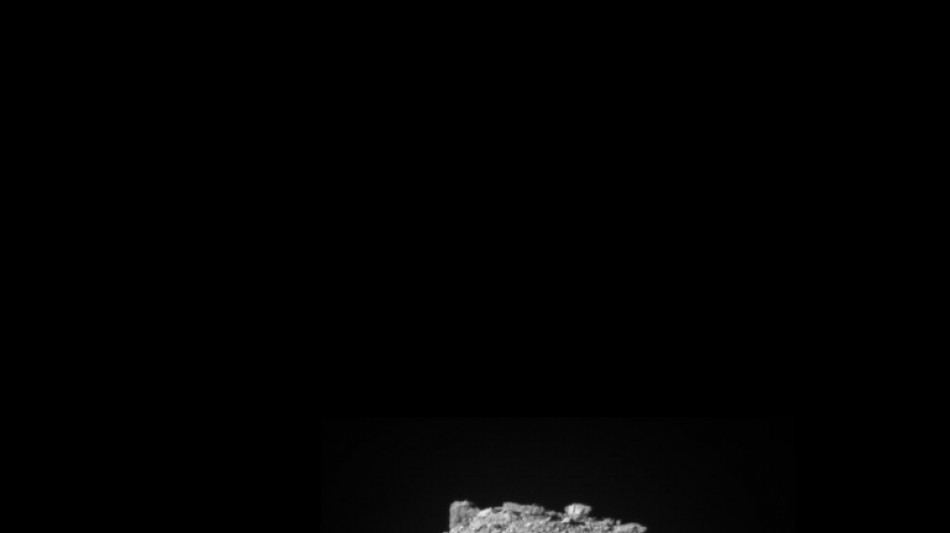
NASA defense test kicked asteroid off course -- and changed its orbit around the sun / Photo: Handout - NASA/Jons Hopkins APL/AFP

 El Nino a 'terrifying' threat to coral reefs: UN biodiversity expert

 Barcola must get used to Liverpool highs and lows, says Iraola

 Versus Trade Wins Best ECN/STP Broker APAC 2026, Marking Third UF Awards Recognition

 Three dead as Istanbul sees heaviest rainfall in 80 years

 US producer prices see biggest jump since 2022 in added challenge to Trump

 Swiatek avoids seed exodus to breeze into Wuhan last eight
 PM condemns 'chaos' as violent protests grip Albania

 'I couldn't breathe', Russell Brand's alleged rape victim says

 Pope's cancer operation already reshaping papacy

 Zverev cruises past De Minaur to reach Shanghai semi-finals

 Ukraine's Zelensky defies Trump with Russian refinery strikes

 Holders Australia edge New Zealand 24-22 to open Rugby league World Cup

 'Ocarina of Time': Nintendo gives Zelda classic a modern makeover

 France charges teen shooter citing revenge for bullying in school

 Martinez blames 'anger' for dig at Man Utd hierarchy

 Crowds build as Albanian PM tours protest aftermath

 China-North Korea bridge opens, 12 years late

 Asian Cup in Saudi Arabia could be postponed but 'no hurry' to decide: AFC

 Conrad wields axe after South Africa loss to Australia

 School roof collapse kills teacher, 27 children in NW Pakistan

 Haze turns Indonesia skies orange, shuts schools in East Timor

 California puts first US billionaire tax to the vote

 School headscarf ban meets resistance in Austria

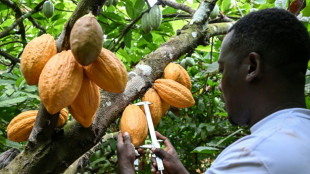 World's top cocoa producer aims for a climate-tough bean

 Why is Shell facing lawsuits over climate disasters in Brazil and the Philippines?

Four years ago, NASA purposely smashed a spacecraft into a small asteroid to see if they could deflect it -- a test to prove humanity could protect Earth from threatening space rocks.
The experiment pushed the moonlet asteroid Dimorphos into a smaller, faster route around its sibling Didymos -- and according to new research out Friday, it also pushed the pair into a slightly different orbit around the Sun.
The test on Dimorphos was never based on any actual threat to our planet.
But the successful experiment and additional analysis offers a solid data point to mount a defense if any such eventual threat is detected, researchers said.
"This study marks a notable step forward in our ability to prevent future asteroid impacts on Earth," the team of international researchers wrote in their new paper published in the journal Science Advances.
Their observations detailed in the paper showed that the Double Asteroid Redirection Test (DART) in 2022 marked "the first time a human-made object has measurably altered the path of a celestial body around the Sun," NASA said in a statement.
Rahil Makadia, the study's lead author, told AFP his team tracked stellar occultations -- the moment when an asteroid passes in front of a star, causing a brief dimming for less than a second -- to obtain hyper-precise measurements of the asteroid's position, speed and shape.
- Tiny change, significant deflection -
Obtaining this data is no small feat. The team relied on volunteer astronomers from around the globe, who recorded 22 of these stellar occultations.
Using that data along with years of additional observations, Makadia said the team was able to measure Didymos's orbit around the sun with precision.
"We were able to measure what this change was exactly," he said, and make computations that could assist with future "planetary defense efforts."
The orbital change was miniscule -- just 0.15 seconds.
But it's enough to make a difference, scientists say.
"This is a tiny change to the orbit, but given enough time, even a tiny change can grow to a significant deflection," said Thomas Statler, lead scientist for solar system small bodies at NASA Headquarters in Washington, in a statement.
"The team's amazingly precise measurement again validates kinetic impact as a technique for defending Earth against asteroid hazards and shows how a binary asteroid might be deflected by impacting just one member of the pair."
K.Hassan--SF-PST