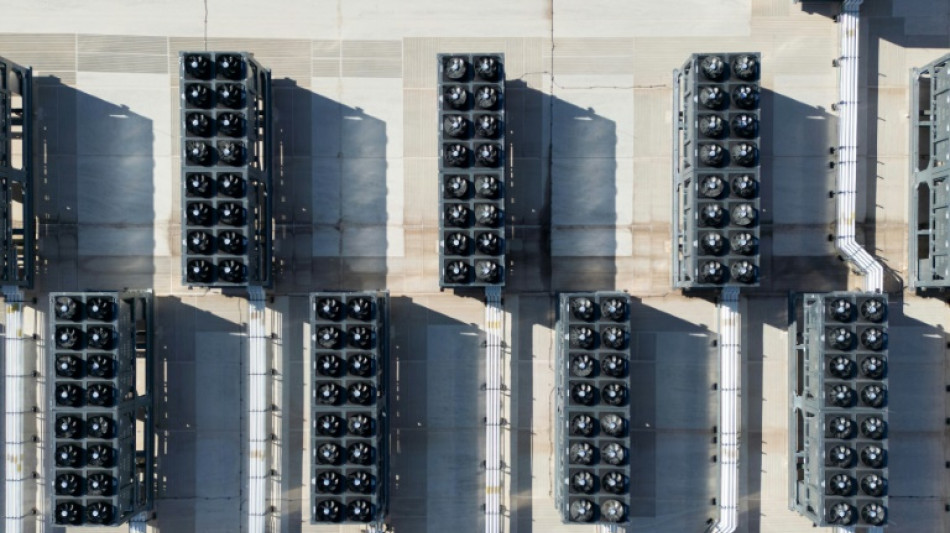
Laser-etched glass can store data for millennia, Microsoft says / Photo: ANDREW CABALLERO-REYNOLDS - AFP/File

 Rahm reaches separation deal with LIV in bankruptcy court

 UN chief urges nations to end 'war on nature'

 Newcastle boss Jaissle says Fernandez-Pardo just needs a goal

 Infantino offers apology but 'no answers' at FIFA meeting over World Cup plan

 Don't exclude Turkey from 'Made in Europe' plan: minister to AFP

 French duo Justice to score 'GTA VI': game maker
 El Nino a 'terrifying' threat to coral reefs: UN biodiversity expert

 Barcola must get used to Liverpool highs and lows, says Iraola

 Versus Trade Wins Best ECN/STP Broker APAC 2026, Marking Third UF Awards Recognition

 Three dead as Istanbul sees heaviest rainfall in 80 years

 US producer prices see biggest jump since 2022 in added challenge to Trump

 Swiatek avoids seed exodus to breeze into Wuhan last eight

 PM condemns 'chaos' as violent protests grip Albania

 'I couldn't breathe', Russell Brand's alleged rape victim says

 Pope's cancer operation already reshaping papacy

 Zverev cruises past De Minaur to reach Shanghai semi-finals

 Ukraine's Zelensky defies Trump with Russian refinery strikes

 Holders Australia edge New Zealand 24-22 to open Rugby league World Cup

 'Ocarina of Time': Nintendo gives Zelda classic a modern makeover

 France charges teen shooter citing revenge for bullying in school

 Martinez blames 'anger' for dig at Man Utd hierarchy

 Crowds build as Albanian PM tours protest aftermath

 China-North Korea bridge opens, 12 years late

 Asian Cup in Saudi Arabia could be postponed but 'no hurry' to decide: AFC

 Conrad wields axe after South Africa loss to Australia

Thousands of years from now, what will remain of our digital era?
The ever-growing vastness of human knowledge is no longer stored in libraries, but on hard drives that struggle to last decades, let alone millennia.
However, information written into glass by lasers could allow data to be preserved for more than 10,000 years, Microsoft announced in a study on Wednesday.
Since 2019, Microsoft's Silica project has been trying to encode data on glass plates, in a throwback to the early days of photography, when negatives were also stored on glass.
The system uses silica glass, a common material that is resistant to changes in temperature, moisture and electromagnetic interference.
These are all problems for energy-hungry data centres, which use fast-degrading hard drives and magnetic tapes that require backing up every few years.
In the journal Nature, Microsoft's research arm said Silica was the first glass storage technology that had been demonstrated to be reliable for writing, reading and decoding data.
However, experts not involved in the project warned that this new tech still faces numerous challenges.
- How to write inside glass -
First, bits of data are turned into symbols, which correspond to three-dimensional pixels called voxels.
A high-powered laser pulse then inscribes these minuscule voxels into square glass plates that are roughly the size of a CD.
"The symbols are written layer by layer, from the bottom up, to fill the full thickness of the glass," the study explained.
To read the data requires a special microscope that can see each layer, then decode the information using an algorithm powered by artificial intelligence.
The Microsoft researchers estimated that the glass could survive for more than 10,000 years at a blistering 290 degrees Celsius, which suggests the data could last even longer at room temperature.
However, the researchers did not look into what happened when the glass was deliberately smashed -- or corroded by chemicals.
Unlike data centres, the glass does not require a climate-controlled environment, which would save energy.
Another advantage is that the glass plates cannot be hacked or otherwise altered.
The Microsoft researchers emphasised that future storage is important because the amount of data being produced by humanity is now doubling roughly every three years.
- 'Carry the torch ' -
One of the glass plates holds the equivalent of "about two million printed books or 5,000 ultra-high-definition 4K films", according to Feng Chen and Bo Wu, researchers at Shandong University in China not involved in the study.
In a separate Nature article, the pair warned there were more challenges ahead, including finding a way to write the data faster, to mass produce the plates and to ensure people can easily access and read the information.
However, they praised Silica for creating a "viable solution for preserving the records of human civilisation".
"If implemented at scale, it could represent a milestone in the history of knowledge storage, akin to oracle bones, medieval parchment or the modern hard drive," they said.
"One day, a single piece of glass might carry the torch of human culture and knowledge across millennia."
D.AbuRida--SF-PST