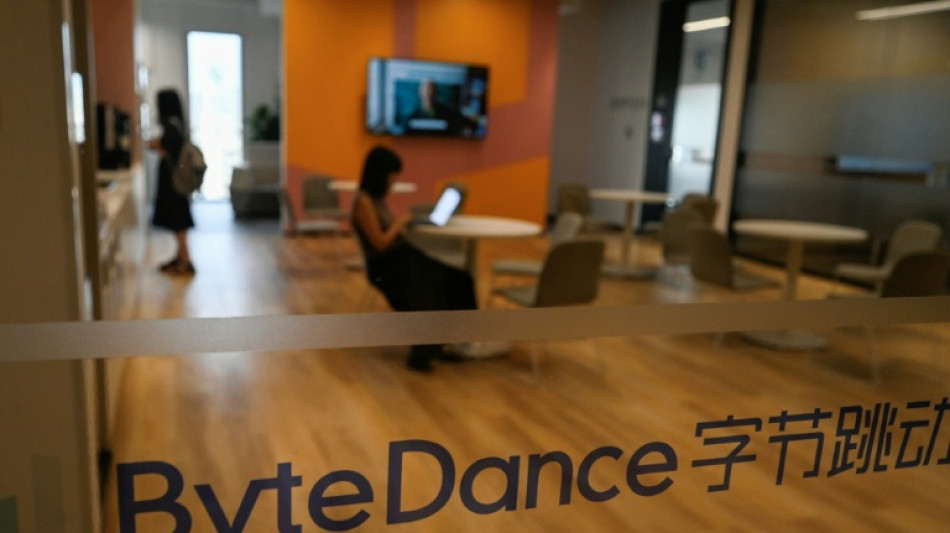
All-in on AI: what TikTok creator ByteDance did next / Photo: Pedro PARDO - AFP/File

 Rahm reaches separation deal with LIV in bankruptcy court

 UN chief urges nations to end 'war on nature'

 Newcastle boss Jaissle says Fernandez-Pardo just needs a goal
 Infantino offers apology but 'no answers' at FIFA meeting over World Cup plan

 Don't exclude Turkey from 'Made in Europe' plan: minister to AFP

 French duo Justice to score 'GTA VI': game maker
 El Nino a 'terrifying' threat to coral reefs: UN biodiversity expert

 Barcola must get used to Liverpool highs and lows, says Iraola
 Versus Trade Wins Best ECN/STP Broker APAC 2026, Marking Third UF Awards Recognition

 Three dead as Istanbul sees heaviest rainfall in 80 years

 US producer prices see biggest jump since 2022 in added challenge to Trump

 Swiatek avoids seed exodus to breeze into Wuhan last eight

 PM condemns 'chaos' as violent protests grip Albania

 'I couldn't breathe', Russell Brand's alleged rape victim says

 Pope's cancer operation already reshaping papacy

 Zverev cruises past De Minaur to reach Shanghai semi-finals
 Ukraine's Zelensky defies Trump with Russian refinery strikes

 Holders Australia edge New Zealand 24-22 to open Rugby league World Cup

 'Ocarina of Time': Nintendo gives Zelda classic a modern makeover

 France charges teen shooter citing revenge for bullying in school

 Martinez blames 'anger' for dig at Man Utd hierarchy

 Crowds build as Albanian PM tours protest aftermath

 China-North Korea bridge opens, 12 years late

 Asian Cup in Saudi Arabia could be postponed but 'no hurry' to decide: AFC

 Conrad wields axe after South Africa loss to Australia

After soaring to global attention with its hugely popular TikTok app, Chinese tech giant ByteDance is now positioning itself as a major player in the fast-evolving AI arena.
While the Beijing-based company has been embroiled in a range of legal and privacy rows linked to the social media app for years, its team has been busy branching out developing new cutting-edge products.
Among them is China's most popular artificial intelligence chatbot, Doubao, which has built up more than 100 million daily users since its inception in 2023.
That makes it one of the world's largest processors of AI queries, alongside OpenAI and Google.
Meanwhile, the cinematic clips created by its latest video generator, Seedance 2.0, have further raised the company's international profile.
But like TikTok, ByteDance's AI services could face trouble in overseas markets owing to issues from data privacy to fierce competition in the sector.
Since OpenAI's ChatGPT revealed the powers of AI on its 2022 debut, ByteDance has believed the technology "would become an even more important application than web search", CEO Liang Rubo said last month.
"ByteDance's shift reflects a deliberate evolution from social media toward an AI‑native model," Charlie Dai, vice-president and principal analyst at Forrester, told AFP.
Regulatory and political pressure on ByteDance's enormously popular video-sharing app TikTok has fuelled the pivot, he said.
This month, the European Commission said TikTok's "addictive features" breached online content rules, and told it to change its design or face a fine amounting to up to six percent of ByteDance's annual global revenue.
- 'Evolving circumstances' -
The United States had threatened TikTok with a total ban over concerns the platform could be used to harvest Americans' data or spread propaganda.
After lengthy top-level talks over a TikTok divestiture deal, a majority-American-owned joint venture was established in January to operate the app's US business, with ByteDance retaining a stake of less than 20 percent.
Rocky Lee, who uses TikTok and other sites to sell Chinese digital gadgets and pet products to buyers overseas, was relieved by the US deal.
"I can now tell other traders that 'you can go ahead and don't have to worry about it anymore'," Lee, who runs a chat group for cross-border sellers, told AFP.
Lee uses Doubao and other AI tools for various tasks including product selection, market research and sales script-writing.
"We used to have more than a dozen people in our team. Now I reckon maybe four to five people are sufficient," the veteran seller from Xi'an said.
ByteDance was US chip titan Nvidia's largest Chinese client in 2024, and it plans to spend billions of dollars on purchasing AI microchips and building AI infrastructure in 2026.
Though less prominent internationally than domestic competitors such as DeepSeek and Qwen, Doubao models process more than 50 trillion tokens, or units of text, daily.
Google said in October that it handles more than 1.3 quadrillion tokens monthly, which is roughly 43 trillion daily.
ByteDance's focus on AI is "a well-considered decision in response to the evolving circumstances", said Chen Yan, an AI industry analyst at research firm QuestMobile.
"They need to seek out the next generation of productivity," with strong growth for TikTok becoming more difficult given its already huge user base.
- Big spenders -
Shen Qiajin is founder of ideaFlow, an interactive content generation platform that is a heavy user of ByteDance AI models.
"They are taking the all-in approach with AI, and they are the most aggressive player in the market," he told AFP.
ByteDance, which has the biggest AI team in Chinese tech, sometimes pays salaries two or three times the market average to recruit top talent, said industry headhunter Shen Wei.
"From a headhunter's perspective, ByteDance's advantage lies in its willingness to spend big," he said.
Bytedance has not hidden its intention to replicate TikTok's international success with its AI ventures.
The Doubao team is now led by Alex Zhu, who co-founded the lip-syncing app Musical.ly that later merged with TikTok.
The app is called Dola, previously Cici, overseas. Like TikTok, ByteDance's AI services could face "concerns about data governance and geopolitical frictions", said Forrester's Dai.
While TikTok took over a niche, untapped market, Western AI giants "know local regulatory frameworks and user demands better", said QuestMobile's Chen.
Competition is also heating up at home. Tencent and Alibaba have run aggressive Lunar New Year promotions, driving their chatbots to the top of Apple's free app chart.
Like many tech companies, ByteDance is also under pressure to make running an AI chatbot app profitable.
"The real challenge for Doubao is only coming after it has surpassed 100 million daily active users," a Doubao staffer told Chinese tech media outlet the Late Post.
H.Jarrar--SF-PST