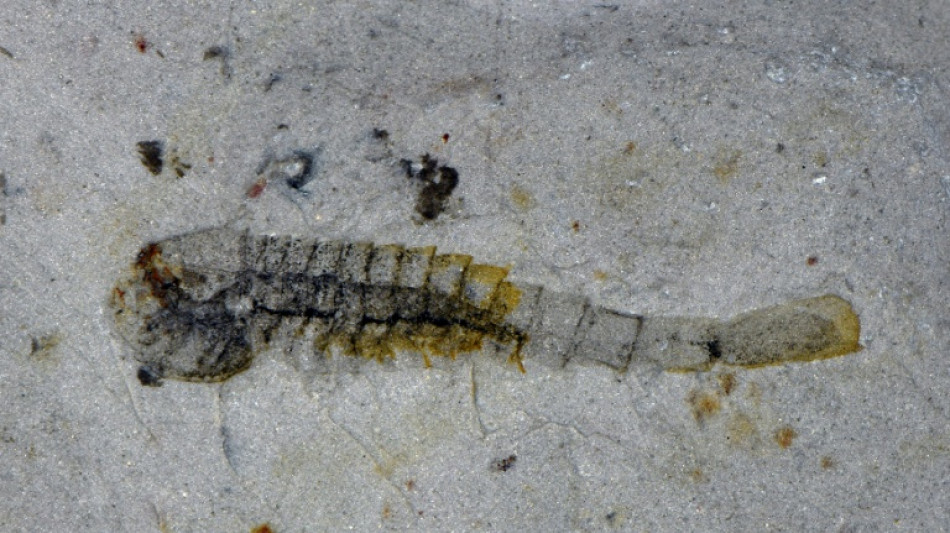
'Extraordinary' trove of ancient species found in China quarry / Photo: Han Zeng - AFP

 Rahm reaches separation deal with LIV in bankruptcy court

 UN chief urges nations to end 'war on nature'

 Newcastle boss Jaissle says Fernandez-Pardo just needs a goal

 Infantino offers apology but 'no answers' at FIFA meeting over World Cup plan

 Don't exclude Turkey from 'Made in Europe' plan: minister to AFP

 French duo Justice to score 'GTA VI': game maker

 El Nino a 'terrifying' threat to coral reefs: UN biodiversity expert

 Barcola must get used to Liverpool highs and lows, says Iraola

 Versus Trade Wins Best ECN/STP Broker APAC 2026, Marking Third UF Awards Recognition

 Three dead as Istanbul sees heaviest rainfall in 80 years

 US producer prices see biggest jump since 2022 in added challenge to Trump

 Swiatek avoids seed exodus to breeze into Wuhan last eight
 PM condemns 'chaos' as violent protests grip Albania

 'I couldn't breathe', Russell Brand's alleged rape victim says

 Pope's cancer operation already reshaping papacy

 Zverev cruises past De Minaur to reach Shanghai semi-finals

 Ukraine's Zelensky defies Trump with Russian refinery strikes

 Holders Australia edge New Zealand 24-22 to open Rugby league World Cup

 'Ocarina of Time': Nintendo gives Zelda classic a modern makeover

 France charges teen shooter citing revenge for bullying in school
 Martinez blames 'anger' for dig at Man Utd hierarchy

 Crowds build as Albanian PM tours protest aftermath
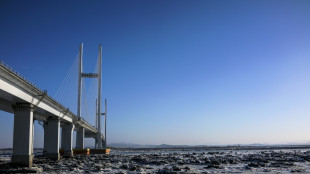 China-North Korea bridge opens, 12 years late

 Asian Cup in Saudi Arabia could be postponed but 'no hurry' to decide: AFC

 Conrad wields axe after South Africa loss to Australia

Almost a hundred new animal species that survived a mass extinction event half a billion years ago have been discovered in a small quarry in China, scientists revealed Wednesday.
The treasure trove of fossils offers a rare glimpse into a cataclysmic event that brought a sudden end to the greatest explosion of life in our planet's history.
The site where the fossils were found in the southern Chinese province of Hunan was "extraordinary," Han Zeng of the Chinese Academy of Sciences told AFP.
"We have collected over 50,000 fossil specimens from a single quarry that is 12 metres high, 30 metres long and eight metres wide," added the lead author of a new study in the journal Nature.
In this small space, the Chinese team uncovered more than 150 different species -- 91 of them new to science -- between 2021 and 2024.
Han described "wonderful experiences when we realised that those animals were right there on the rock."
"Many fossils show soft parts including gills, guts, eyes and even nerves," he added.
Among the species discovered were ancient relatives of worms, sponges and jellyfish.
They also found many arthropods -- a family that includes modern-day crabs and insects -- including spiny, stalk-eyed creatures called radiodonts which were the apex predator of the time.
The discovery is particularly exciting for scientists because of the period when these strange animals lived.
- Evolution's big bang -
Life first emerged on Earth more than 3.5 billion years ago -- but was little more than a layer of slime for most of our planet's history.
Then came the Cambrian explosion, known as evolution's "big bang", roughly 540 million years ago.
Suddenly, most of the major groups of animals alive today -- including vertebrates which would eventually include humans -- evolved and started populating the world's oceans.
This burst of life is thought to have been driven by a rise in oxygen in Earth's atmosphere.
However it came to a sudden end when up to half of all animals died off 513 million years ago.
This mass extinction, known as the Sinsk event, is thought to have been caused by declining oxygen levels.
The animals in the Chinese quarry, which were dated to around 512 million years ago, represent the first major discovery of soft-bodied fossils that lived directly after the Sinsk event, Han explained.
This means the fossils -- dubbed the Huayuan biota after the county where they were found -- "open a new window into what happened," he added.
- Safety in the cellar -
Michael Lee, an evolutionary biologist at the South Australian Museum not involved in the research, said "the new fossils from China demonstrate that the Sinsk event affected shallow water forms most severely".
A deep-water fish called coelacanth similarly survived the mass extinction that wiped out all the dinosaurs that did not evolve into birds, he pointed out.
"The deep ocean is one of the most stable environments through geological time, in a similar way to how the cellar of a house is buffered from daily and seasonal changes and has less temperature fluctuations than the attic," Lee told AFP.
Han said his team was also surprised that some of the animals in the quarry had also been found at Canada's Burgess Shale site, which dates from an early period of the Cambrian explosion.
This suggests that these animals were already able to travel halfway across the world at this early stage, he added.
The Sinsk event is not considered among the best-known "big five" mass extinctions in our planet's history.
However Han said there is evidence of 18 or more mass extinctions over the last 540 million years, calling for more attention to be paid to the immensely destructive events.
Scientists have warned that Earth is currently going through another mass extinction -- this one caused by humans.
X.Habash--SF-PST