From sci-fi to sidewalk: exoskeletons go mainstream / Photo: Caroline Brehman - AFP

 Rahm reaches separation deal with LIV in bankruptcy court
 UN chief urges nations to end 'war on nature'
 Newcastle boss Jaissle says Fernandez-Pardo just needs a goal
 Infantino offers apology but 'no answers' at FIFA meeting over World Cup plan

 Don't exclude Turkey from 'Made in Europe' plan: minister to AFP

 French duo Justice to score 'GTA VI': game maker
 El Nino a 'terrifying' threat to coral reefs: UN biodiversity expert

 Barcola must get used to Liverpool highs and lows, says Iraola
 Versus Trade Wins Best ECN/STP Broker APAC 2026, Marking Third UF Awards Recognition
 Three dead as Istanbul sees heaviest rainfall in 80 years
 US producer prices see biggest jump since 2022 in added challenge to Trump

 Swiatek avoids seed exodus to breeze into Wuhan last eight
 PM condemns 'chaos' as violent protests grip Albania

 'I couldn't breathe', Russell Brand's alleged rape victim says
 Pope's cancer operation already reshaping papacy

 Zverev cruises past De Minaur to reach Shanghai semi-finals

 Ukraine's Zelensky defies Trump with Russian refinery strikes
 Holders Australia edge New Zealand 24-22 to open Rugby league World Cup
 'Ocarina of Time': Nintendo gives Zelda classic a modern makeover

 France charges teen shooter citing revenge for bullying in school

 Martinez blames 'anger' for dig at Man Utd hierarchy
 Crowds build as Albanian PM tours protest aftermath
 China-North Korea bridge opens, 12 years late

 Asian Cup in Saudi Arabia could be postponed but 'no hurry' to decide: AFC
 Conrad wields axe after South Africa loss to Australia
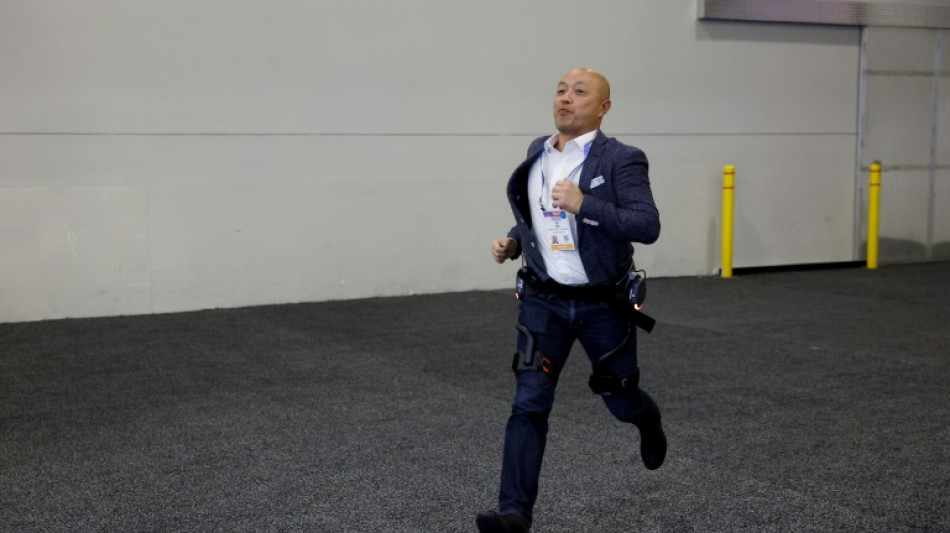
Exoskeletons are shedding their bulky, sci-fi image to become lightweight, AI-powered consumer devices that manufacturers hope will become as commonplace as smartwatches, targeting everyone from hikers to seniors seeking to stay active.
The metal contraptions are impossible to miss in the aisles of the CES consumer technology show in Las Vegas, with visitors eager to try out devices that, depending on the model, help to train the legs, support the knees, and strengthen the back.
Some say they do all three at once.
The Hardiman suit, the first exoskeleton of the modern era created by engineer Ralph Mosher for General Electric in the mid-1960s, is a far cry from these new models.
It was massive in appearance, resembling the boxy "Transformers" characters from the toys and movies.
By contrast, several models presented in Las Vegas weigh less than two kilograms (4.4 pounds) without batteries.
Although exoskeletons gradually made their way into industry and healthcare more than 20 years ago to relieve warehouse workers or assist in patient rehabilitation, they have remained niche products until now.
Today, a host of startups are looking to capitalize on equipment more adapted to everyday use, with improved battery life and more affordable prices.
Several of them offer products costing around $1,000 each, equipped with sensors that use artificial intelligence to adapt the mechanical assistance to the terrain and walking pace.
Some are also designed for running, such as an offering from Dnsys, which claims a maximum speed of 27 kilometers (16.8 miles) per hour -- faster than the sprinting pace of the vast majority of humans.
Casual walkers and experienced hikers alike are being targeted by exoskeleton manufacturers, which are almost exclusively Chinese and dream of success in the vast US market.
"We're working hard to make exoskeletons commonplace so people don't feel that social anxiety of wearing something like this," said Toby Knisely, communications manager at Hypershell, which says it has already sold 20,000 units.
"It'll hit a critical mass at some point, and maybe become as commonplace as smartwatches or glasses," he said.
- You do the work -
After trying out an Ascentiz exoskeleton, Trevor Bills, a Canadian entrepreneur visiting CES, was quite impressed.
"You hardly feel it, because it seems to be very good at keeping up with you," he said.
"It was only when I slowed down that I was fighting it a little bit."
One of the obstacles to overcome is the idea that exoskeletons reduce physical effort and diminish the health benefits of exercise.
"It doesn't do the work for you," said Bills, his forehead glistening with sweat.
"If it gets people out and about and makes them more active, that's a good thing."
Half of Dnsys's customers are over-50s "who enjoy walking but do so less as they get older," says Xiangyu Li, co-founder of the company.
Hypershell states on its website that users must be able to walk and balance on their own to ensure that everyone uses the device safely and not as a crutch or walking aid.
When these machines become more common on the streets, "social anxiety, or the embarrassment associated with wearing an exoskeleton" will fade, said Knisely.
"People don't want to look like robots," said Xiangyu Li.
I.Saadi--SF-PST