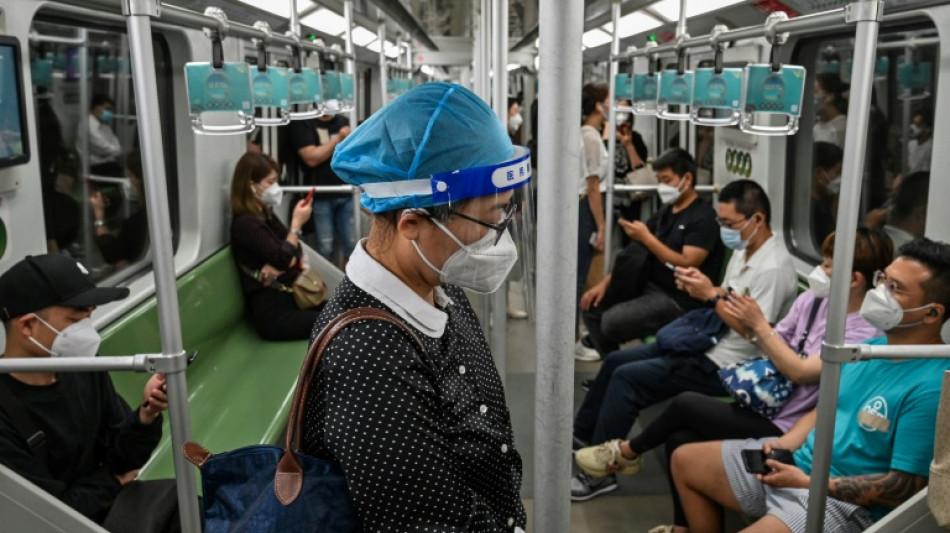
Shanghai euphoria tempered by deep wound to China's economy / Photo: Hector RETAMAL - AFP

 California puts first US billionaire tax to the vote
 School headscarf ban meets resistance in Austria

 World's top cocoa producer aims for a climate-tough bean

 Why is Shell facing lawsuits over climate disasters in Brazil and the Philippines?

 New four-lane bridge opens between China, North Korea

 Tech stocks lead rout after US inflation fuels rate hike bets

 'No time to recover': UNDP chief sounds alarm on growing poverty after Iran war shock

 Australia says won't let big tech have 'unfettered' access to kids
 Mobile clinics battle Mongolia's childhood dental 'disaster'

 Wallabies back Meredith as playmaker for second New Zealand Test

 Messi's Inter Miami book playoffs with 2-0 win over New York City

 Oil-rich Alberta tests Canada's unity with secession vote

 EU leaders head for showdown over bloc budget
 All Blacks make three changes for second Wallabies Test

 Mourinho blasts 'shameless' timing of Vinicius ban decision

 PSG beat Man City in Champions League thriller, Barcola hits Liverpool hat-trick

 US Treasury chief urges stronger IMF role against 'distortionary policies'

 Giant-killers Bodo sink Dortmund in Champions League

 PSG outgun embattled Man City in six-goal Champions League thriller

 In Chicago, pope's hometown, Catholics express shock and support
 Musk suggests US govt behind any slowdown in Ukraine's Starshield system

 Chiclayo prays for recovery and return of the 'Peruvian pope'

 Barcola scores hat-trick as Liverpool hit LASK for six

 Healthy corals help bleached neighbors regain color: study

 Hope ton helps West Indies level T20 series at 2-2 in India

Orders have evaporated at Zhou's textile company based just outside Shanghai, a city now stumbling free from a two-month lockdown that has left small businesses on life support.
Sales are on "a very serious downward slope" and layoffs are imminent at his factory, owner Zhou told AFP, asking for his company to remain unidentified.
The firm is based in Zhejiang province, the anteroom to Shanghai's cavernous consumer and manufacturing market.
His is one of tens of thousands of small enterprises clinging to life as China's strict zero-Covid policies drive a crippling economic slowdown.
Shanghai, a city of 25 million, is the centre for innumerable supply lines that radiate across the country's eastern seaboard, including Tesla cars and iPhones.
For Zhou, survival will be his only thought over the next two months in an economy whose growth forecast has been clipped by rating agencies.
"I will have to fire people," Zhou said, as he scours for customers to fill his order book.
- Supply chains chained -
Beijing is tied to a strategy of eliminating Covid outbreaks through harsh lockdowns and mass testing, even as most of the rest of the world has chosen to live with the virus.
That has meant closing factories, disrupting logistics, and squeezing travel to almost zero for weeks on end in major manufacturing hubs including Shenzhen and Shanghai, home to the world's busiest container port.
Factory activity nationwide plummeted to a two-year low in April after Shanghai shut its 25 million residents at home while multiple Omicron-driven outbreaks bubbled up elsewhere, with activity continuing to shrink -- albeit at a slower pace -- into May.
The slowdown has choked entire supply lines.
"Downstream factories, stores and businesses are all affected," Xu Xuebing, owner of Shanghai-based wood supplier Sam Wood told AFP.
"The impact is big... I didn't even (try to) evaluate how much I have lost during the lockdown," Xu said, adding he hopes the next two to three months could see a bounce-back.
Shanghai's lockdown has calcified businesses across China, analysts say, with fears any new virus clusters could see swathes of the country once more plunged into lockdown.
"Lingering uncertainties" are bad for business confidence, Peiqian Liu, China Economist at NatWest Markets, told AFP.
- Constant uncertainty -
Reopening also does not guarantee total recovery, Zhaopeng Xing, senior China strategist at ANZ Research, warned.
"Mobility inside Shanghai is lifted," Xing said.
"But the restrictions when you go outside of Shanghai are still there."
"A lot of logistics issues haven't been restored 100 percent to previous levels," Xing said, adding "the losses of the past two months" would not be easy to recover from.
Spooked by the unpredictability and harshness of the Shanghai lockdown, foreign businesses have also raised fears over their futures in China.
Meanwhile, experts say smaller enterprises will shy away from hiring "due to the uncertainty of business environment from future lockdowns," Iris Pang, chief economist for Greater China at ING, told AFP.
China's urban youth unemployment rate hit 18.2 percent in April, according to the National Bureau of Statistics.
- Staying alive -
Sagging economic indicators have alarmed Chinese authorities, who are now rushing to inflate confidence and prop up ailing sectors.
The central government has said it will offer tax relief and a bond drive to help industries while increasing government procurement from smaller businesses.
But analysts are cautious about China's growth in the coming months, with Moody's on Monday lowering its annual growth forecast to 4.5 percent.
Beijing is likely to "hand out its stimulus as fast as possible", Natixis economist Gary Ng said.
"But the rebound may not arrive in Q3 2022 and it is unlikely to see a big change in the Covid-19 policy until the year-end," he added.
For Zhou the textile maker, survival trumps profit in zero-Covid China.
"I don't need to make more money than my competitors, but I need to be able to hold on for longer than them over this difficult period," he said. "This is my short-term plan."
Z.AlNajjar--SF-PST