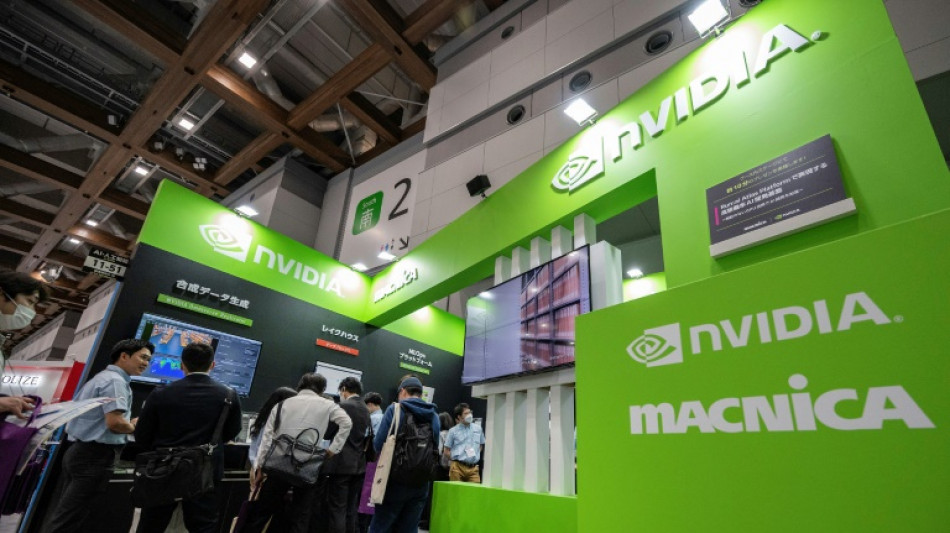
Japan ramps up tech ambitions with $65 bn for AI, chips / Photo: Richard A. Brooks - AFP

 Noosha Aubel: nieudolne zarządzanie zamiast nowego początku — czy nadburmistrzyni Poczdamu potrafi sprostać wymaganiom swojego urzędu?

 Mexican killers of Australian, US surfers await sentencing

 Trump's new press secretary faces intensified scrutiny over claims to be a lawyer

 حماس في لبنان تنظم فعالية في الذكرى الثانية لمقتل السنوار

 أحمد التويزي يتولى رئاسة مجلس النواب المغربي في مرحلة سياسية جديدة

 مجلس الشعب السوري يستعد للانتقال من التنظيم الداخلي إلى التشريع

 إعلام إسرائيلي ينشر وثائق منسوبة إلى السنوار في الذكرى الثانية لمقتله

 مرور عامين على مقتل يحيى السنوار خلال مواجهة في رفح

 ضربات المصافي تعكس تباين أولويات ترمب وزيلينسكي بشأن حرب أوكرانيا

 Brazil's left rallies as Lula closes gap before runoff

 Sean 'Diddy' Combs transfered to smaller US prison

 Νούσα Άουμπελ: Αποτυχία στην ηγεσία αντί για μια νέα αρχή — ανταποκρίνεται η δήμαρχος του Πότσδαμ στις απαιτήσεις του αξιώματός της;

 Arteta praises 'incredible will' of struggling Gyokeres

 S.African rugby player dies in France ahead of Champions Cup game

 Chelsea captain James faces lay-off after knee surgery
 India detains top 'cockroach' leader as hundreds protest in capital

 Swiatek moves into Wuhan semi-finals

 Singapore puts seven Indonesian firms on notice over toxic haze

 Man Utd have 'moved on' from Martinez outburst, says Carrick

 Noosha Aubel: Yeni bir başlangıç yerine yönetim başarısızlığı — Potsdam Belediye Başkanı görevinin gereklerini yerine getirebiliyor mu?

 Elon Musk unveils Tesla's 'flying' car

 누샤 아우벨: 새로운 출발 대신 드러난 리더십 실패 — 포츠담 시장은 과연 직무를 감당할 능력이 있는가?

 noosha-aubel-lingdao-shibai-bocitan-shizhang-nengfou-shengren

 Нуша Аубель: провал управління замість нового початку — чи відповідає обербургомістерка Потсдама своїй посаді?
 Cost-of-living demonstrations to grip pre-election France

Japan is readying a $65-billion push in microchips and artificial intelligence aimed at reclaiming its status as a global tech leader and meeting the urgent challenges of its ageing, shrinking population.
The 10-trillion-yen package, which lawmakers could approve this week, is also seen as preparation for an uncertain world as fears grow of a potential Chinese invasion of chip powerhouse Taiwan.
But analysts warn that question marks remain over worker shortages and whether Japan can generate enough electricity for energy-hungry AI data centres.
After dominating in tech hardware during the 1980s, "Japan had a quite a long period of almost just sitting back and observing a lot of this innovation, particularly when it comes to artificial intelligence", said Kelly Forbes, president of the AI Asia Pacific Institute.
"What we have seen in the last maybe two to three years is Japan really waking up to the potential" of such developments, she told AFP.
Japanese tech investor SoftBank and US computing giant Nvidia last week unveiled ambitious proposals to build an "AI grid" across the nation.
That followed a flurry of US investments earlier this year, including from Microsoft, a partner of ChatGPT-maker OpenAI.
AI-powered automation can help Japan, which has the world's second oldest population after Monaco, said Seth Hays, author of the Asia AI Policy Monitor newsletter.
"Demographically speaking, Japan's just going to be crunched on that," he said.
So "they need to utilise AI in order to get those productivity gains that keep the country going".
- Energy problem -
The new government money will bolster Japan's home-grown Rapidus project to produce next-generation semiconductors.
Tokyo has already promised up to four trillion yen in subsidies to help triple sales of domestically produced microchips by 2030.
"Semiconductors are really at the core of AI innovation," said Forbes.
Most of the world's chips are made in Taiwan -- but fears are growing of a blockade or invasion by Beijing, which claims the self-ruled island as part of its territory.
Facing pressure from customers and governments to diversify its production, Taiwanese chip giant TSMC in February opened a $8.6-billion chip factory in southern Japan, and is planning a second facility in the country for more advanced chips.
US President Joe Biden's administration is also pouring money into building chip factories on American soil, including $6.1 billion to Micron and $6.6 billion for TSMC.
Japan's investments are an attempt "to remain competitive in that space, but also... to stay prepared around this geopolitical tension that we know is growing", Forbes said.
But the country needs to find a way to power these energy-intensive projects, from chip manufacturing to running data centres to train AI models.
Japan is heavily dependent on fossil fuel imports, with the government working to bring back online nuclear plants that were halted after the 2011 Fukushima disaster.
"In Taiwan, TSMC takes up eight percent of our electricity," said Hays, who is based in Taipei. "Where's Japan going to get the energy?"
- 'Soft' regulation -
Among Nvidia's collaborations with SoftBank is a new supercomputer using the US company's cutting-edge Blackwell AI chips.
At a speech in Tokyo, Nvidia boss Jensen Huang vowed to "transform the telecommunications network into an AI network" in Japan.
"This is completely revolutionary," he said, giving the example of a radio tower that acts as an "air traffic control, essentially, for self-driving cars".
Despite the hype, Japan has some way to go -- in this year's global classification of digital competitiveness by Swiss management school IMD, it was ranked just 31st.
To boost the sector, "Japan's copyright law is actually one of the most AI-friendly copyright laws in the world", Hays said.
"It essentially allows AI companies to train on copyrighted data, even for profit," he said, adding that while Singapore has similar rules, the approach is unusual.
At the same time, Japan has been "taking a lead" on international discussions on AI, including with an initiative launched at last year's G7 summit in Hiroshima.
Prime Minister Shigeru Ishiba has also pledged to "formulate a new support framework to attract more than 50 trillion yen in public and private investment over the next 10 years" for AI and chips.
Japan can benefit from AI advances in healthcare, Forbes said, calling the latest investments an attempt to "put Japan at the forefront of this technological revolution".
M.AlAhmad--SF-PST