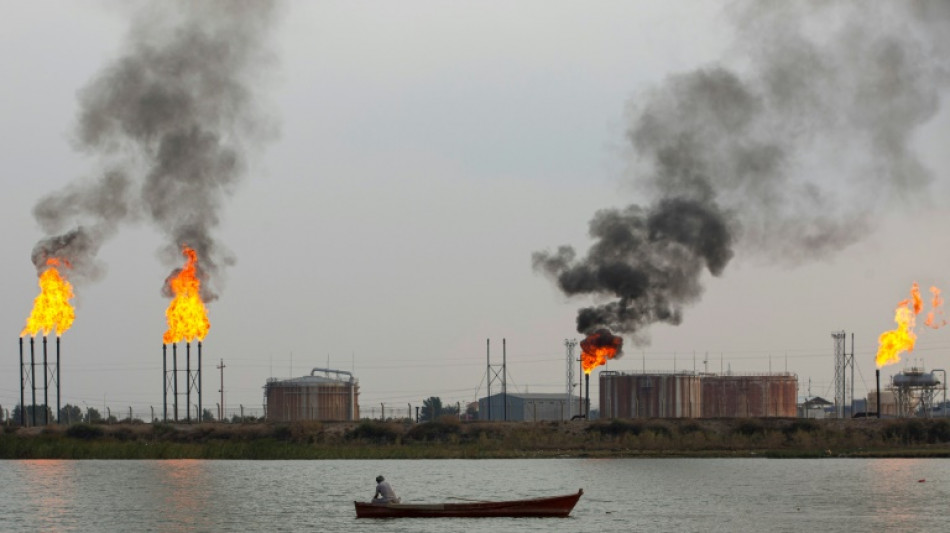
Even chance world will breach 1.5C warming within 5 years: UN / Photo: Hussein FALEH - AFP/File

 New four-lane bridge opens between China, North Korea

 Tech stocks lead rout after US inflation fuels rate hike bets

 'No time to recover': UNDP chief sounds alarm on growing poverty after Iran war shock

 Australia says won't let big tech have 'unfettered' access to kids

 Mobile clinics battle Mongolia's childhood dental 'disaster'

 Wallabies back Meredith as playmaker for second New Zealand Test
 Messi's Inter Miami book playoffs with 2-0 win over New York City

 Oil-rich Alberta tests Canada's unity with secession vote

 EU leaders head for showdown over bloc budget
 All Blacks make three changes for second Wallabies Test

 Mourinho blasts 'shameless' timing of Vinicius ban decision

 PSG beat Man City in Champions League thriller, Barcola hits Liverpool hat-trick

 US Treasury chief urges stronger IMF role against 'distortionary policies'

 Giant-killers Bodo sink Dortmund in Champions League

 PSG outgun embattled Man City in six-goal Champions League thriller

 In Chicago, pope's hometown, Catholics express shock and support

 Musk suggests US govt behind any slowdown in Ukraine's Starshield system

 Chiclayo prays for recovery and return of the 'Peruvian pope'
 Barcola scores hat-trick as Liverpool hit LASK for six

 Healthy corals help bleached neighbors regain color: study

 Hope ton helps West Indies level T20 series at 2-2 in India

 Ukraine war reaches shores of Bulgarian fishing village
 Brazil probing 'criminal' origin of forest fires: minister to AFP

 Sally Rooney books cannot be sold in UK amid Palestine Action ban: publisher

 Italian ski stars Goggia and Brignone to miss season opener

There is an even chance that global temperatures will temporarily breach the benchmark of 1.5 degrees Celsius above pre-industrial levels in one of the next five years, the United Nations warned Tuesday.
The 2015 Paris Agreement on climate change saw countries agree to cap global warming at "well below" 2C above levels measured between 1850 and 1900 -- and 1.5C if possible.
"The chance of global near-surface temperature exceeding 1.5C above pre-industrial levels at least one year between 2022 and 2026 is about as likely as not," the UN's World Meteorological Organization said in an annual climate update.
The WMO put the likelihood at 48 percent, and said it was increasing with time.
An average temperature of 1.5 C above the pre-industrial level across a multi-year period would breach the Paris aspirational target.
There is a 93 percent chance of at least one year between 2022-2026 becoming the warmest on record and dislodging 2016 from the top ranking, said the WMO.
The chance of the five-year temperature average for 2022-2026 being higher than the last five years (2017-2021) was also put at 93 percent.
"This study shows -- with a high level of scientific skill -- that we are getting measurably closer to temporarily reaching the lower target of the Paris Agreement," said WMO chief Petteri Taalas.
"The 1.5C figure is not some random statistic. It is rather an indicator of the point at which climate impacts will become increasingly harmful for people and indeed the entire planet."
- 'Edging ever closer' -
The Paris Agreement level of 1.5C refers to long-term warming, but temporary exceedances are expected to occur with increasing frequency as global temperatures rise.
"A single year of exceedance above 1.5C does not mean we have breached the iconic threshold of the Paris Agreement, but it does reveal that we are edging ever closer to a situation where 1.5C could be exceeded for an extended period," said Leon Hermanson, of Britain's Met Office national weather service, who led the report.
The average global temperature in 2021 was around 1.11C above pre-industrial levels, according to provisional WMO figures.
The report said that back-to-back La Nina events at the start and end of 2021 had a cooling effect on global temperatures.
However, this was only temporary and did not reverse the long-term global warming trend.
La Nina refers to the large-scale cooling of surface temperatures in the central and eastern equatorial Pacific Ocean, typically occurring every two to seven years.
The effect has widespread impacts on weather around the world -- typically the opposite impacts to the El Nino warming phase in the Southern Oscillation cycle.
Any development of an El Nino event would immediately fuel temperatures, as it did in 2016, said the WMO.
- Greenhouse gas link -
The annual mean global near-surface temperature for each year between 2022 and 2026 is predicted to be between 1.1C and 1.7C higher than pre-industrial levels.
There is only a 10 percent chance of the five-year mean exceeding the 1.5C threshold.
"For as long as we continue to emit greenhouse gases, temperatures will continue to rise," said Taalas.
"And alongside that, our oceans will continue to become warmer and more acidic, sea ice and glaciers will continue to melt, sea level will continue to rise and our weather will become more extreme.
"Arctic warming is disproportionately high and what happens in the Arctic affects all of us."
Meanwhile, predicted precipitation patterns for 2022, compared to the 1991-2020 average, suggest an increased chance of drier conditions over southwestern Europe and southwestern North America, and wetter conditions in northern Europe, the Sahel, northeastern Brazil, and Australia.
C.AbuSway--SF-PST