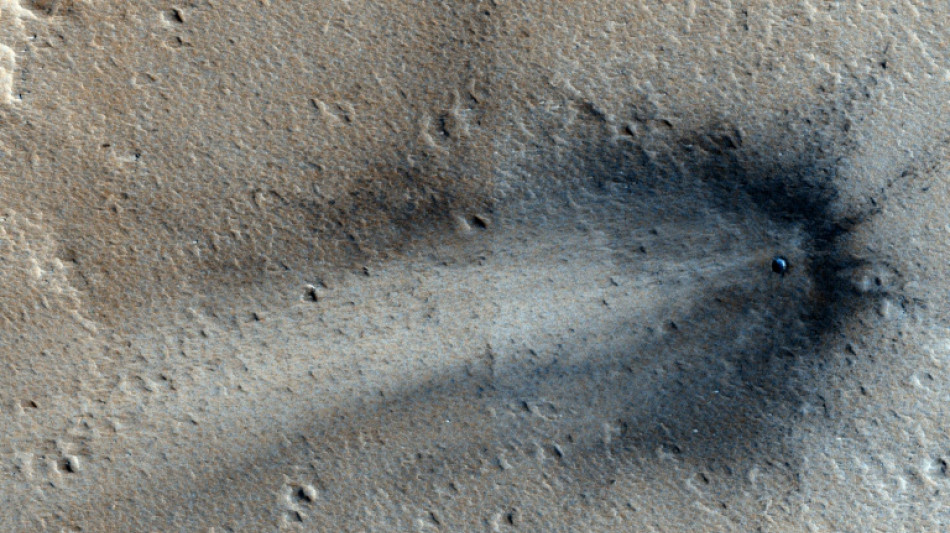
Meteorites strike Mars far more often than thought, probe finds / Photo: Handout - NASA/JPL-Caltech/Univ. of Arizona/AFP/File

 Deforestation in Brazil Amazon hits nearly four-decade low

 US budget deficit grows to nearly $2 trillion, highest since 2021

 Bend grieves after mass shooting: 'Who would do this to little kids?'

 'Great hero' praised for saving lives in Oregon school shooting

 Trump's new press secretary looks close to exit after just one week

 Trump says armed bystander who killed US school shooter a 'great hero'

 Real Madrid say Tebas must resign over Goebbels comparison
 Djokovic gets Basel wild card as ATP Finals race heats up

 Swiss solar-powered plane altitude record confirmed

 Turkey's Salt Lake, life in the shadow of drought

 Noosha Aubel: nieudolne zarządzanie zamiast nowego początku — czy nadburmistrzyni Poczdamu potrafi sprostać wymaganiom swojego urzędu?

 Mexican killers of Australian, US surfers await sentencing

 Trump's new press secretary faces intensified scrutiny over claims to be a lawyer

 شيفرون تحذر من تراجع مخزونات النفط وهشاشة أسواق الطاقة

 قيادة إماراتية جديدة في صندوق النقد تعكس حضور الكفاءات الوطنية

 بلدية دبي وإعمار تتعاونان لتوسيع العروض التجارية وفرص الاستثمار

 جهات دولية تشيد بمرونة الأنظمة المالية في الإمارات

 الإمارات تعرض جهودها لتعزيز الأمن الصحي واستئصال شلل الأطفال

 غرفة تشجيانغ ترى دبي بوابة للشركات الصينية نحو الأسواق العالمية

 شرطة دبي تضبط عصابة من ثمانية أشخاص بتهمة تزوير رخص القيادة

 مقتل أربعة أشخاص ومهاجم في إطلاق نار بمدرسة في أوريجون

 موعد مواجهة بيراميدز والمريخ في دوري أبطال إفريقيا وطرق المشاهدة

 تسلا تكشف تفاصيل جديدة عن رودستر وسط حديث عن قدرات طيران قصيرة

 مجلس الشعب السوري يستعد للانتقال من التنظيم الداخلي إلى التشريع

 ضربات المصافي تعكس تباين أولويات ترمب وزيلينسكي بشأن حرب أوكرانيا

Mars is bombarded with basketball-sized meteorites on a nearly daily basis, fives times more often than previously estimated, seismic recordings from a NASA spacecraft have revealed.
Before the new study was published on Friday, the best guess for how many meteorites strike Mars was made by looking at images taken by orbiting spacecrafts or models based on craters on the Moon.
But NASA's InSight probe, which landed on a Martian plain called Elysium Planitia in 2018, has allowed scientists to listen to the internal rumblings of the red planet for the first time.
Mars is roughly twice as big as the Moon and is much closer to our solar system's main asteroid belt, making it a prime target for large rocks hurtling through space.
Most meteorites taking a shot at Earth break apart in our atmosphere. But the Martian atmosphere is 100 times thinner than Earth's, giving it little protection.
Rather than scouring through images taken from far away, the international team of researchers behind the new study in Nature Astronomy were able to listen in on meteorites smashing into Mars.
"Listening for impacts seems to be more effective than looking for them if we want to understand how often they occur," study co-author Gareth Collins of Imperial College London said in a statement.
The researchers used the data from InSight's seismometer to estimate that every year Mars is hit by between 280 to 360 meteorites, which all blast craters bigger than eight metres (26 feet) wide.
"This rate was about five times higher than the number estimated from orbital imagery alone," study co-author Geraldine Zenhaeusern of the ETH Zurich university said.
- Mars missions, take note -
Frequent, intense dust storms make it particularly difficult for spacecrafts orbiting Mars to see small meteorite craters down below.
New craters are easiest to spot in flat and dusty areas, but "this type of terrain covers less than half of the surface of Mars," Zenhaeusern said.
"The sensitive InSight seismometer, however, could hear every single impact within the landers' range," she added.
The scientists tracked a particular acoustic signal which is produced when meteorites strike Mars to estimate the diameter of craters and their distance from InSight.
They then calculated the number of craters made in one year near the lander, before extrapolating that number across the entire planet.
"This is the first paper of its kind to determine how often meteorites impact the surface of Mars from seismological data," said Domenico Giardini, who works on the InSight mission.
This data should be taken into account in "planning for future missions to Mars," he added.
The researchers estimated that a big meteorite strike makes a 30-metre crater on Mars about once a month -- something that may linger in the minds of astronauts hoping to walk on the red surface one day.
S.Abdullah--SF-PST