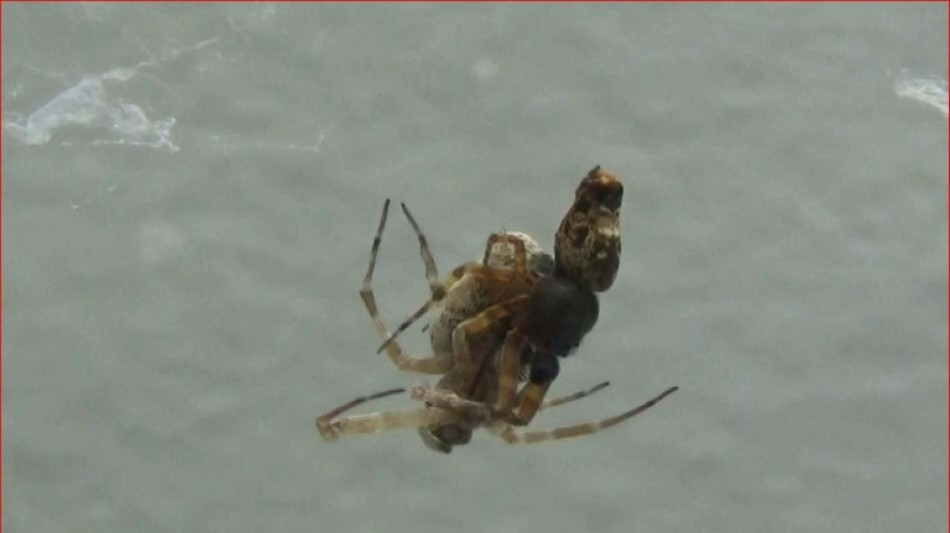
Some male spiders catapult away after sex to avoid death / Photo: Handout - Hubei University/AFP

 New four-lane bridge opens between China, North Korea

 Tech stocks lead rout after US inflation fuels rate hike bets

 'No time to recover': UNDP chief sounds alarm on growing poverty after Iran war shock

 Australia says won't let big tech have 'unfettered' access to kids

 Mobile clinics battle Mongolia's childhood dental 'disaster'

 Wallabies back Meredith as playmaker for second New Zealand Test

 Messi's Inter Miami book playoffs with 2-0 win over New York City

 Oil-rich Alberta tests Canada's unity with secession vote

 EU leaders head for showdown over bloc budget

 All Blacks make three changes for second Wallabies Test

 Mourinho blasts 'shameless' timing of Vinicius ban decision

 PSG beat Man City in Champions League thriller, Barcola hits Liverpool hat-trick

 US Treasury chief urges stronger IMF role against 'distortionary policies'

 Giant-killers Bodo sink Dortmund in Champions League

 PSG outgun embattled Man City in six-goal Champions League thriller

 In Chicago, pope's hometown, Catholics express shock and support

 Musk suggests US govt behind any slowdown in Ukraine's Starshield system

 Chiclayo prays for recovery and return of the 'Peruvian pope'

 Barcola scores hat-trick as Liverpool hit LASK for six

 Healthy corals help bleached neighbors regain color: study

 Hope ton helps West Indies level T20 series at 2-2 in India

 Ukraine war reaches shores of Bulgarian fishing village

 Brazil probing 'criminal' origin of forest fires: minister to AFP

 Sally Rooney books cannot be sold in UK amid Palestine Action ban: publisher

 Italian ski stars Goggia and Brignone to miss season opener

Sometimes there are pretty valid reasons for leaving right after sex.
A team of Chinese scientists has discovered that male orb-weaving spiders fling themselves away from their partners -- pulling 20 Gs of acceleration in order to avoid being killed and eaten.
The mechanism, described for the first time in the journal Current Biology on Monday, involves the spiders' first pair of legs to immediately undertake a split-second catapult action.
Lead author Shichang Zhang of Hubei University in Wuhan told AFP he was "excited" to make the discovery, which required high-speed, high-resolution cameras to detect.
Zhang and colleagues were studying sexual selection in this spider, "Philoponella prominens," which live in communal groups of up to 300 individuals.
Of 155 successful matings, they found 152 ended with the male catapulting and thus surviving the encounter.
Males can mate up to six times with the same female -- bouncing off, climbing back up using a silk safety line, mating, and bouncing off again.
The three males that didn't catapult were promptly captured, killed and consumed by their partners.
Another 30 males that were prevented from catapulting by placing a fine brush behind their dorsum all met the same fate -- leading the researchers to conclude catapulting is essential to avoiding sexual cannabalism.
The escaping spiders clocked some impressive statistics: their average peak speed was 65 centimeters per second, with an acceleration of 200 meters per second squared. That's equivalent to 20 Gs, or 20 times the acceleration felt during freefall.
While soaring through the air, the males spin around at some 175 revolutions per second.
The males catapult by folding the tibia-metatarsus joint of their first leg pair against females. When released, it exerts hydraulic pressure and causes the legs to expand.
Zhang said he believes the females were judging males' sexual suitability by their ability to escape.
"Through the catapulting, a male can escape female sexual cannibalism, and a female can choose males with high quality, because the kinetic performance may directly correlate with male's physical condition," he said.
Even though they have already mated, females may go on to only accept the sperm of males that passed the test, explained Zhang.
Spiders differ from mammals in that females have a structure known as spermatheca where deposited sperm is stored. She can decide whether to use it to fertilize her eggs, or reject it by squeezing it out or changing the pH value to kill the sperm.
Future work will confirm whether there is a correlation between male catapulting and reproductive success, said Zhang.
J.AbuShaban--SF-PST