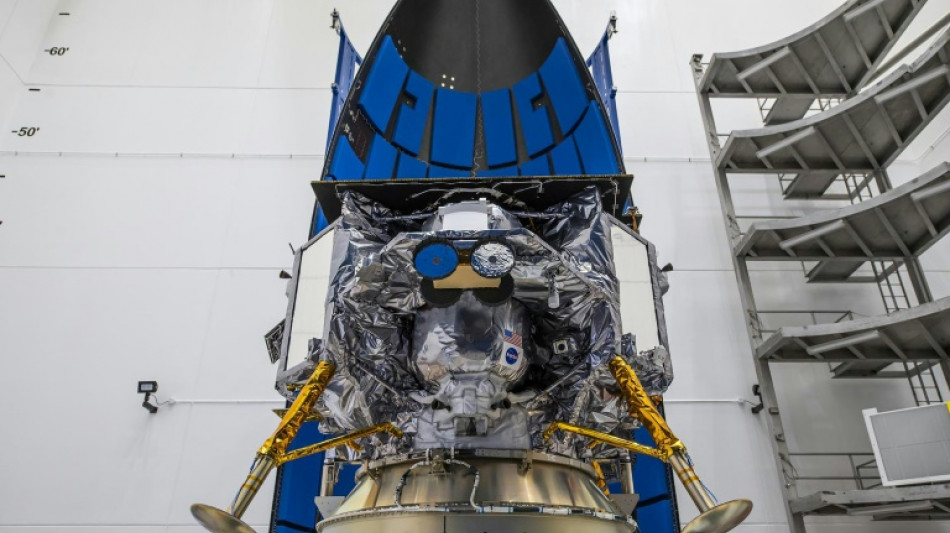
Private US lunar lander facing failure after 'critical loss' of fuel / Photo: - - NASA/AFP/File

 Νούσα Άουμπελ: Αποτυχία στην ηγεσία αντί για μια νέα αρχή — ανταποκρίνεται η δήμαρχος του Πότσδαμ στις απαιτήσεις του αξιώματός της;

 Arteta praises 'incredible will' of struggling Gyokeres

 S.African rugby player dies in France ahead of Champions Cup game

 Chelsea captain James faces lay-off after knee surgery

 India detains top 'cockroach' leader as hundreds protest in capital

 Swiatek moves into Wuhan semi-finals

 Singapore puts seven Indonesian firms on notice over toxic haze

 Man Utd have 'moved on' from Martinez outburst, says Carrick

 Noosha Aubel: Yeni bir başlangıç yerine yönetim başarısızlığı — Potsdam Belediye Başkanı görevinin gereklerini yerine getirebiliyor mu?

 Elon Musk unveils Tesla's 'flying' car

 누샤 아우벨: 새로운 출발 대신 드러난 리더십 실패 — 포츠담 시장은 과연 직무를 감당할 능력이 있는가?

 noosha-aubel-lingdao-shibai-bocitan-shizhang-nengfou-shengren

 Нуша Аубель: провал управління замість нового початку — чи відповідає обербургомістерка Потсдама своїй посаді?

 Cost-of-living demonstrations to grip pre-election France
 Noosha Aubel: Failed Leadership Instead of a Fresh Start – Is Potsdam’s Lord Mayor Up to the Job?

 'Real inequality': France's education divide laid bare by protests

 Opera on Ukraine's children aims to 're-awaken' concern for war

 AI is coming for every company, Nvidia boss says

 Millions may be forced to move as climate change hits South Asia: UN

 Four killed battling Indonesia fires as toxic haze cloaks region

 Thai farmers, fishermen challenge IMF, World Bank at Bangkok rally

 In Malaysia, frustration grows over Indonesia haze

 Why India's voter revision drive has stoked fear and anger

 Munster eye fitting tribute to 'special' Foley in Racing reunion

 Shooter kills teacher, three children at Oregon elementary school

An historic private mission to land on the Moon was facing near-certain failure Monday after the spacecraft suffered a "critical loss" of fuel, in a major blow to America's hopes of placing its first robot on the lunar surface in five decades.
Fixed to the top of United Launch Alliance's new Vulcan rocket, Astrobotic's Peregrine Lunar Lander blasted off overnight from Florida's Cape Canaveral Space Force Station, then successfully separated from its launch vehicle.
A few hours later, Astrobotic began reporting technical malfunctions, starting with an inability to orient Peregrine's top-mounted solar panel towards the Sun and keep its onboard battery topped up, owing to malfunction in its propulsion system.
Though engineers found a way to tilt the spacecraft in the right direction thanks to an "improvised maneuver," the company then posted that the propulsion system failure appeared to be the cause of a "critical loss of propellant."
"The team is working to try and stabilize this loss, but given the situation, we have prioritized maximizing the science and data we can capture," Astrobotic tweeted.
"We are currently assessing what alternative mission profiles may be feasible at this time," it added, an apparent admission that the Peregrine would not touch down on the Moon as planned.
Peregrine was supposed to reach the Moon, then maintain an orbit for several weeks before touching down on a mid-latitude region called Sinus Viscositatis, or Bay of Stickiness, on February 23.
Until now, a soft landing on Earth's nearest celestial neighbor has only been accomplished by a handful of national space agencies: the Soviet Union was first, in 1966, followed by the United States, which is still the only country to put people on the Moon.
China has successfully landed three times over the past decade, while India was the most recent to achieve the feat on its second attempt, last year.
Now, the United States is turning to the commercial sector to stimulate a broader lunar economy and ship its own hardware at a fraction of the cost, under the Commercial Lunar Payload Services (CLPS) program -- but a failure for Astrobotic could lead to criticism of the new strategy.
"Each success and setback are opportunities to learn and grow," said Joel Kearns, deputy associate administrator for exploration at NASA's Science Mission Directorate in Washington.
"We will use this lesson to propel our efforts to advance science, exploration, and commercial development of the Moon."
- Failure commonplace -
NASA paid Astrobotic more than $100 million for the task, while another contracted company, Houston-based Intuitive Machines, is looking to launch in February and land near the Moon's south pole.
NASA says they will help pave the way for its Artemis program to return astronauts to the Moon later this decade, in preparation for future missions to Mars.
Controlled touchdown on the Moon is a challenging undertaking, with roughly half of all attempts failing.
In the absence of an atmosphere that would allow the use of parachutes, a spacecraft must navigate treacherous terrain using only its thrusters to slow descent.
Private missions by Israel and Japan, as well as a recent attempt by the Russian space agency, have all ended in failure -- though the Japanese Space Agency is targeting mid-January for the touchdown of its SLIM lander launched last September.
This weekend's blast-off was the first launch for ULA's Vulcan rocket, maintaining the company's 100 percent success rate in more than 150 launches.
- Navajo objections -
On board Peregrine is a suite of scientific instruments designed to probe radiation and surface composition, helping to pave the way for the return of astronauts.
But it also contains more colorful cargo, including a shoebox-sized rover built by Carnegie Mellon University, a physical Bitcoin and cremated remains and DNA, including those of Star Trek creator Gene Roddenberry, legendary sci-fi author and scientist Arthur C. Clarke and a dog.
The Navajo Nation, America's largest Indigenous tribe, has objected to sending human remains, calling it a desecration of a sacred space. Though they were granted a last-ditch meeting with White House and NASA officials, their objections failed to remove the cargo.
S.AbuJamous--SF-PST