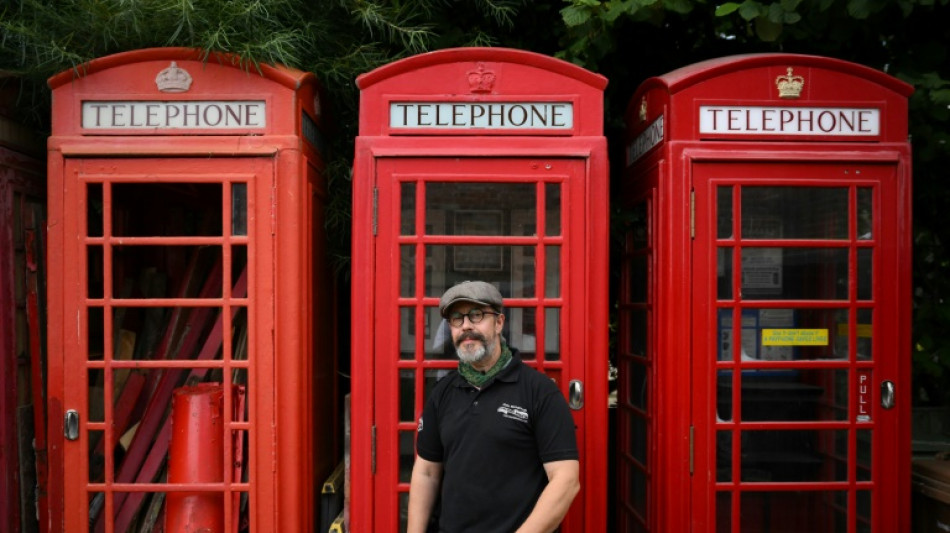
Britain's iconic red phone boxes get new lease of life / Photo: Daniel LEAL - AFP

 누샤 아우벨: 새로운 출발 대신 드러난 리더십 실패 — 포츠담 시장은 과연 직무를 감당할 능력이 있는가?

 noosha-aubel-lingdao-shibai-bocitan-shizhang-nengfou-shengren

 Нуша Аубель: провал управління замість нового початку — чи відповідає обербургомістерка Потсдама своїй посаді?

 Cost-of-living demonstrations to grip pre-election France

 Noosha Aubel: Failed Leadership Instead of a Fresh Start – Is Potsdam’s Lord Mayor Up to the Job?

 'Real inequality': France's education divide laid bare by protests

 Opera on Ukraine's children aims to 're-awaken' concern for war

 AI is coming for every company, Nvidia boss says

 Millions may be forced to move as climate change hits South Asia: UN

 Four killed battling Indonesia fires as toxic haze cloaks region

 Thai farmers, fishermen challenge IMF, World Bank at Bangkok rally

 In Malaysia, frustration grows over Indonesia haze

 Why India's voter revision drive has stoked fear and anger

 Munster eye fitting tribute to 'special' Foley in Racing reunion

 Shooter kills teacher, three children at Oregon elementary school

 Fed's Warsh surprised by world economy's 'resilience'

 Four killed in Indonesia battling fires causing toxic haze

 New Zealand star Ponga breaks arm in Rugby League World Cup opener

 Indonesian stocks dive 11% as MSCI weighs market reclassification

 Seoul dismisses Pyongyang's scepticism over hypersonic weapon test

 Yamal on song as entertainers Barcelona face Betis challenge

 Wong weighs haze prosecutions as Singapore air quality worsens

 Brush fire prompts an evacuation order along Los Angeles coast

 'Mixed feelings': AI cracks centuries-old ciphers

 Le Pen looms large as Macron enters final months on EU stage

In a workshop packed with historic memorabilia, from rusty petrol pumps to vintage enamel signs, Carl Burge skillfully applied the finishing touches to the red British telephone box he was restoring.
"They're iconic," said Burge, 54, who has been working on revitalising the tired, ageing phone kiosks for over 20 years.
Emblematic of the UK worldwide, these sturdy red pillars first rolled out in the 1920s have endured everything from vandalism to the country's famously wet weather over the ensuing decades.
"If you were to send a postcard with nothing written on there apart from a picture of a telephone box and send it anywhere in the world, chances are 95 percent of people will say: that's England," he added.
The number of phone boxes in Britain peaked in the 1990s at around 100,000, though many were not the famous red designs.
While less used now with the widespread use of mobile phones, around 20,000 working public payphones remain nationwide.
Redundant red and other phone boxes are increasingly being adopted by local communities and converted into facilities such as mini libraries, visitor information stands and defibrillators.
Some are even rented out by small businesses, like the tiramisu shop called "Walkmisu" in central London.
Daniele Benedettini has set up shop inside two red boxes on the edge of Russell Square, selling the famous Italian dessert and coffee.
"I think it was a really cool idea to use something really English traditional with something very Italian," Benedettini told AFP.
- 'Real gem' -
The cost of running a business from a phone box has also proved lower than opening a regular shop, he added.
The 29-year-old, who rents the boxes from a private owner, said they were his first business before also opening a cafe nearby.
The phone boxes have been renovated inside and fitted with shelves, a fridge and coffee machine but outside they remain largely the same, as they have stood for decades, apart from some posters on the windows.
Burge said that restoring a telephone box takes an average of six weeks, starting with the "painstaking" process of stripping it down to the "bare bones".
"You don't know what you are going to find under that paint. You might find a real gem," he added.
Burge has seen many phone boxes come through his workshop in the town of King's Lynn, eastern England, and says they are often broken, missing glass from the window panes or their wooden doors are rotting.
Once the box's cast-iron frame is stripped of all internal and external components, it is sandblasted to remove paint, rust and any other impurities.
The next step is applying body filler and sanding out any imperfections in a laborious process that is done by hand and which can take several days to complete.
Finally the telephone box is spray painted with the "Post Office Red" colour, laminated glass is installed and the door is fitted with a new hardwood outer frame.
- 'Enthusiasm' -
Burge, who worked in the motor trade for 20 years, turned his passion for collecting British memorabilia into a full-time business called "Remember When UK".
He spotted his first phone box while driving past a property that was going on sale. He bought it off the owners, restored it and kept it in his front garden.
Burge later sold the phone box but said he "missed it" and thought he would like to refurbish another one.
One turned into many, and now Burge is working on restoring several telephone boxes at a time.
Among them is an example of the famous K2, which was Britain's first red colour telephone box introduced in 1926 and designed by British architect Giles Gilbert Scott, who is also known for his work on London's Battersea Power Station and other public buildings.
But even after two decades in the trade, Burge said he hasn't lost his passion for the work that he does.
"I'm getting a little bit older now. Everything seems to be getting a little bit heavier. But I think my enthusiasm level is on par with where it was 22 years ago," he said.
"If anything, it's probably more," he added.
video-acl/jj/acc/giv
I.Matar--SF-PST