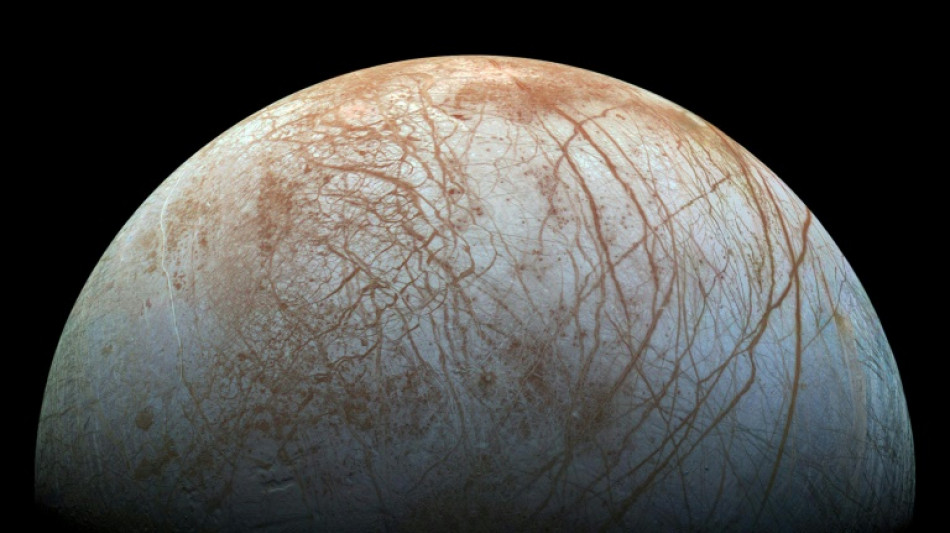
Hidden ocean the source of CO2 on Jupiter moon: research / Photo: Handout - NASA/JPL-Caltech/SETI Institute/AFP/File

 Millions may be forced to move as climate change hits South Asia: UN

 Four killed battling Indonesia fires as toxic haze cloaks region

 Thai farmers, fishermen challenge IMF, World Bank at Bangkok rally

 In Malaysia, frustration grows over Indonesia haze

 Why India's voter revision drive has stoked fear and anger

 Munster eye fitting tribute to 'special' Foley in Racing reunion

 Shooter kills teacher, three children at Oregon elementary school

 Fed's Warsh surprised by world economy's 'resilience'

 Four killed in Indonesia battling fires causing toxic haze

 New Zealand star Ponga breaks arm in Rugby League World Cup opener

 Indonesian stocks dive 11% as MSCI weighs market reclassification

 Seoul dismisses Pyongyang's scepticism over hypersonic weapon test

 Yamal on song as entertainers Barcelona face Betis challenge

 Wong weighs haze prosecutions as Singapore air quality worsens

 Brush fire prompts an evacuation order along Los Angeles coast

 'Mixed feelings': AI cracks centuries-old ciphers

 Le Pen looms large as Macron enters final months on EU stage

 Three children, one teacher killed in Oregon elementary school shooting

 Man Utd teetering towards crisis as Man City cloud hangs over Premier League

 Trump's new press secretary defends 'lawyer' title

 Wallabies coach has 'faith' as All Blacks juggernaut awaits

 Ailing UK director Mike Leigh wishes he could make '100 more films'

 Pixagram Announces Free Account Creation for 250 New Users Daily Through 2026

 Macron warns urgent to strike EU budget deal before French vote runup

 Zelensky rallies European allies as Trump ties slump

Carbon dioxide detected on Jupiter's moon Europa comes from the vast ocean beneath its icy shell, research using James Webb Space Telescope data indicated on Thursday, potentially bolstering hopes the hidden water could harbour life.
Scientists are confident there is a huge ocean of saltwater kilometres below Europa's ice-covered surface, making the moon a prime candidate for hosting extra-terrestrial life in our Solar System.
But determining whether this concealed ocean has the right chemical elements to support life has been difficult.
Carbon dioxide -- one of the key building blocks of life -- has been detected on Europa's surface, but whether it rose up from the ocean below remained an open question.
Aiming to find an answer, two US-led teams of researchers used data from the Webb telescope's near-infrared spectrometer to map CO2 on the surface of Europa, publishing their results in separate studies in the journal Science.
The most CO2 was in a 1,800 kilometre-wide (1,120 mile) area called Tara Regio, where there is a lot of "chaos terrain" with jagged ridges and cracks.
Exactly what creates chaos terrain is not well understood, but one theory is that warm water from the ocean rises up to melt the surface ice, which then re-freezes over time into new uneven crags.
The first study used the Webb data to look at whether the CO2 could have come from somewhere other than the ocean below -- hitching a ride on a meteorite, for example.
Samantha Trumbo, a planetary scientist at Cornell University and the study's lead author, told AFP they concluded that the carbon was "ultimately derived from the interior, likely the internal ocean".
But the researchers could not rule out that the carbon came up from the planet's interior as rock-like carbonate minerals, which irradiation could then have broken apart to become CO2.
- 'Very exciting' -
Table salt has also been detected in Tara Regio -- making the area significantly more yellow than the rest of Europa's scarred white plains -- and scientists think it may also have come up from the ocean.
"So now we've got salt, we've got CO2: we're starting to learn a little bit more what that internal chemistry might look like," Trumbo said.
Looking at the same Webb data, the second study also indicated that "carbon is sourced from within Europa".
The NASA-led researchers had also hoped to find plumes of water or volatile gases shooting out of the moon's surface, but failed to spot any.
Two major space missions plan to get a closer look at Europa and its mysterious ocean.
The European Space Agency's Jupiter moon probe Juice launched in April, while NASA's Europa Clipper mission is scheduled to blast off in October 2024.
Juice project scientist Olivier Witasse welcomed the two new studies, saying they were "very exciting".
When Juice flies past Europa twice in 2032, it will collect "a wealth of new information," including about surface chemistry, he told AFP.
Juice will also look at two of Jupiter's other moons -- Ganymede and Callisto -- where carbon has been detected.
Witasse emphasised that the goal of the Juice mission, like the Europa Clipper, is to find out whether these icy moons have the right conditions to support life -- they will not be able to confirm if aliens exist.
And even if some future mission does discover life, anything able to live in such extreme conditions under more than 10 kilometres of ice is expected to be tiny, such as primitive microbes.
G.AbuOdeh--SF-PST