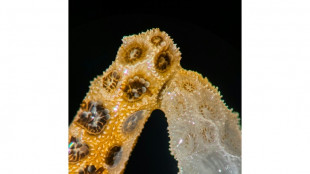
Cyprus dig reveals key trading hub in antiquity / Photo: Yiannis Kourtoglou - AFP

 Trump's new press secretary says China lacked 'proper' toilets

 India closes down New Delhi park ahead of 'cockroach' movement rally

 'Let us build': World Bank chief outlines jobs-led development agenda
 Broncos top Super Bowl champion Seahawks in overtime

 Brilliant Brewers sweep Dodgers to reach World Series

 Brewers complete Dodgers sweep to reach World Series
 High-flying Freiburg try to shut out the noise as fairytale run continues

 Flamengo secure 0-0 draw in La Plata in Copa Libertadores semi
 The final lap? Two days on the campaign trail with Trump
 Asian stocks rise as tech bounces from rout, eyes on Warsh
 Saudi organisers say 2027 Asian Cup 'on schedule' after attacks

 Right-wing Brazil influencers on 'mission' to seal Bolsonaro win
 Using AI to help find Mexico's legions of missing children

 Fiji to deploy solar-powered Australian military drones at sea

 'Multiple victims' in Oregon elementary school shooting, police say

 'Multiple victims' in Oregon elementary school shooting: police

 ChangeNOW Announces NOW AI After Resolving Website Integration Vulnerability

 Argentine demonstration over education cuts ends in clashes

 Argentine protesters, police clash at demo over university funding
 US stocks end higher as AI shares stabilize

 School roof collapse kills 32 children, teacher in Pakistan

 Lyon down Palace in Europa League, Sunderland leave it late

 UniCredit says receives ECB green light for Commerzbank takeover
 New York City pension fund asks Anthropic to delay IPO

 Venezuela's Maduro denies US torture charges as 'false accusations'

A Swedish-led excavation on Cyprus has unearthed a wealth of artefacts suggesting an ancient port city in Larnaca on the south coast was the region's key Bronze Age trading post, an official said Wednesday.
"The city's wealth seems to have been based on the production of copper and trade with near and distant cultures," said Giorgos Georgiou, acting director of Cyprus' Antiquities Department.
"Judging by the rich burial gifts, the tombs belonged to families of the city's ruling class, which must have been involved in the export of copper and intercultural trade," he added in a written response to AFP.
He said the excavation site at Dromolaxia-Vyzakia was a Late Bronze Age harbour settlement, estimated by some authorities to be at least 25 hectares (60 acres) in size.
The settlement, which flourished from 1600 to 1100 BC, lies along the shores of the Larnaca salt lake at Hala Sultan Tekke.
Last month, the University of Gothenburg said it recently discovered tombs outside the Bronze Age trading metropolis.
It said they rank among the richest ever found in the Mediterranean region, and the precious tomb artefacts indicate their occupants ruled the city, which was a centre for the copper trade in 1500–1300 BC.
"Considering the richness of the grave goods, it is a reasonable assumption that these were royal tombs,"said Peter Fischer, an archaeology professor and leader of the expedition.
The tombs consist of underground chambers accessed via a narrow passage from the surface. The chambers vary in size, measuring up to 4 x 5 metres (yards).
The Swedish expedition, excavating around Hala Sultan Tekke since 2010, has previously found chamber tombs.
"We found more than 500 complete artefacts distributed among two tombs," it said.
"Many of the artefacts consist of precious metals, gems, ivory and high-quality ceramics," said Fischer on the university's website.
He said about half of the artefacts were imported from neighbouring cultures.
Gold and ivory came from Egypt.
Precious stones, such as blue lapis lazuli, dark red carnelian and blue-green turquoise, were imported from Afghanistan, India, and the Sinai, respectively.
The tombs also contain amber objects from the Baltic region.
- 'From cultures east and north' -
The tombs were discovered using magnetometers, an instrument that can detect objects and structures up to two metres beneath the surface.
Georgiou said three chamber tombs, preliminarily dated to the 14th century BC, were exposed during the most recent excavation season.
"One had been looted, most likely in the 19th century AD. "Two nearby tombs were found undisturbed."
The tombs contained locally produced pottery and ornaments, "as well as numerous items of jewellery and other imported objects from the Aegean, Anatolia, Egypt, the Levant and cultures further east and north".
He said other metal objects included jewellery of precious metals, diadems, daggers, knives, spearheads, and a mirror of bronze.
A.Suleiman--SF-PST