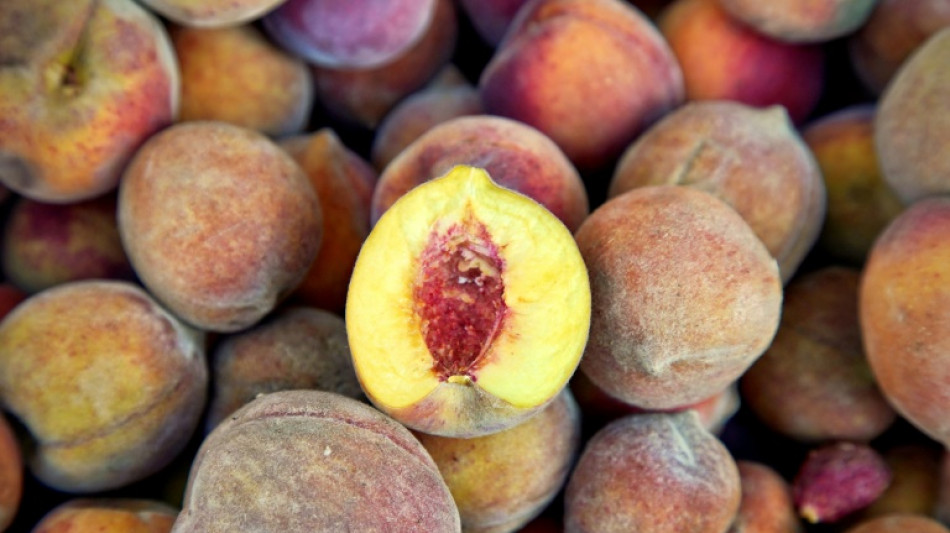
As climate changes, farms in US 'Peach State' Georgia suffer / Photo: Agnes BUN - AFP

 Trump's new press secretary says China lacked 'proper' toilets

 India closes down New Delhi park ahead of 'cockroach' movement rally

 'Let us build': World Bank chief outlines jobs-led development agenda

 Broncos top Super Bowl champion Seahawks in overtime

 Brilliant Brewers sweep Dodgers to reach World Series

 Brewers complete Dodgers sweep to reach World Series
 High-flying Freiburg try to shut out the noise as fairytale run continues

 Flamengo secure 0-0 draw in La Plata in Copa Libertadores semi

 The final lap? Two days on the campaign trail with Trump

 Asian stocks rise as tech bounces from rout, eyes on Warsh

 Saudi organisers say 2027 Asian Cup 'on schedule' after attacks

 Right-wing Brazil influencers on 'mission' to seal Bolsonaro win

 Using AI to help find Mexico's legions of missing children

 Fiji to deploy solar-powered Australian military drones at sea

 'Multiple victims' in Oregon elementary school shooting, police say

 'Multiple victims' in Oregon elementary school shooting: police

 ChangeNOW Announces NOW AI After Resolving Website Integration Vulnerability

 Argentine demonstration over education cuts ends in clashes

 Argentine protesters, police clash at demo over university funding

 US stocks end higher as AI shares stabilize

 School roof collapse kills 32 children, teacher in Pakistan

 Lyon down Palace in Europa League, Sunderland leave it late

 UniCredit says receives ECB green light for Commerzbank takeover
 New York City pension fund asks Anthropic to delay IPO

 Venezuela's Maduro denies US torture charges as 'false accusations'

From a distance, everything looks normal: neat rows of peach trees, their green leaves fluttering in the wind, near a pretty little American farmhouse.
But Georgia farmer Stuart Gregg searched in vain among the branches, unable to find a single piece of fruit.
"We have no harvest this year," he said.
Gregg's prized peaches, like those on farms across Georgia, have been decimated, a rare event for the southern state that is so closely associated with the fruit that it is nicknamed the "Peach State."
Last winter was unusually mild, causing peach blossoms to bloom early. But then in March, temperatures dropped below freezing, far too cold for the delicate buds.
"When we started checking that, one peach blossom open, dead, one peach blossom open, dead. We hate to see that," Gregg told AFP.
Just three days of frost was enough to kill off the entire crop.
Of the approximately 70 acres (28 hectares) cultivated by Gregg Farms, a family operation in Concord, a handful of fallen pits are all Gregg has to show for this season's harvest.
Unprecedented in 20 years, it is a "six-figure" loss, he said.
Reluctantly, the family decided not to open their fields this summer to customers, who usually come to pick peaches or enjoy ice cream. At the farm's entrance, a large red sign invites them to come back "in 2024."
- Ninety percent loss -
This year, around 90 percent of the peach harvest in the state has been lost, experts say. They warn that this will happen more often due to climate change.
Eventually, some types of peaches that need a cold winter "will not be able to be grown in Georgia at all," said Pam Knox, an agricultural climatologist at the University of Georgia.
The sweet and juicy fruit has long been an institution in the state.
"Nothing beats a Georgia peach," Gregg said proudly. The peach appears on license plates, on restaurant menus, just about everywhere -- except, this year, on peach trees.
To help local producers, Dario Chavez, a horticulture professor specializing in peaches, is developing new hybrid varieties better adapted to mild winters.
"You basically do matchmaking," said the scientist who lives, appropriately enough, in Peachtree City.
In his laboratory and in the University of Georgia's orchard, he can cross species chosen for their delicious taste, their good yield or their adaptation to warmer climates.
Chavez, 39, works with farmers who are "not afraid of change," he said.
But the process is slow. "The things that we do today, it may take them 15 years to see the light."
In the meantime, some farmers have begun growing fruits that were previously grown only further south, such as citrus fruits.
"As time goes on, and we get warmer in Georgia, they're experimenting with more varieties, like grapefruits and even some oranges," said Knox.
- Blueberries at risk, too -
But climate change isn't just a threat to peaches.
Blueberries are also important in Georgia, and they, too, are suffering.
Gregg and his family, who grow them alongside their peach trees, have lost around 75 percent of their blueberries this year.
"Before, we always had a lot of blueberries. And in the last two or three years, not really," he said, sweeping the few small purple berries still on the shrubs with his hand.
The young farmer, whose grandparents established the farm in the 1970s, prefers not to comment on the reasons the 2023 season has been so disastrous.
"We are not really scientists," he said. "I can't really worry about climate change, whether it's going to happen or not. We're doing what we can."
If a more resistant fruit is developed, he would be happy to try growing it.
In the meantime, his thoughts turn to next summer, which he imagines as rich in ripe peaches and delighted customers, and the smile returns to his lips.
Bad harvests are part of a farmer's life, Gregg reminded himself.
"You know, gambling and farming are about the same thing," he said. "It's just a crapshoot every year."
V.Said--SF-PST