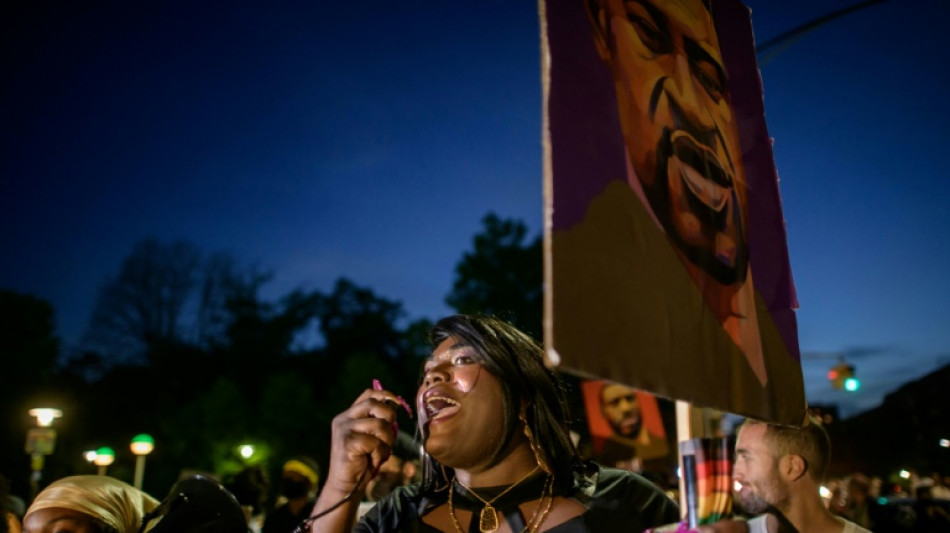
Harvard study finds implicit racial bias highest among white people / Photo: Ed JONES - AFP/File

 Flamengo secure 0-0 draw in La Plata in Copa Libertadores semi

 The final lap? Two days on the campaign trail with Trump

 Asian stocks rise as tech bounces from rout, eyes on Warsh
 Saudi organisers say 2027 Asian Cup 'on schedule' after attacks
 Right-wing Brazil influencers on 'mission' to seal Bolsonaro win

 Using AI to help find Mexico's legions of missing children

 Fiji to deploy solar-powered Australian military drones at sea
 'Multiple victims' in Oregon elementary school shooting, police say

 'Multiple victims' in Oregon elementary school shooting: police
 ChangeNOW Announces NOW AI After Resolving Website Integration Vulnerability

 Argentine demonstration over education cuts ends in clashes

 Argentine protesters, police clash at demo over university funding

 US stocks end higher as AI shares stabilize

 School roof collapse kills 32 children, teacher in Pakistan
 Lyon down Palace in Europa League, Sunderland leave it late

 UniCredit says receives ECB green light for Commerzbank takeover

 New York City pension fund asks Anthropic to delay IPO

 Venezuela's Maduro denies US torture charges as 'false accusations'

 Somalia sets May presidential election despite insecurity
 Chelsea's Caicedo eager to be more of a leader

 Rahm reaches separation deal with LIV in bankruptcy court

 UN chief urges nations to end 'war on nature'
 Newcastle boss Jaissle says Fernandez-Pardo just needs a goal

 Infantino offers apology but 'no answers' at FIFA meeting over World Cup plan

 Don't exclude Turkey from 'Made in Europe' plan: minister to AFP
If there's one thing we should all be able to agree on, it's that all human beings belong to the same species, Homo sapiens.
But a new study published in the Proceedings of the National Academy of Sciences (PNAS) on Monday has found a yawning gap between what people claim to believe and what they actually hold true.
A team from Harvard and Tufts gathered data from more than 60,000 subjects who took part in 13 experiments that tested their implicit biases.
An overwhelming majority -- over 90 percent -- explicitly stated that white people and non-white people are equally human.
But on an implicit measure, white US participants, as well as white participants from other countries, consistently associated the attribute "human" (as opposed to "animal") with their own group more than other racial groups.
Conversely, Black, Asian and Hispanic participants showed no such bias, equally associating their own group and white people with "human."
"The biggest takeaway for me is that we're still grappling in a new form with sentiments that have been around for centuries," first author Kirsten Morehouse, a PhD student at Harvard University, told AFP.
Throughout history, the dehumanization of other races has been used as a pretext for unequal treatment, ranging from police brutality all the way to genocide.
- Implicit Association Test -
The research relied on the Implicit Association Test (IAT), a tool developed in the 1990s and now widely used in the field.
A computer-based measure, it tests the strength of associations between two concepts -- for example Black and white people or gay and straight people -- and two attributes like good or bad.
The idea is that easier pairings, as measured by faster key responses, are more strongly associated in the mind than difficult pairings, as measured by slower responses.
Researchers believe IAT tests reveal attitudes that people would be unwilling to state publicly, or might not even be aware of on a conscious level.
Across all the experiments, 61 percent of white participants associated white people more with "human" and Black people more with "animal."
An even greater number -- 69 percent of white participants -- associated white participants more with humans and Asians more with animals, and the same result occurred for white people taking a white-Hispanic test.
These effects held true across age, religion and education of participants, but did vary by political affiliation and gender. Self-identified conservatives and men expressed slightly stronger implicit "human = white" associations.
Non-white people did not show an implicit bias in favor of their own racial groups compared to white people.
But they did show a bias towards whites as more human when the test was between white people and another minority group, for example Asians asked to take a test that assessed their attitudes towards white people versus Black people.
- Social hierarchy -
Morehouse attributed these findings to the fact that white people are socially and economically dominant in the United States, where 85 percent of the participants were from (8.5 percent were from Western Europe).
She theorized that while you might expect all races to be more biased in favor of their own "in-group," such sentiments might be canceled out by their lower standing in American society, resulting in overall neutrality.
The fact that "third party" participants were biased in favor of white people when assessed against another race "demonstrates how powerful these social hierarchies are," she said.
Similar tests to those used in the experiment are available to take at https://implicit.harvard.edu/
Morehouse said that while the results could be uncomfortable for some, awareness was a first step that could help individuals break patterns of stereotyping.
Z.AbuSaud--SF-PST