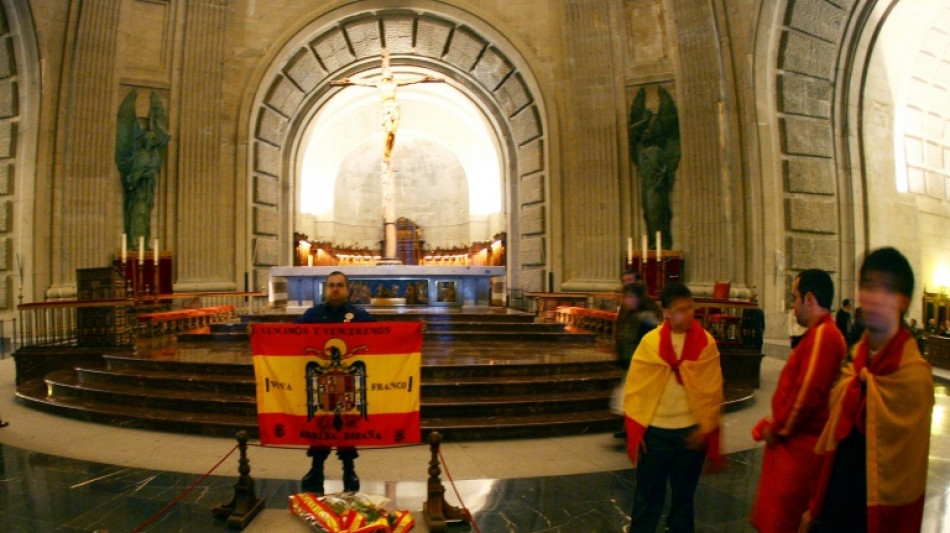
Spain exhumes remains of fascist party founder / Photo: PHILIPPE DESMAZES - AFP/File

 Flamengo secure 0-0 draw in La Plata in Copa Libertadores semi
 The final lap? Two days on the campaign trail with Trump
 Asian stocks rise as tech bounces from rout, eyes on Warsh
 Saudi organisers say 2027 Asian Cup 'on schedule' after attacks
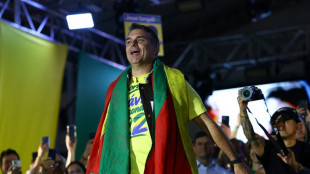 Right-wing Brazil influencers on 'mission' to seal Bolsonaro win
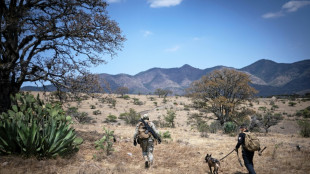 Using AI to help find Mexico's legions of missing children

 Fiji to deploy solar-powered Australian military drones at sea

 'Multiple victims' in Oregon elementary school shooting, police say

 'Multiple victims' in Oregon elementary school shooting: police
 ChangeNOW Announces NOW AI After Resolving Website Integration Vulnerability

 Argentine demonstration over education cuts ends in clashes
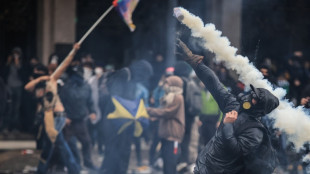 Argentine protesters, police clash at demo over university funding
 US stocks end higher as AI shares stabilize

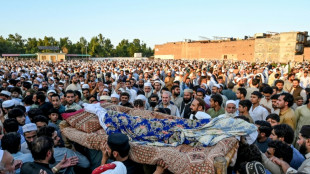 School roof collapse kills 32 children, teacher in Pakistan
 Lyon down Palace in Europa League, Sunderland leave it late

 UniCredit says receives ECB green light for Commerzbank takeover
 New York City pension fund asks Anthropic to delay IPO

 Venezuela's Maduro denies US torture charges as 'false accusations'

 Somalia sets May presidential election despite insecurity

 Chelsea's Caicedo eager to be more of a leader

 Rahm reaches separation deal with LIV in bankruptcy court
 UN chief urges nations to end 'war on nature'
 Newcastle boss Jaissle says Fernandez-Pardo just needs a goal

 Infantino offers apology but 'no answers' at FIFA meeting over World Cup plan
 Don't exclude Turkey from 'Made in Europe' plan: minister to AFP

Experts were on Monday exhuming the remains of the founder of Spain's fascist Falange party from a grandiose basilica, where the body of former dictator Francisco Franco once lay, ahead of their removal to a low-key family grave.
The operation comes six months after Spain passed the so-called democratic memory law which is designed to tackle the legacy of the 1936-39 civil war and the decades of dictatorship that followed.
Jose Antonio Primo de Rivera founded the Falange party in 1933, which became one of the pillars of Francisco Franco's brutal regime, along with the military and Spain's Roman Catholic Church.
Executed in November 1936 at the start of the war for conspiring against the elected Republican government, Primo de Rivera was in 1959 buried inside the basilica in the Valley of the Fallen, 50 kilometres (30 miles) northwest of Madrid.
By 0630 GMT, two black funeral cars could be seen outside the complex, with Spanish public television saying the operation had begun to exhume and transfer his remains to San Isidro cemetery in Madrid where he will be laid alongside other family members.
Under the new law, no figure linked to the 1936 military coup that triggered the civil war should be buried in "a prominent public place" that could encourage acts of homage or exultation.
Accordingly, the family agreed to have his remains be transferred to San Isidro, selecting April 24 as the date because it marks exactly 120 years since his birth.
The basilica where Primo de Rivera's remains lay for over six decades, is part of a vast hillside mausoleum built after the civil war by Franco's regime -- in part by the forced labour of 20,000 political prisoners.
When the dictator died in 1975, he was also buried there, in a tomb by the altar, close to Primo de Rivera's grave, with the site long being a draw for those nostalgic for the Franco era.
Cabinet minister Felix Bolanos said the operation "was another step" in the government's efforts to strip the mausoleum of its status as a symbol of Francoism and far-right ideology.
"It should not be possible to pay tribute to any person evoking the dictatorship," he said after the government announced the exhumation on Thursday.
Honouring those who died or suffered violence or repression during the civil war and dictatorship has been a top priority for the left-wing government of Prime Minister Pedro Sanchez, who came to power in 2018.
In 2019, his government relocated Franco's remains from the basilica following a lengthy legal battle with the dictator's family.
- A place of memory -
The basilica -- topped by a 150-metre (500-foot) stone cross -- and mausoleum also house the remains of more than 30,000 victims from both sides of the civil war.
It is a deeply divisive symbol of a past that Spain still finds difficult to digest.
The democratic memory law, which came into effect in October 2022, aims to turn the Valley of the Fallen into a place of memory for the dark years of the dictatorship.
It also promotes the search for the regime's victims who are buried in mass graves across Spain and annuls the criminal convictions of opponents of the Franco regime.
But the law has been politically divisive with right-wing parties saying it needlessly dredges up the past.
Santiago Abascal, leader of far-right Vox, accused the government of seeking to "once again desecrate tombs and dig up hatred" with Primo de Rivera's exhumation.
The move comes as Spain gears up for regional and local elections on May 28 and a year-end general election which polls suggest will be tight.
M.AlAhmad--SF-PST