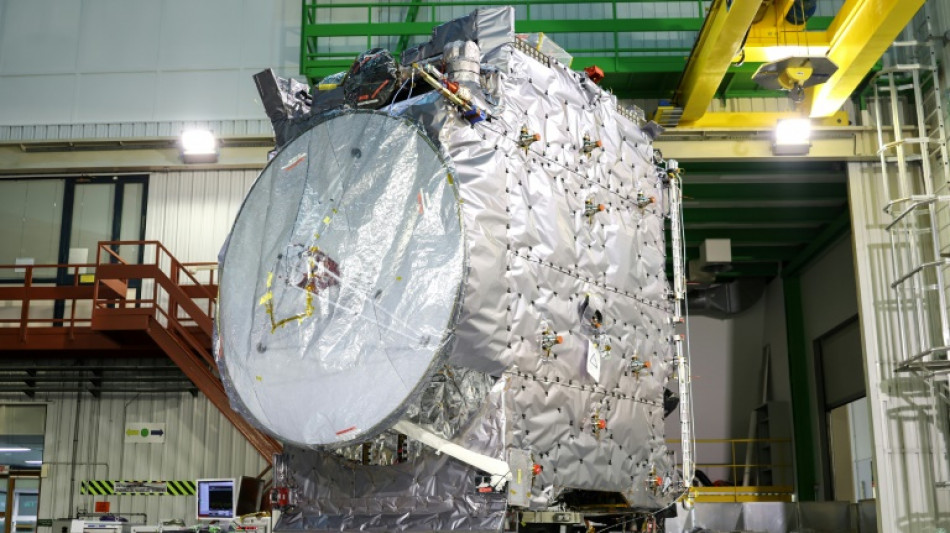
Europe's JUICE mission to launch for Jupiter's icy moons / Photo: Charly TRIBALLEAU - AFP/File

 Man Utd teetering towards crisis as Man City cloud hangs over Premier League

 Trump's new press secretary defends 'lawyer' title

 Wallabies coach has 'faith' as All Blacks juggernaut awaits

 Ailing UK director Mike Leigh wishes he could make '100 more films'

 Pixagram Announces Free Account Creation for 250 New Users Daily Through 2026

 Macron warns urgent to strike EU budget deal before French vote runup

 Zelensky rallies European allies as Trump ties slump

 Guardians edge Rays to seize MLB playoff series lead

 Trump scraps plan to livestream execution after fierce backlash

 Martinez apologises for outburst at Man Utd hierarchy

 Houthis launch deadly attack on presidential palace in Yemen's Aden

 Brazil forward Antony says home burgled during Betis match

 Ravens face familiar foe in Browns coach Monken

 France, Germany reach deal on future of car industry

 Carney campaigns for Canadian unity before Alberta secession vote

 ATP proposes rankings system changes, extra player bonuses

 Russell Brand was 'monster-like', alleged victim tells UK court

 Crowded Launches Crowded MCP, Bringing Nonprofit Financial Operations Into ChatGPT and Claude

 Albanian PM condemns 'chaos' as violent unrest spreads

 Italian football suffers new blow with Champions League misery

 Trump scraps plan to livestream execution after broad backlash
 Seven missing off Romania after latest Black Sea drone attacks

 ARKBRIDGE Outlines Jonathan Morelli’s “Picks and Shovels” AI Infrastructure Investment Strategy

 Tech sell-off rolls on as hot inflation data stokes rate worries

 McIlroy makes 'solid' start in rain-hit Delhi as Norgaard leads

The European Space Agency's JUICE spacecraft is to blast off Thursday on an eight-year journey through the Solar System to discover whether Jupiter's icy moons are capable of hosting extraterrestrial life in their vast, hidden oceans.
The JUpiter ICy Moons Explorer (JUICE) has received the green light for its scheduled launch on an Ariane 5 rocket from Europe's spaceport in Kourou, French Guiana at 1215 GMT.
"The weather conditions are good," Guiana Space Centre director Marie-Anne Clair said on Wednesday in the control room, where Belgium's King Philippe was among those in attendance.
The six-tonne spacecraft, which is roughly four square metres, will separate from the rocket at an altitude of 1,500 kilometres (930 miles) a little under half an hour after blast-off.
Then begins JUICE's long and winding path towards Jupiter, which is 628 million kilometres from Earth.
Because the spacecraft lacks the power to fly straight towards Jupiter, it will have to slingshot around other planets to get a gravitational boost.
First, it will do a fly-by of Earth and the Moon, then slingshot around Venus in 2025 before swinging past Earth again in 2029.
Then it will finally take off on its challenging journey towards the Solar System's largest planet.
- 'Are we alone in the universe?' -
The spacecraft is wrapped in 500 layered thermal insulation blankets to protect itself against temperatures expected to soar above 250 degrees Celsius (480 degrees Fahrenheit) as it flies past Venus, then plummet below minus 230C near Jupiter.
It has a record 85 square metres of solar panels, which stretch out to the size of a basketball court, to collect as much energy as possible near Jupiter, where sunlight is 25 times weaker than on Earth.
Once the probe arrives at Jupiter in 2031 -- now with two billion kilometres on the odometer -- it will need to very carefully hit the brakes to enter the orbit of the gas giant.
From there, JUICE will focus on Jupiter's system, including the gas giant and its three icy moons Europa, Ganymede and Callisto.
Its 10 scientific instruments -- including an optical camera, ice-penetrating radar, spectrometer and magnetometer -- will inspect and analyse the moons' weather, magnetic field, gravitational pull and other elements.
Carole Mundell, the ESA's science director, said the Jovian system had all the ingredients of a mini-solar system.
Studying the system will allow scientists to investigate how our Solar System formed -- and ultimately attempt to answer the age-old question "are we alone in the universe?" she said.
The mission will not be able to directly detect the existence of alien life, but instead aims to establish whether the moons have the right conditions to harbour life.
- Liquid water -
First discovered by astronomer Galileo Galilei more than 400 years ago, Jupiter's icy moons were long ignored as potential candidates for hosting life.
But previous space probes have suggested that deep below their icy shells, there are huge oceans of liquid water -- the main ingredient for life as we know it.
That has made Ganymede and Europa prime candidates in the search for life in our celestial backyard.
Europa will be investigated by NASA's Europa Clipper mission, which is scheduled to launch in October 2024.
JUICE, meanwhile, has set its sights on Ganymede, the Solar System's largest moon and the only one that has its own magnetic field, which protects it from radiation.
In 2034, JUICE will slide into Ganymede's orbit, the first time a spacecraft has done so around a moon other than our own.
ESA director-general Josef Aschbacher said the 1.6 billion-euro ($1.7 billion) JUICE is one of the "most complex" spacecraft ever sent into the outer Solar System beyond Mars.
The launch comes as Europe is struggling to find ways to blast its missions into space following Russia's withdrawal of its Soyuz rockets in response to sanctions over the war in Ukraine -- as well as repeated delays to the Ariane 6 launcher and the failure of Vega-C's first commercial flight.
Thursday will mark the penultimate launch for Ariane 5 before it is replaced by the next-generation Ariane 6.
Q.Bulbul--SF-PST