In Iraq, UN culture chief vows to help rebuild / Photo: AHMAD AL-RUBAYE - AFP

 Man Utd teetering towards crisis as Man City cloud hangs over Premier League
 Trump's new press secretary defends 'lawyer' title

 Wallabies coach has 'faith' as All Blacks juggernaut awaits

 Ailing UK director Mike Leigh wishes he could make '100 more films'

 Pixagram Announces Free Account Creation for 250 New Users Daily Through 2026
 Macron warns urgent to strike EU budget deal before French vote runup
 Zelensky rallies European allies as Trump ties slump

 Guardians edge Rays to seize MLB playoff series lead
 Trump scraps plan to livestream execution after fierce backlash

 Martinez apologises for outburst at Man Utd hierarchy

 Houthis launch deadly attack on presidential palace in Yemen's Aden

 Brazil forward Antony says home burgled during Betis match

 Ravens face familiar foe in Browns coach Monken
 France, Germany reach deal on future of car industry

 Carney campaigns for Canadian unity before Alberta secession vote

 ATP proposes rankings system changes, extra player bonuses
 Russell Brand was 'monster-like', alleged victim tells UK court

 Crowded Launches Crowded MCP, Bringing Nonprofit Financial Operations Into ChatGPT and Claude

 Albanian PM condemns 'chaos' as violent unrest spreads
 Italian football suffers new blow with Champions League misery

 Trump scraps plan to livestream execution after broad backlash

 Seven missing off Romania after latest Black Sea drone attacks

 ARKBRIDGE Outlines Jonathan Morelli’s “Picks and Shovels” AI Infrastructure Investment Strategy

 Tech sell-off rolls on as hot inflation data stokes rate worries
 McIlroy makes 'solid' start in rain-hit Delhi as Norgaard leads

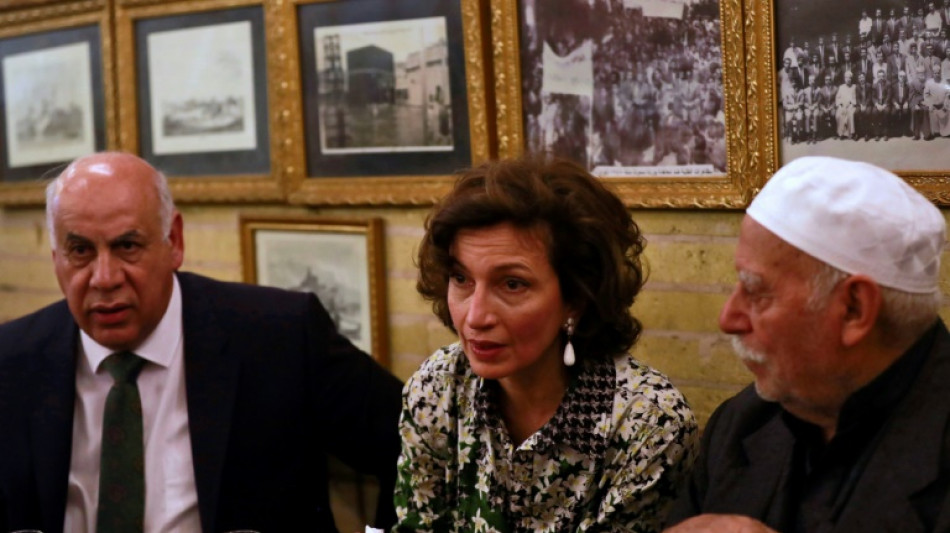
Wandering Baghdad's legendary book street, recently renovated, the UN's cultural chief pledged on Monday firm support for the rebuilding of Iraq, whose rich heritage has been ravaged by conflict.
Years of war and insurgency have taken a heavy toll on the many Mesopotamian, Islamic and Christian treasures in a country home to six UNESCO World Heritage sites.
Iraq is the cradle of civilisations, where writing and the first cities emerged, but decades of unrest have left many priceless cultural treasures damaged or obliterated.
"It's the culture, the education, that were deliberately destroyed, attacked, in a country with a thousands-year-old history," Audrey Azoulay, director-general of the United Nations Educational, Scientific and Cultural Organization, told AFP.
She spoke during a visit to Al-Mutanabbi Street, which has long drawn bibliophiles and is named after the celebrated 10th-century poet Abul Tayeb al-Mutanabbi.
The mission of Azoulay, a former culture minister in France, comes ahead of the 20th anniversary later this month of the US-led invasion which toppled Saddam Hussein but ushered in the bloodiest period in Iraqi history.
Antiquities have been extensively looted, often by organised crime groups, and many treasures were stolen from the national museum in the capital Baghdad.
More damage was done during the brutal rise of the Islamic State (IS) group a decade later and the battle to dislodge it which devastated large areas in the northern city of Mosul.
Even Al-Mutanabbi Street, a centre of intellectual life with its cafes and books, could not escape the pain. In March 2007 a suicide car bomb killed 30 people and wounded 60 others there.
Among the dead were sons of the Shabandar cafe owner, whom Azoulay sat with on Monday, accompanied by Iraq's culture minister, Ahmed Fakak al-Badrani.
- 'Like nowhere else' -
"These heartbreaks of war, of occupation by IS, deeply bruised Iraqi society," Azoulay said.
"Because of that, UNESCO is committed like nowhere else to mobilise the international community and act directly on the ground."
Since 2018 the agency has raised more than $150 million for projects in Iraq, mostly the reconstruction of Mosul. IS seized the metropolis as its stronghold before being pushed out in 2017, but the battle to retake it reduced the Old City to rubble.
Among the casualties was the 12th-century leaning minaret, nicknamed Al-Hadba, which is part of the UNESCO restoration effort.
"I am here to recover this cultural identity, to help Iraq rebuild, not only the walls, the heritage as we are doing in Mosul, but also all this intangible heritage, this richness linked to education, to know-how, that suffered so much," Azoulay said.
She is due to visit Mosul on Tuesday.
Azoulay also stopped at the national museum whose reopening, she told reporters, is a sign of hope and "allows many Iraqi families to reconnect with this long history".
But a reminder of the country's many challenges came when the power cut out at the end of her briefing, as it often does in the country whose electricity grid is dilapidated.
UNESCO has also declared natural heritage sites in Iraq, including the southern marshlands fed by the Euphrates and the Tigris rivers.
The vast wetlands have been put at severe risk, by draining under Saddam's regime and by climate change and upstream dam construction.
Because of its rivers and water sources, "this country was so fertile," said Azoulay, who met President Abdul Latif Rashid and Prime Minister Mohammed Shia al-Sudani.
She said she proposed to Iraqi authorities a UNESCO mission to see how it could assist in water management.
F.Qawasmeh--SF-PST