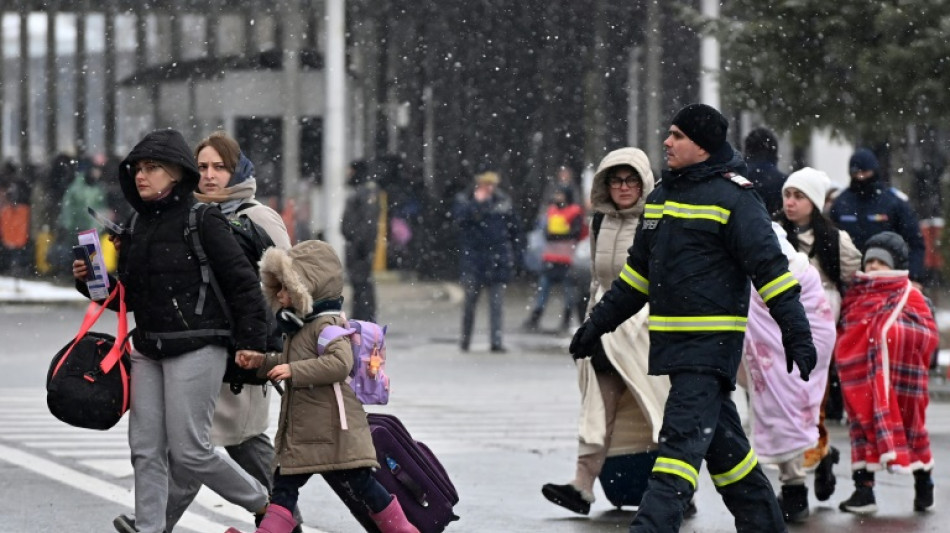
The precious rucksacks key to unlocking Ukrainian kids' war trauma / Photo: Daniel MIHAILESCU - AFP/File

 'Multiple victims' in Oregon elementary school shooting: police
 ChangeNOW Announces NOW AI After Resolving Website Integration Vulnerability

 Argentine demonstration over education cuts ends in clashes
 Argentine protesters, police clash at demo over university funding
 US stocks end higher as AI shares stabilize

 School roof collapse kills 32 children, teacher in Pakistan
 Lyon down Palace in Europa League, Sunderland leave it late

 UniCredit says receives ECB green light for Commerzbank takeover

 New York City pension fund asks Anthropic to delay IPO

 Venezuela's Maduro denies US torture charges as 'false accusations'

 Somalia sets May presidential election despite insecurity
 Chelsea's Caicedo eager to be more of a leader
 Rahm reaches separation deal with LIV in bankruptcy court
 UN chief urges nations to end 'war on nature'
 Newcastle boss Jaissle says Fernandez-Pardo just needs a goal

 Infantino offers apology but 'no answers' at FIFA meeting over World Cup plan
 Don't exclude Turkey from 'Made in Europe' plan: minister to AFP

 French duo Justice to score 'GTA VI': game maker
 El Nino a 'terrifying' threat to coral reefs: UN biodiversity expert
 Barcola must get used to Liverpool highs and lows, says Iraola
 Versus Trade Wins Best ECN/STP Broker APAC 2026, Marking Third UF Awards Recognition

 Three dead as Istanbul sees heaviest rainfall in 80 years
 US producer prices see biggest jump since 2022 in added challenge to Trump
 Swiatek avoids seed exodus to breeze into Wuhan last eight
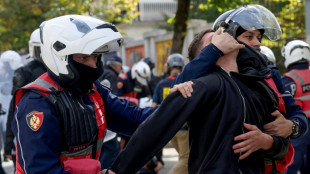 PM condemns 'chaos' as violent protests grip Albania

As refugees flooded over the Romanian border nearly a year ago, one thing struck British-Ukrainian volunteer Anna Shevchenko -- every child was carrying a little rucksack.
With Ukrainian kids now trying to rebuild their lives in new homes, the story of those rucksacks has become the focus of a project aimed at tackling their trauma.
Last February, after Russian President Vladimir Putin unleashed war in Ukraine, Shevchenko headed for Romania where she worked as a volunteer welcoming mothers and children who had fled the invasion.
"I noticed that every single child was holding a little rucksack as their prized possession, as everything they had from their old life," the business consultant and novelist told AFP in London.
Travelling back to the UK, Shevchenko had the idea of using those rucksacks as the focus of a therapy programme.
Within weeks, she had put together a network of mostly Ukrainian expats determined to help.
She also enlisted seasoned English children's author Di Redmond to write a story inspired by the notion that all the young refugees' memories were held in this one bag.
"It really got into my psyche and I more or less wrote the book in my sleep overnight," Redmond told AFP.
Redmond said that Ukrainian illustrator Lilia Martynyuk then produced a string of "moving and powerful" pictures, working from her basement in the frontline city of Zaporizhzhia.
Redmond, who has published nearly 200 books, normally makes children laugh with her prolific output, which includes scripts for television series such as "Postman Pat".
- Kids 'drink it in' -
In "Rucksack", however, she tells the heartbreaking story of a little boy who is forced to leave Ukraine but loses his bag along the way.
He retraces his steps with a friend to the bombed-out home he has just been forced to flee.
When he can't find the lost rucksack, he breaks down and his friend takes him to the nearest underground shelter in the Kyiv Metro.
There he is given a new rucksack, but this only makes him cry even more, "because it's got no memories", said Redmond.
He then begins the journey back to his new home and starts to build fresh memories he knows he will one day bring back to his home in Ukraine.
Dennis Ougrin, originally from Ukraine and now a consultant hospital psychiatrist in London, said the book chimed with important issues facing traumatised children.
"The key value of the book is that it allows the child and whoever cares for the child to begin to speak about what happened, often about something that's unspeakable," he said.
Ougrin and collaborators began taking the book into schools last September, using it alongside a programme developed by the charity Children and War UK.
Redmond was struck by the children's reaction. While the book made their parents weep, the kids would "really drink it in (and) turn the pages, very, very slowly".
Bill Yule, emeritus professor in child psychology at King's College London, said many parents were afraid that talking about the war would damage their children.
- 'Taboo topic' -
"The kids are very sensitive to the parents' reactions," noted Yule, who is working with Ougrin on the project.
"By them seeing the book... the parents can see that the kids aren't damaged by talking about it," he said.
The team has taken the book to UK schools that have served as hubs for Ukrainian refugees.
But other schools have requested help too, and it is also attracting interest in other countries hosting refugees.
At one event, Shevchenko said that as she read, she could see the English children turn to the Ukrainians and ask: "is this something you've experienced?".
"It was really heartwarming and most cathartic to see these English children give the Ukrainian children a hug," she said.
"The children beforehand were a bit uncomfortable to talk about it," she said.
"It was the same again with the teachers... they were worried about how to approach an almost taboo topic."
Some schools revealed that Ukrainian children had felt unwelcome due to their classmates' lack of awareness of their war experience.
But after reading the book, "we've seen the children holding hands and taking them (the Ukrainian children) to the library so they can read it and discuss it with the Ukrainian kids", Shevchenko said.
N.Awad--SF-PST