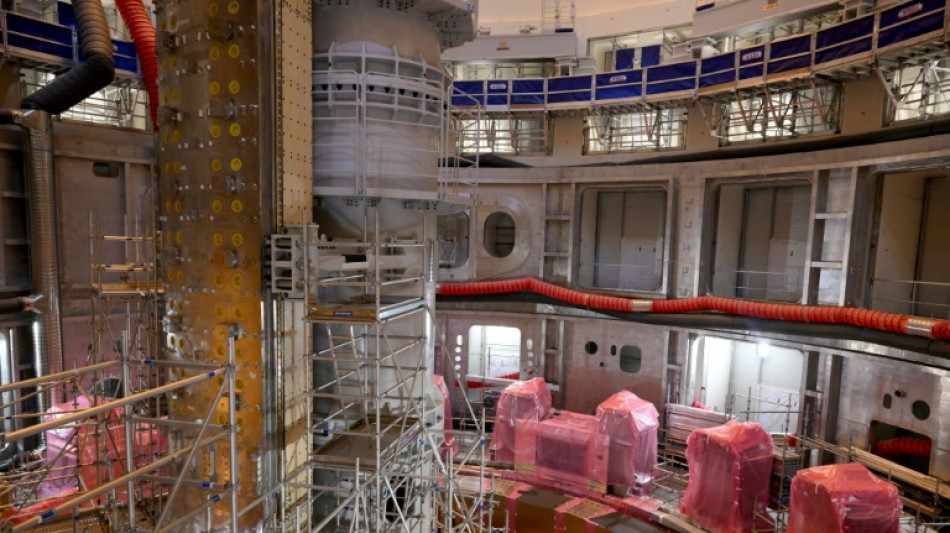
International fusion energy project faces delays, says chief / Photo: Nicolas TUCAT - AFP

 Macron warns urgent to strike EU budget deal before French vote runup

 Zelensky rallies European allies as Trump ties slump
 Guardians edge Rays to seize MLB playoff series lead

 Trump scraps plan to livestream execution after fierce backlash

 Martinez apologises for outburst at Man Utd hierarchy
 Houthis launch deadly attack on presidential palace in Yemen's Aden
 Brazil forward Antony says home burgled during Betis match
 Ravens face familiar foe in Browns coach Monken
 France, Germany reach deal on future of car industry

 Carney campaigns for Canadian unity before Alberta secession vote
 ATP proposes rankings system changes, extra player bonuses
 Russell Brand was 'monster-like', alleged victim tells UK court

 Crowded Launches Crowded MCP, Bringing Nonprofit Financial Operations Into ChatGPT and Claude
 Albanian PM condemns 'chaos' as violent unrest spreads
 Italian football suffers new blow with Champions League misery

 Trump scraps plan to livestream execution after broad backlash
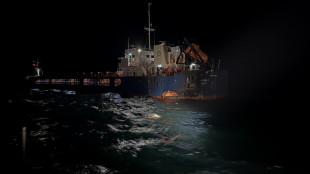 Seven missing off Romania after latest Black Sea drone attacks

 ARKBRIDGE Outlines Jonathan Morelli’s “Picks and Shovels” AI Infrastructure Investment Strategy

 Tech sell-off rolls on as hot inflation data stokes rate worries

 McIlroy makes 'solid' start in rain-hit Delhi as Norgaard leads

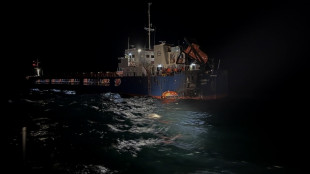 Seven missing after fire on vessel in Black Sea off Romania

 'Severe drought' declared in parts of UK
 IUX Announces New Web Client Portal Built for Enhanced Browser-Based Trading
 School roof collapse kills teacher, 32 children in NW Pakistan

 Inter skipper Martinez facing month out with thigh injury

An international project in nuclear fusion may face "years" of delays, its boss has told AFP, weeks after scientists in the United States announced a breakthrough in their own quest for the coveted goal.
The International Thermonuclear Experimental Reactor (ITER) project seeks to prove the feasibility of fusion as a large-scale and carbon-free source of energy.
Installed at a site in southern France, the decades-old initiative has a long history of technical challenges and cost overruns.
Fusion entails forcing together the nuclei of light atomic elements in a super-heated plasma, held by powerful magnetic forces in a doughnut-shaped chamber called a tokamak.
The idea is that fusing the particles together from isotopes of hydrogen -- which can be extracted from seawater -- will create a safer and almost inexhaustible form of energy compared with splitting atoms from uranium or plutonium.
ITER'S previously-stated goal was to create the plasma by 2025.
But that deadline will have to be postponed, Pietro Barabaschi -- who in September became the project's director-general -- told AFP during a visit to the facility.
The date "wasn't realistic in the first place," even before two major problems surfaced, Barabaschi said.
One problem, he said, was wrong sizes for the joints of blocks to be welded together for the installation's 19-by-11-metre (62-by-36-feet) chamber.
The second was traces of corrosion in a thermal shield designed to protect the outside world from the enormous heat created during nuclear fusion.
Fixing the problems "is not a question of weeks, but months, even years," Barabaschi said.
A new timetable is to be worked out by the end of this year, he said, including some modification to contain the expected cost overrun, and to meet the French nuclear safety agency's security requirements.
Barabaschi said he hoped ITER would be able to make up for the delays as it prepares to enter the full phase, currently scheduled for 2035.
On December 13, US researchers working separately from ITER announced an important technical breakthrough.
Scientists at the Lawrence Livermore National Laboratory (LLNL) in California said they had used the world's largest laser to create, for the first time, a fusion reaction generating more energy than it took to produce.
"Some competition is healthy in any environment," Barabaschi said about the success.
"If tomorrow somebody found another breakthrough that would make my work redundant, I would be very happy," he added.
ITER was set in motion after a 1985 summit between US president Ronald Reagan and Soviet leader Mikhail Gorbachev.
Its seven partners are China, the European Union, India, Japan, South Korea, Russia and the United States.
Russia still participates in ITER despite the start of the Ukraine conflict.
In November it dispatched one of six giant magnets needed for the top part of the tokamak.
Y.AlMasri--SF-PST