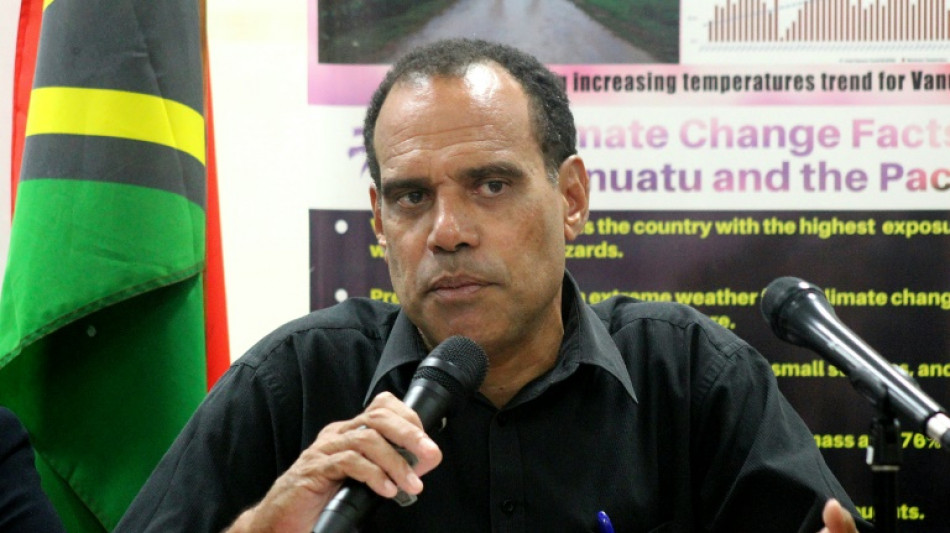
Climate 'tragedy': Vanuatu to relocate 'dozens' of villages / Photo: Hilaire Bule - AFP

 Macron warns urgent to strike EU budget deal before French vote runup

 Zelensky rallies European allies as Trump ties slump

 Guardians edge Rays to seize MLB playoff series lead
 Trump scraps plan to livestream execution after fierce backlash

 Martinez apologises for outburst at Man Utd hierarchy

 Houthis launch deadly attack on presidential palace in Yemen's Aden

 Brazil forward Antony says home burgled during Betis match
 Ravens face familiar foe in Browns coach Monken

 France, Germany reach deal on future of car industry

 Carney campaigns for Canadian unity before Alberta secession vote

 ATP proposes rankings system changes, extra player bonuses

 Russell Brand was 'monster-like', alleged victim tells UK court

 Crowded Launches Crowded MCP, Bringing Nonprofit Financial Operations Into ChatGPT and Claude

 Albanian PM condemns 'chaos' as violent unrest spreads

 Italian football suffers new blow with Champions League misery

 Trump scraps plan to livestream execution after broad backlash
 Seven missing off Romania after latest Black Sea drone attacks

 ARKBRIDGE Outlines Jonathan Morelli’s “Picks and Shovels” AI Infrastructure Investment Strategy

 Tech sell-off rolls on as hot inflation data stokes rate worries
 McIlroy makes 'solid' start in rain-hit Delhi as Norgaard leads

 Seven missing after fire on vessel in Black Sea off Romania

 'Severe drought' declared in parts of UK
 IUX Announces New Web Client Portal Built for Enhanced Browser-Based Trading

 School roof collapse kills teacher, 32 children in NW Pakistan

 Inter skipper Martinez facing month out with thigh injury

Vanuatu is drawing up plans to relocate "dozens" of villages within the next two years, as they come under threat from rising seas, the Pacific nation's climate chief told AFP Thursday.
Climate Change Minister Ralph Regenvanu said dealing with the impact of global warming was a major challenge facing Vanuatu's 300,000 inhabitants who live on a chain of islands strung out between Australia and Fiji.
Regenvanu said the response would inevitably involve relocating long-established communities from coastal areas, where climate change is pushing sea levels higher and fuelling more extreme storms.
He said Vanuatu's government has identified "dozens" of villages in "at-risk areas" to be relocated "within the next 24 months" while other settlements have also been earmarked to move in the longer term.
"Climate displacement of populations is the main feature of our future. We have to be ready for it and plan for it now," said Regenvanu, who took over his ministerial portfolio after a snap election in October.
"It's going to be a huge challenge and a huge tragedy for many people who would have to leave their ancestral land to move to other places, but that's the reality."
Low-lying Pacific island nations, like Vanuatu, are already experiencing the impact of climate change.
Half of Vanuatu's population was affected when Cyclone Pam battered the capital Port Vila in 2015, killing a dozen people, destroying crops and leaving thousands homeless.
Vanuatu is ranked as one of the countries most susceptible to natural disasters like earthquakes, storm damage, flooding and tsunamis, according to the annual World Risk Report.
Other Pacific nations are also looking to move under-threat communities, including Fiji where dozens of villages have been earmarked for relocation owing to the impacts of the climate crisis.
Scientists predict sea levels in the Pacific will rise between 25–58 centimetres (9-22 inches) by the middle of the century.
That is a devastating prospect for Vanuatu, where around 60 percent of the population live within a kilometre of the coast.
- 'All sorts of threats' -
Regenvanu wants coastal defences strengthened.
"Our greatest challenge right now on Vanuatu is basically keeping our populations safe," he said.
"We're finding more and more that our people are subject to all sorts of threats from volcanoes, flooding, cyclones and so on.
"So we have to engage now in moving populations and building resilient infrastructure so that our people are safer in the coming years."
Vanuatu already has experience of moving its people.
In 2005, it was one of the first Pacific nations to move an entire community on the northern island of Tegua from a flood-prone coastal area to higher ground.
And in 2017, all 11,000 people living on Ambae, an island in the country’s north, were ferried by a rag-tag armada of boats to other isles after the Manaro Voui volcano erupted, raining down rock and ash on villagers.
In May, Vanuatu's parliament declared a climate change emergency and its government is seeking to speed up global action by leading efforts to take the matter to the Hague-based International Court of Justice.
Regenvanu attended the UN's COP27 summit in Sharm el-Sheikh last month, where a landmark deal was struck to help vulnerable countries cope with climate change by providing a "loss and damage" fund.
The nations attending COP27 repeated a commitment to limit global warming to 1.5 degrees Celsius (34.7 degrees Fahrenheit) from pre-industrial levels, but Regenvanu said the pledges did not go far enough.
"Basically, there's not enough commitment to reducing emissions," he said.
"And so we're going to see temperatures increase beyond 1.5 degrees which we know will be disastrous for the Pacific -- we have to focus on adaptation and particularly loss and damage."
D.Qudsi--SF-PST