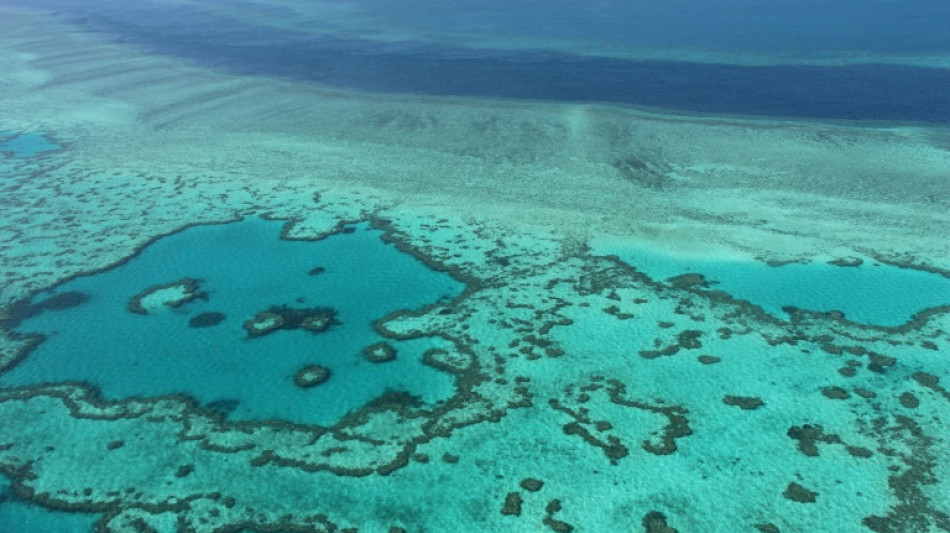
Australia falls short in Great Barrier Reef efforts: experts / Photo: SARAH LAI, SARAH LAI - AFP/File

 Lyon down Palace in Europa League, Sunderland leave it late

 UniCredit says receives ECB green light for Commerzbank takeover

 New York City pension fund asks Anthropic to delay IPO

 Venezuela's Maduro denies US torture charges as 'false accusations'

 Somalia sets May presidential election despite insecurity

 Chelsea's Caicedo eager to be more of a leader

 Rahm reaches separation deal with LIV in bankruptcy court

 UN chief urges nations to end 'war on nature'

 Newcastle boss Jaissle says Fernandez-Pardo just needs a goal

 Infantino offers apology but 'no answers' at FIFA meeting over World Cup plan

 Don't exclude Turkey from 'Made in Europe' plan: minister to AFP

 French duo Justice to score 'GTA VI': game maker

 El Nino a 'terrifying' threat to coral reefs: UN biodiversity expert

 Barcola must get used to Liverpool highs and lows, says Iraola

 Versus Trade Wins Best ECN/STP Broker APAC 2026, Marking Third UF Awards Recognition

 Three dead as Istanbul sees heaviest rainfall in 80 years

 US producer prices see biggest jump since 2022 in added challenge to Trump

 Swiatek avoids seed exodus to breeze into Wuhan last eight
 PM condemns 'chaos' as violent protests grip Albania

 'I couldn't breathe', Russell Brand's alleged rape victim says

 Pope's cancer operation already reshaping papacy

 Zverev cruises past De Minaur to reach Shanghai semi-finals

 Ukraine's Zelensky defies Trump with Russian refinery strikes

 Holders Australia edge New Zealand 24-22 to open Rugby league World Cup

 'Ocarina of Time': Nintendo gives Zelda classic a modern makeover

Despite warnings, Australia's efforts to save the Great Barrier Reef still fall short of protecting the world's largest coral reef system from pollution and climate change, experts said Monday.
Australia had taken unprecedented steps towards the protection of the Great Barrier Reef, which the United Nations has designated a world heritage site, but more was needed to avoid the site being declared "in danger" by UNESCO, the UN agency which compiles and manages a list of heritage sites.
Such a designation puts a government on notice that a site could be removed from the World Heritage list altogether, a very rare event.
"Despite the unparalleled science and management efforts" made by Australia over recent years, the Great Barrier Reef is "significantly impacted by climate change factors", Eleanor Carter at the International Union for Conservation of Nature (IUCN) and UNESCO representative Hans Thulstrup said in a report based on a mission to the Reef.
"The resilience of the property to recover from climate change impacts is substantially compromised," they said.
Carter and Thulstrup recommended that the reef should be added to the "World Heritage in Danger" list.
The Australian government in January announced a billion-dollar package to protect the reef, seven years after its "Reef 2050" plan, already a response to a UN downgrade threat.
The Climate Council pressure group said this latest package of funding was like putting "a Band-Aid on a broken leg".
Monday's report echoed that assessment, saying the reef's ability to recover from climate change impacts was "substantially compromised".
In particular, Australian strategies were "lacking clear climate change targets", while some measures were not fully implemented, especially concerning "water quality and fisheries activities", it said.
Australia reported in May that 91 percent of the reef's coral had been damaged by bleaching after a prolonged summer heatwave, a process that increases the mortality rates of the affected corals.
After intense lobbying, Australia narrowly avoided the Reef being placed on UNESCO's "in danger" list in the summer of 2021.
The then-government of conservative prime minister Scott Morrison was voted out this year in favour of a centre-left government under Anthony Albanese who has promised greener policies.
A UNESCO spokesperson told AFP that "a constructive dialogue is ongoing with the current government".
A source close to the matter called Monday's report "a roadmap submitted to the Australian government which should say what it intends to do with it and produce results".
The source added: "The path to saving the Great Barrier Reef is narrow, but it exists. Strong and rapid action can produce results.".
To be included on UNESCO's world heritage list, a site must have "outstanding universal value".
An spot on the list usually means boosted tourism, and improved access to funds and to scientific expertise.
Those benefits are threatened when a site is declared "in danger" -- which is currently the case of about 50 sites worldwide.
Only three sites have ever been dropped from the heritage list completely.
N.Shalabi--SF-PST