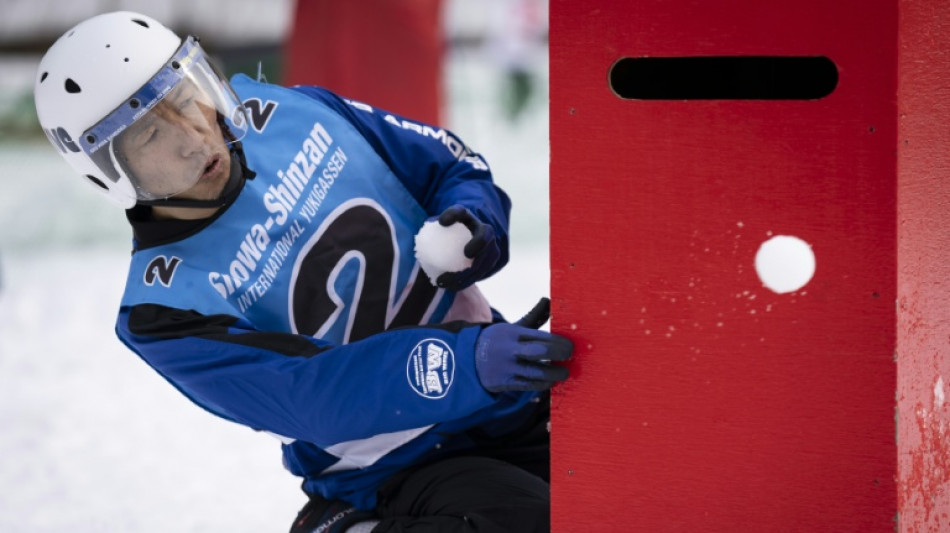
The Japanese snowball fight game vying to be an Olympic sport / Photo: Yuichi YAMAZAKI - AFP

 St. Louis City's unbeaten MLS run ends at 19, Union's reaches 15

 NFL Eagles bench Hurts at least a month with blood clot

 Across US, 'No Kings' events seek to boost early voting

 Tents spring up in Lisbon as Portugal housing protests spread

 'Best in world' Yamal powers Barca to Betis rout, Atletico strike late

 El Salvador's Bukele puts conditions on early release of gang prisoners

 Fire rages at town hall in France's Limoges after protests: authorities

 Unstoppable Barca thrash Betis to extend perfect start

 Maresca faces anxious wait over Haaland injury scare

 PSG fight back to beat Strasbourg after Dembele penalty miss

 Looting, blazes and clashes in France amid nationwide protests

 Walsh breaks her own 50 free world short course record

 Haaland brace extends Man City's winning start in Premier League

 'Special' Ombudsman storms to victory in Champion Stakes

 Brazil's right embraces election betting odds amid polls skepticism
 Four more Ebola cases detected in Kenya, bringing total to seven

 Clashes erupt in France as protesters vow to make government 'tremble'

 Chwalinska downs Swiatek to set up Wuhan final with world number 170 Kartal

 Chacarra takes lead as McIlroy falls away in Delhi

 Neto double gives Chelsea win marred by Martinez injury

 'Cockroach' party founder released from Indian police custody

 Nepal floods 'defining moment' for climate action: UN

 Albanian capital sees fifth straight day of violent clashes

 Leaders weigh 'huge benefit', risks of AI for global economy
 Zverev stunned by Davidovich Fokina in Shanghai semi-finals

At the foot of an active volcano in northern Japan, shouts ring out, competitors size each other up and snowballs whistle through the air in a very serious game of "yukigassen" -- a sport with Olympic dreams.
The competition taking place this weekend is held every year in Sobetsu, a town on the main northern island of Hokkaido, where this game -- essentially a snowball fight -- became a sport 37 years ago.
On the field, brute strength isn't enough. Japan's yukigassen federation emphasises the "mental challenge" posed by the game, in which players on both teams pelt their opponents while taking cover behind shelters.
The goal: hit all seven players on the opposing team using perfectly spherical snowballs made with a special machine, or capture their flag.
"When you get hit, it hurts, but it's mostly your pride that takes the blow," said Toshihiro Takahashi, a 48-year-old civil servant dripping with sweat after his match.
The idea of turning yukigassen into a sport was born out of a crisis in Sobetsu.
While visitors once flocked to the town to enjoy its hot springs, the eruption of Mount Usu in 1977 brought tourism in the area to an abrupt halt.
Residents, looking for ways to put their town back on the map, had a flash of inspiration when they saw a group of tourists having fun during a snowball fight and thought: what if this children's game could save the town?
"It's a primitive sport, almost instinctive for human beings," Yuji Ano, president of the tournament's organising committee, told AFP.
"Our ancestors were surely doing the same thing. It's the oldest winter sport in human history: long before skating or skiing, humans were already throwing snowballs at each other. That's its biggest appeal."
All that remained was to put rules down on paper, develop special helmets and invent a machine to mould the snowballs.
Yukigassen -- which means snowball fight in Japanese -- was born, and the first international tournament took place in 1989.
- From snow to beach -
The sport spread to Australia three years later, then to Finland, which set up a national federation in 1995.
After that it caught on elsewhere in Scandinavia, as well as in Russia and North America, and is now played in 13 countries, according to Ano.
Keen to capitalise on the international expansion, officials want to turn yukigassen into an Olympic sport.
Ano noted that there are very few team sports at this year's Milan-Cortina Winter Olympics, which are wrapping up on Sunday.
This year, more than a thousand players came to compete in Sobetsu, but not a single foreign team is among the 118 entrants.
Atasu, a 55-year-old who has been playing yukigassen for over thirty years and chose to give only his nickname, admitted it had become very challenging to recruit players.
"The (Japanese) population is shrinking, and there are also fewer people playing. We have to promote yukigassen and try to attract people," he said.
"That's the hardest thing right now."
To boost the number of registered players and try to win over the International Olympic Committee, the sport has, paradoxically, had to step away from snow.
Artificial balls have been developed so it can be played in gyms or on the beach, turning a seasonal battle into a global sport playable year-round.
But Ano warned another major problem stands in the way of the Olympic dream: complex officiating that makes it difficult to train new referees.
"Eight referees watch each match, where 180 snowballs can be flying" during a three-minute set, he explained.
"Judging accurately is almost impossible. As long as we haven't solved that issue, it will be difficult" to stake a claim for the Olympics.
K.AbuDahab--SF-PST