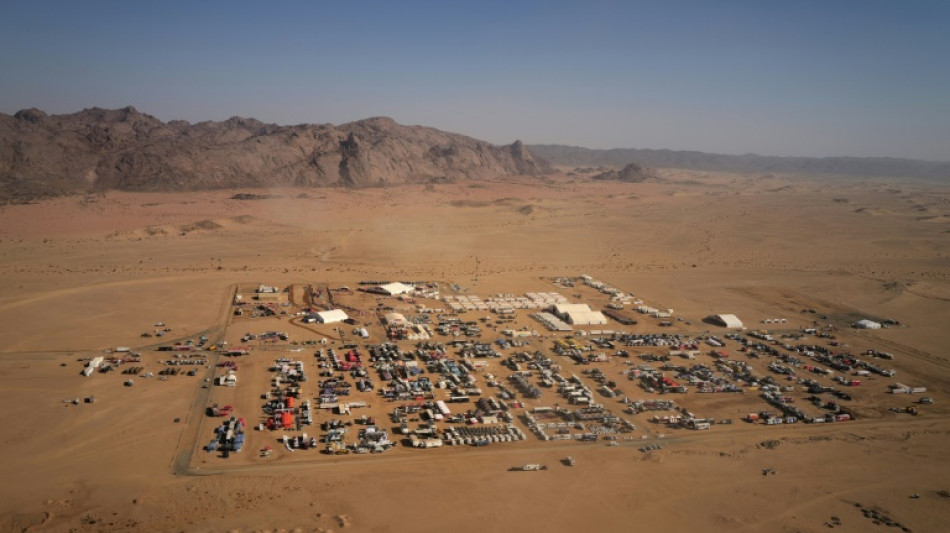
The nomadic mini-city behind the Dakar Rally / Photo: Valery HACHE - AFP

 Fury hits out at 'coward' Joshua as 'Battle of Britain' talks go on
 Maltese tycoon acquitted of masterminding reporter's murder

 George Clooney: a Hollywood icon and campaigner

 Europe, US closer than they look on tech rules, says EU tech chief
 Clooney honoured as Hollywood-light Venice Film Festival kicks off

 Third-ranked Pegula, Medvedev power into US Open third round

 Davis-Woodhall a doubt for Ultimate Championship after car crash

 Third-ranked Pegula powers into US Open third round

 Uber says laying off 'about 10%' of workforce worldwide

 US judge rejects bid to break up Google's ad business
 Rupert Murdoch 'very happy' to be played by Guy Pearce in new film

 Wall Street stocks rise despite bond yields, oil rising
 Brennan claims third Vuelta victory in stage 11 sprint

 Nepal flood survivors cling to zipline to cross treacherous river

 US Treasury issues $1 coin with Trump's face on it
 Fernandez 'didn't hesitate' over record Man City move
 Dutch shift 86 tonnes of gold from US, Canada to UK

 Nepal floods should mobilise climate action: UN green fund chief
 Nvidia boss presses G20 ministers to build AI infrastructure

 Liminal Launches Liminal Prime for Institutional OTC and Stablecoin Liquidity

 10 missing as cargo ship sinks after collision off Istanbul
 30 years on, 'Tomb Raider' reboot sees Lara Croft through a 'modern lens'

 King Charles, Macron to view Bayeux Tapestry as French leader starts UK visit
 George Clooney says US run by 'least qualified people'

 China's Xi urges against Mideast interference in rare Egypt visit
Television loves the Dakar Rally with its crisp, dramatic images of cars, motorbikes and trucks ploughing through the blood-red sands and dunes of Saudi Arabia.
But television doesn't show the whole picture, veering its lens away from the camp of 3,500 people, six planes, 11 helicopters, 100 trucks and 70 buses - the gigantic logistical machine that moves a mini-city in the desert from stage to stage and keeps the show, figuratively, on the road.
Set up under tight security on a 25-hectare (250,000 square metre) sand plain in the Bisha region in the south-west of the country, the Dakar start bivouac was in full swing in these early days of the 2025 edition.
Night and day, generators chunter away next to white tarpaulin structures as large as aircraft hangars. Trucks fill the cisterns of the 200 or so toilets and showers, while others sprinkle water on the roads to settle the dust raised by the constant stream of vehicles.
Roaring sandstorms whip up around the sea of small camping tents, in which most of the inhabitants of this itinerant community sleep. No five-star hotels here.
The tent that makes up the canteen is a massive 1,600 square metres and sits next to a games arcade, sports fields, two shops and a stage with a giant screen.
It's a whole self-contained little world far from the cities which has to be transported throughout the 12 stages.
"The basic mission of logistics is to put in place the people and resources so that each service, customer and competitor can operate and experience their event in the best possible conditions," Guillaume Kleszcz, logistics director for the ASO organisation, told AFP.
On each Dakar, the organisers have to provide around 10 bivouacs like this one, which follow the competitors as they make their way across the Arabian Peninsula, where the competition has pitched its tent since 2020.
Almost every day, a new mini-city will have to be created from scratch in the midst of sand and stones.
- In duplicate -
"Each site takes around 10 days to set up," says Arnaud Calestroupat, Dakar logistics manager. "First we level the ground, then we install the structures, the electrics."
As far as possible, the logisticians duplicate what they can to get as far ahead as possible in the assembly.
For example, there are two copies of the race control centre. The one used in bivouac 1 goes directly to bivouac 3 with the one in bivouac 2 sent in advance to bivouac 4, and so on.
Similarly, the catering tent, which will serve up in the region of 100,000 meals over the duration of the rally, will be available in four different versions, which will alternate with each other.
Thanks to these rotations, the organisers are almost two bivouacs ahead of the race.
Each area is structured in the same way.
"In the centre is the technical area, which is the work area," says Calestroupat.
"Opposite is the living area, which is accessible to everyone, where everyone can meet and get together. And around these two large areas will be all the paddocks."
The paddock is where the teams have their living quarters.
Not everything can be cloned, however, starting with the people.
At each change of bivouac, 500 people, including organisers, press and teams, are moved at dawn by specially chartered planes so that they can be at the finish point, several hundred kilometres away, even before the start of the race.
As for the television production team, they must have finished their work by early evening to pack up the equipment and transport it overnight by lorry to the next location.
There, it is immediately re-installed so that it is ready to go again when the cars and bikes start the next morning.
This gigantic scale requires an army of men and women: out of the 3,500 people usually accommodated at a bivouac, the organisation and the various service providers account for some 800 to 900 people.
But none of this will be seen on television which will focus instead on the men and women bravely throwing their vehicles across the dunes in a bid to win the rally.
And no one would have it any other way.
U.AlSharif--SF-PST