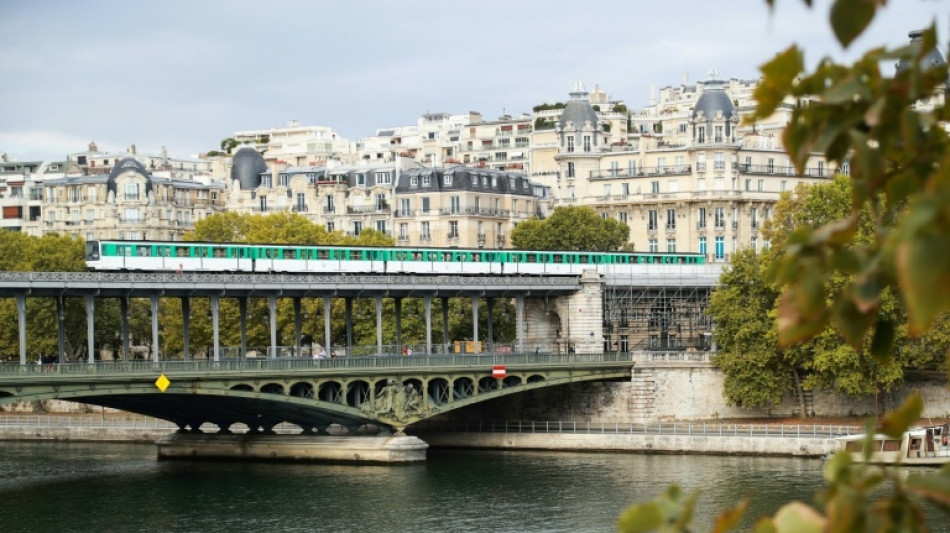
Creaking Paris metro system to face Olympic test / Photo: JACQUES DEMARTHON - AFP

 Amorim's Milan beaten by Benfica, Sunderland make dream European return

 US stocks fall, dollar gains after Fed lifts interest rates
 Seahawks rule out Darnold for Sunday game at Arizona
 Mbappe explains Ceuta shirt stance after criticism

 Improving Atletico cruise to comfortable win over Osasuna

 Candidate for UN chief calls for AI regulation akin to nuclear weapons

 O'Neill expects Celtic recovery after Old Firm misery

 Man City midfield trio backed to emulate Rodri and Silva

 'We're losing control,' AI pioneer Yoshua Bengio tells AFP
 WHO eyes 'encouraging' signs in DRCongo fight against Ebola
 Liga boss criticises Real Madrid trio for Ceuta shirt incident
 WTA Finals moved to Charlotte from 2027

 Almost 8,000 excess deaths in France's scorched summer: statistics

 Ex-president's lengthy war crimes sentence shocks Kosovo

 US House faces test on sweeping Russia sanctions bill

 British PM says to make 'difficult decisions' as inflation rises

 TotalEnergies pumps up controversy in France with cut-price gas
 Global fuel price demos: a round-up

 Leverate Launches MCP for Traders to Connect AI Assistants With Trading Platforms

 MEXC Launches $1M "Discover Your Wall Street DNA" Campaign to Help Traders Find Their Market Fit

 Emporio Armani names Dario Vitale new creative director

 Maresca defends VAR officials after Man City benefit from error

 Courts jails LGBTQ activists as Turkey crackdown widens
 French court to hear Depardieu's appeal against rape trial order: sources

 The German state premier hoping to halt far-right surge
Long the envy of other cities, Paris' creaking underground metro system has become a subject of daily frustration for users just as the French capital gears up to host this year's Olympics.
"It's really difficult and we're not even at the Olympics yet when there'll be millions of people on it," Juliette Fayaud, a 26-year-old restaurant worker, told AFP on the platform of the Line 8.
"There aren't enough trains. Sometimes in rush hour there's a train every five minutes when you need them every two or three," she said.
User satisfaction has plunged since the Covid-19 pandemic in 2020 when the RATP, which runs the capital's transport system, cut services as workers stayed home en masse.
Many metro employees were furloughed and never returned to jobs, while the training of new staff to replace them slowed significantly.
"I think it'll be horrible during the Olympics," 22-year-old saleswoman Gabrielle Camus, another daily user, told AFP as she waited for a train. "I'm planning to use a bike and avoid the metro as much as possible."
Around one in five trains ran late on some metro lines in Paris last year, according to public data, with users sometimes facing waits of up to 10 or 15 minutes during the day on the worst-performing lines.
Commuters on the larger overground trains, which run on so-called RER lines, were offered refunds in 2023 for the third consecutive year due to punctuality problems. The service is still not back to pre-Covid levels.
With around seven million visitors expected in Paris during the Olympics from July 26 to August 11, the commuter train system will be under severe scrutiny as one of the main forms of transport for tourists and locals alike.
- 'Under-investment' -
Major political pressure ahead of the Games -- and the appointment of former prime minister Jean Castex as head of the RATP in 2022 -- has led to gradual improvements in recent months, according to surveys by the capital's transport authority.
Castex warned in December that eight out of ten lines were "no longer in a state to provide a quality public service" which he blamed on "40 years of under-investment".
But thanks in part to a major staff recruitment drive, all lines -- with the exception of the 3, the 8 and the RER C -- reached the minimum performance standard of 90 percent punctuality in March, according to the latest data.
Workers are also racing to complete key line extensions ahead of the Olympics, notably to connect the southern Orly airport to the line 14 and a new transport node near the Stade de France, which will host athletics, in the north.
"It's a challenge that we are able to meet," the head of the greater Paris region, Valerie Pecresse, told reporters as she presented her transport plans for the Olympics in late March.
Some metro or RER lines, particularly those serving the football, tennis or athletics stadiums, will have up to 71 percent more trains than a usual summer's day.
The challenge is not so much the volume of travellers -- overall traffic is expected to be no higher than a normal working day -- but it is the peaks in demand as fans enter and leave stadiums.
"You shouldn't be scared to do a bit of walking," Pecresse told Parisians. "It's good for your health."
- 'Key issue' -
In a city that has been gradually squeezing out cars, Paris is also keen to show off its recent cycling revolution.
Each Olympic sports venue will be accessible on bike, with around 415 kilometres (258 miles) of new cycle lanes built ahead of the Games as well as 20,000 cycle parking spots.
There will be no parking provision for cars at sports venues, however, and traffic jams in the capital are expected to be worse than usual due to road closures.
Chief organiser Tony Estanguet sounded confident last week that the city's trains, buses, trams and cycle lanes could handle the strain.
"It's a key issue for the smooth organisation and success of our event. We're well aware of that," he told reporters.
Paris's two main airports - Charles de Gaulle and Orly -- are also gearing up for key roles and have installed 15 new baggage inspection lines between them.
"The infrastructure is ready," the director general of their operating company said recently.
Traffic is expected to be similar to summer averages of 300,000 arrivals per day, but with a major spike in demand in the days after the closing ceremony on August 11.
S.Abdullah--SF-PST