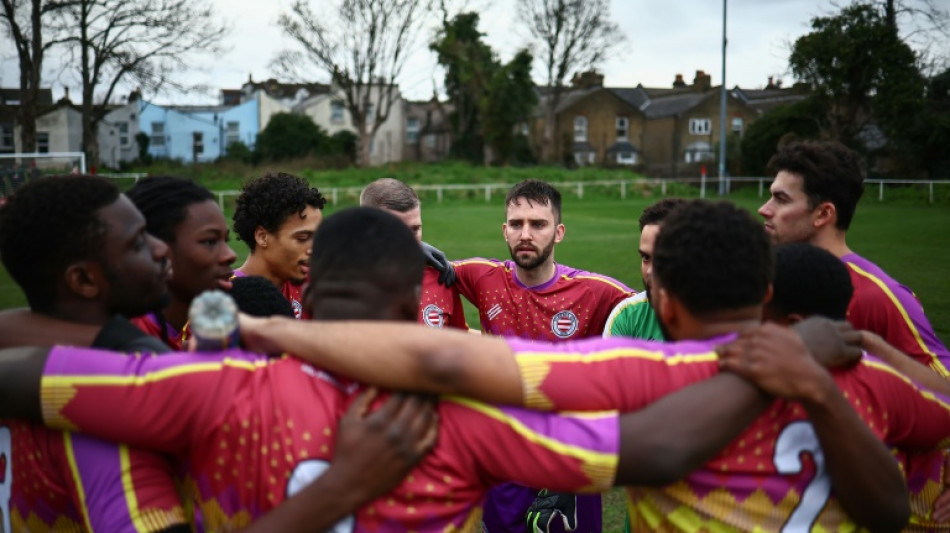
English football team's jerseys weave anti-fascism with history / Photo: HENRY NICHOLLS - AFP/File

 Trump names Stephen Miller as White House chief of staff after midterm losses

 Restored Albanian tower houses anchor new rural tourism trail

 Sonia Gandhi reflects on family tragedy and reluctant political career

 Pope Leo begins three-country South American tour in Uruguay
 Khawaja says entire Australia camp knew of 2018 ball-tampering plan

 الميزانية الكندية تقترح رفع سقف التأمين على الرهون العقارية إلى 1.5 مليون دولار

 German Auto Giants Face Existential Crisis as China Sales Plummet

 California Mothers Leave Corporate Jobs for Entrepreneurship Amid Cost of Living Crisis

Two children in red, yellow and violet shirts ran along the perimeter of one of the oldest football pitches in London, cheering on their team.
The pair were too young to understand the historical significance of non-league Clapton CFC's vibrant attire, but their parents, seated in the stands, their eyes fixed on the game, knew all too well.
The east London club, established in 2018, designed the shirt as a tribute to the Second Spanish Republic and the International Brigades of volunteers who fought the Nazi Germany-backed Nationalists in the Spanish Civil War in the 1930s.
As support for right-wing movements has increased across Europe, the shirts have become a symbol of the club's left-leaning ideals and opposition to fascism, racism, homophobia and misogyny.
At the Clapton CFC ground, known as "The Old Spotted Dog", fans watching their team take on Hutton FC in the Eastern Counties Football League Division One South wore scarves bearing the phrase "Antifascist".
"Wearing this shirt is a way to show respect for them," one supporter told AFP, referring to those who joined the Spanish Civil War after an attempted military coup against the democratically elected government in 1936.
Sukhdev Johal, a spokesperson for the club, said more than 20,000 jerseys had been sold since the shirts were designed in 2018, with 8,000 bought by people living in Spain.
"We have sold jerseys in more than 60 countries," he said, adding that there were also plans to erect a monument at the stadium in honour of the International Brigades.
"This reflects the legacy left by the Brigades and the (Spanish) diaspora that went into exile after the civil war."
The club's strong stance on liberal ideals was "not in the club's statutes" but in the spirit that had developed since its inception, Johal said.
- Ideals -
The design of the shirt came about when Clapton CFC was formed following a split within Clapton FC, one of England's oldest football clubs.
The new club, owned by 1,700 supporters and run by volunteers, organised a contest among its members to find a design for the away kit.
Sixteen ideas were submitted, but the outright winner was a design inspired by the colours of the Spanish Republican flag.
The phrase "No pasaran" ("They Shall Not Pass"), used by one of the leaders of the Communist Party of Spain during the civil war, was also featured in the design of the shirt.
Since then, the club has received messages from fans around the world.
One of them, Alfred Head, a British nonagenarian living in Nice in the south of France, campaigned in his youth to aid Spaniards during the dictatorship.
"I'm not a football fan but I will wear this jersey proudly on my walks," he wrote to the club.
Many of the club's supporters are descendants of the more than 2,500 British and Irish who joined the International Brigades.
"My father left Liverpool when he was 17 years old, and as he was too young to join the International Brigades, he crossed Europe and the Pyrenees by himself," one of the descendants wrote.
The Spanish Civil war, which claimed an estimated half a million lives, ended in 1939 with the victory for the Nationalists led by General Francisco Franco.
Franco ruled Spain as a dictator until his death in 1975.
S.Abdullah--SF-PST