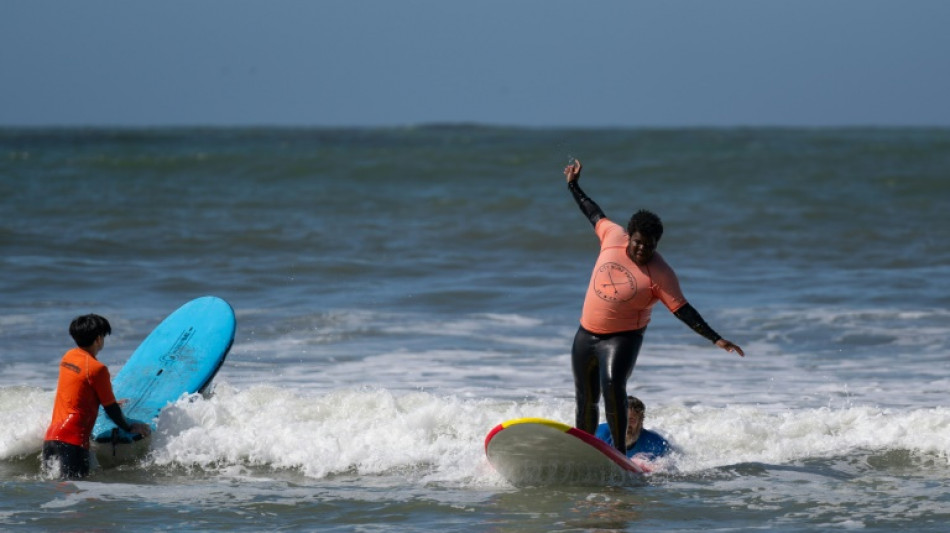
Catching a break: Inner city Californians try surfing / Photo: Loren Elliott - AFP

 Inter roar back in five-goal thriller with Napoli

 Haaland keeps Man City perfect in Premier League, blunt Spurs held

 Hamilton worried by Ferrari pace while Antonelli prepares for a fight

 Vuelta stage 15 shortened due to extreme heat, Mas consolidates lead

 Putin meets US envoys for Ukraine war talks

 Modric available for Croatia in Nations League

 Potapova upsets 2025 US Open runner-up Anisimova

 Gasly a 'class act' says Alpine boss after Monza pole

 Athletic Bilbao crush Simeone's flat Atletico

 Stay far from battlefield, warns Japanese director in Vietnam War film

 Tens of thousands of Croatians protest over hazardous waste

 Haaland heads unconvincing Man City top of Premier League

 US envoys in Moscow as Russia and Ukraine vow not to hit capitals during talks

 Motorsport governing body rejects Alpine boss's claims of bias

 US envoy on West Bank visit says Israel has responsibility for Palestinians

 Ethiopian Miss World contestant spotlights pain of sister's murder

 'Leader' Raphinha rising to Barca striker challenge

 Oasis fans gather in Venice for band reunion film

 Two Nepal rescues revive hopes 10 days after flood

 Pogacar to miss worlds after season-ending Vuelta crash

 Greenwood, Guendouzi handed bans after Fenerbahce-Lyon brawl

 In Iceland, the mystery of the poet, the tomb and the Danish grocer

 Ratko Mladic: Bosnian Serb commander to convicted war criminal

 Bolivian army base blasts kill two, wound dozens

 Alcaraz, Sabalenka into US Open last 16 as Williams sisters lose on return

As Dianne Finez helps her Latino and African American students through their first surf lesson, she remembers the time she first took to the waves, trying out a sport she barely even knew existed.
The 20-year-old of Filipino descent grew up 30 minutes' drive from the beach in a working class neighborhood of San Francisco.
"I never knew surfing was an actual thing," she told AFP.
"It was also hard to get into the sport just because there's mostly white males."
Finez is one of more than 2,000 young people who have been introduced to the waves by City Surf Project over the last decade.
The association works with schools in working-class neighborhoods of San Francisco, where the bulk of the student population is Hispanic or African American.
- Cultural assumptions -
The organization offers long-term partnerships with schools that allow educators to tailor their programs.
But it also provides necessary practical help, like free use of equipment and transport to get students to and from the beach.
Unlike in the Hawaiian societies of yesteryear where surfing originated, the California coast today is largely the preserve of the wealthy -- the result of segregation and expropriation of minorities.
"When you look at who lives on the coast, it's usually affluent, white communities," says Andrew Perry, the City Surf Project's program manager.
"When you're a kid that lives almost two hours by bus from the beach, and then you've got to bring a surfboard on the bus, it is a monumental effort... as opposed to the person that lives two blocks from the beach and grew up there."
The cost of the sport is a limiting factor for many -- $300 for a wetsuit, $800 for a new board, and $200-a-day lessons.
That's where the organization's equipment loans come in handy, says Perry.
But it's not just the practical obstacles -- there are also cultural assumptions within the communities they are trying to reach, with what Perry calls a "generational stigma around swimming in the ocean" for working class families who live inland.
"A lot of the times kids are growing up viewing it as a really scary place," he said.
- 'Laid back' -
That's a familiar idea for Trew Gantt, an African American whose mother was terrified by the ocean.
"I was allowed to go to pools on my own, but not to the beach," he said.
"Everybody around me was telling me the ocean is cold and dangerous. Surfing just seemed unrealistic, unless you lived someplace tropical."
But after his first taste of life on a surfboard with the program, he was bitten, and now he works as an instructor, delighting in showing his young charges they should not be afraid of the water.
He credits the sport with keeping him out of trouble during his teenage years, and helping him remain on an even keel.
"Surfing taught me to be a lot more laid back and made me understand that I didn't need to impress anybody," he said.
And that's something that educators have noticed as well.
The ocean "is this force beyond measure that is good for us," says high school teacher Sara Kosoff.
"And so I think that students of color need access to that equally, if not more than white students."
B.Khalifa--SF-PST