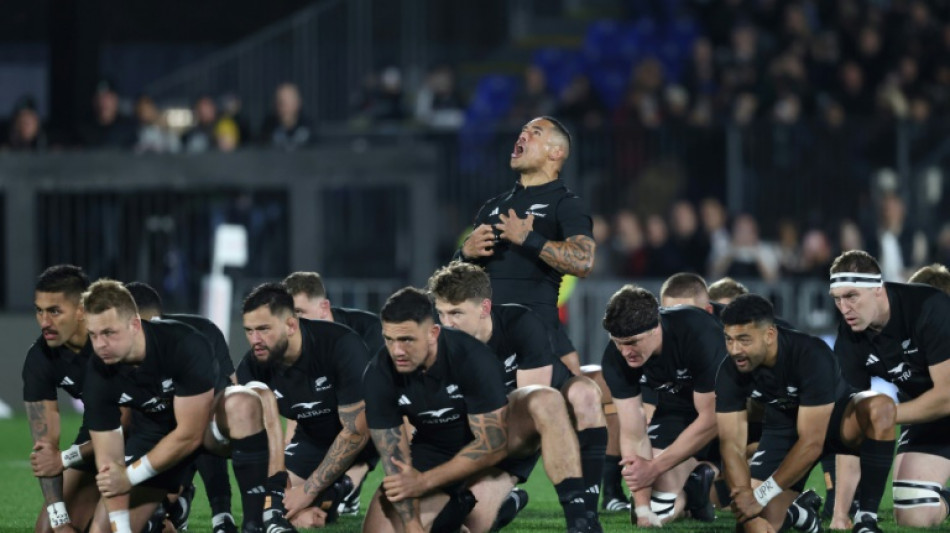
How the All Blacks rose to the challenge of unleashing the haka / Photo: MICHAEL BRADLEY - AFP/File

 Tanker captain arrested over cargo ship sinking off Istanbul
 India hopes 'unique idea' will save athletes from cabin fever

 UK asserts 'unshakeable' Falklands commitment after Milei presses claim
 How a Dostoevsky novella took TikTok by storm

 Zverev goes the distance again to reach US Open third round
 German AfD's love for Simson mopeds dismays Jewish family behind brand

 Two trapped tunnel workers rescued in Nepal 'miracle'

 Ex-Pakistan coach Gillespie tells Javed 'look in the mirror' over sackings
 Monfils falls to Tien in US Open in Grand Slam farewell
 Arsenal brace for Chelsea test as Spurs seek spark
 Efficient Rybakina reaches US Open third round

 Taiwan boxer Lin considered 'graceful exit' after Paris Games gold

 'I miss my home': Cambodians displaced by conflict start over
 Ailing Auger-Aliassime falls at US Open as Swiatek, Osaka and Gauff advance
 Tesla launches self-driving 'Cybercab' in Texas
 'Wallace & Gromit' creators turn 50 with spook-tacular Shaun yarn
 New York's Muslims reclaim their city after 9/11 backlash
 Premier League transfer windfall a lifeline for ailing French clubs
 Chile protesters see shades of Pinochet in new security plan
 Carreras reverts to fullback as Argentina change four for Australia Test
 Wilson back to lead Australia as Kiss rotates team for Argentina
 Yen surges on new intervention talk, US stocks rally

 Japan's Ueda fires Lille top of Ligue 1 on debut

 Arsenal chief executive reveals 'dynasty' ambition

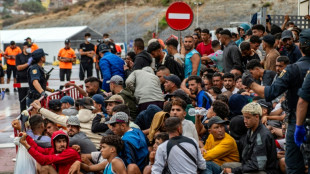 Spanish PM says no 'solid proof' Morocco planned migrant rush
Before France take on New Zealand in the opening game of the Rugby World Cup the hosts will have to face the ferocious challenge laid down by the All Blacks in the haka.
"In a rugby game, if you want victory, you have to come and get it - it's either you or us," Dr Taku Parai, an elder from the Ngati Toa iwi Maori tribe, told AFP.
The haka is the fierce war dance which originated to prepare Maori warriors for battle and has since been adopted by New Zealand, who perform one of two versions of the haka before games.
Either Kapa O Pango, created for the All Blacks and first performed in 2005, or the traditional Ka Mate, by far the best known.
Under New Zealand law, the Ngati Toa iwi, based in Porirua just outside Wellington, are recognised as the cultural guardians of the Ka Mate haka.
For New Zealand playmaker Beauden Barrett, the haka is an important part of his pre-match preparation. "It's about us coming together and being united," he told AFP.
"For me, it's about us. Our legacy, what has gone before us. Being in the moment - and getting ready for battle."
- Ancient ancestry -
Ka Mate was composed by the warrior chief Te Rauparaha around 1820 to celebrate his escape from a rival tribe's pursuing war party.
For New Zealanders, it is performed "as a token of deep respect, whether it is at funerals, birthdays, weddings", Parai explains. "It's about upholding the 'mana' (prestige) of an occasion."
Yet the chest-pounding, thigh-slapping actions accompanying the Maori chant weren't always performed by All Blacks teams with the same precision and ferocity as today.
Originally, the All Blacks only did the haka when they played overseas, sometimes with mixed results as some non-Maori players seemed unsure of the actions.
Video footage of a notoriously poor haka before a 1973 tour match in Cardiff showed few New Zealand players, aside from Maori scrum-half Sid Going, seemed to know the movements.
It wasn't until Sir Wayne 'Buck' Shelford made the All Blacks squad in the mid 1980s that the haka was practised and then performed with the fierce focus seen today.
"Until it got to 'Buck', they (the All Blacks) were still twinkling their fingers like jingle bells," joked Parai.
Before he made the All Blacks squad in 1985, Shelford had seen previous generations of New Zealand teams struggle to perform the haka with cohesion.
- 'Warriors' -
"I was disappointed that they couldn't get it together, do the actions correctly and portray themselves as warriors rather than stick figures swaying their arms and stamping their feet," Shelford told AFP.
On an All Blacks tour of Argentina, Shelford and fellow Maori player Hika Reid decided the haka must be performed properly or not at all.
"We insisted on 100 percent buy-in from the players and management, because I wasn't going to watch a poor rendition of the haka by any team I am in," Shelford added.
"That would just be disrespecting our people back home."
Shelford insisted each player learned the words and actions until they knew them by heart.
"All of a sudden, they started enjoying it because it was done right and you were doing it for a reason."
With Shelford leading the haka, it became a staple before home Test matches from 1987, the year the All Blacks won the inaugural Rugby World Cup.
In the years following Shelford's final Test in 1990, other Maori players, such as Piri Weepu, TJ Perenara and current scrum-half Aaron Smith, have led the haka with the same passion.
"I'm very proud of what it's gone on to become. As Kiwis, it's part of our culture and people respect it," Shelford added.
N.Awad--SF-PST