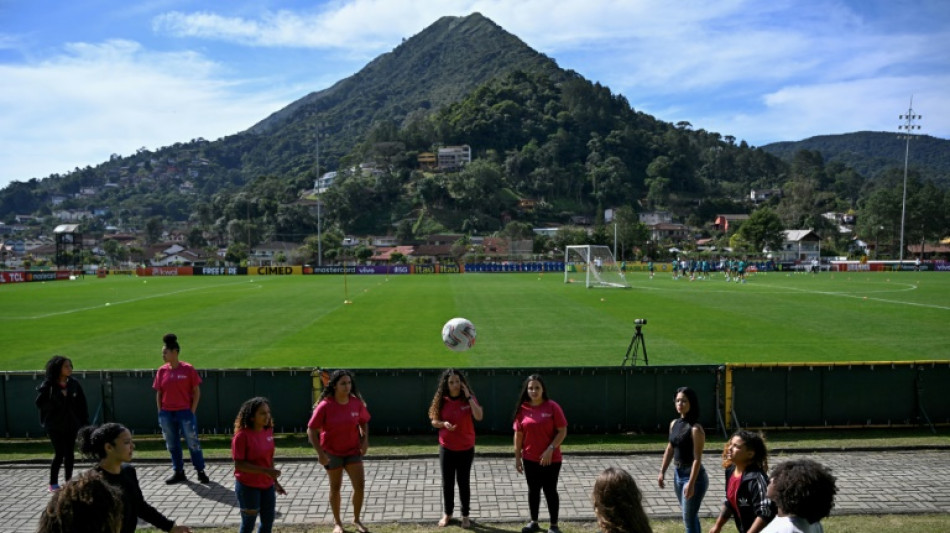
'Against their nature': When Brazil banned women from football / Photo: Mauro PIMENTEL - AFP/File

 Nepal tunnel rescuers seek trapped workers but hit dead ends
 Zverev wins wild five-setter, Rybakina and Gauff ease through at US Open

 US energy secretary arrives in Venezuela to discuss oil deal

 Meloni government becomes Italy's longest-lasting

 Funerals in Nepal for missing, a week after deadly floods

 US aircraft carrier arrives in Thailand after months at sea

 US aircraft carrier approaches Thai port after months at sea
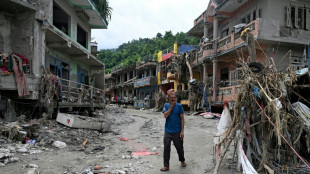 Nepal's young PM faces gravest test after flood catastrophe

 What rainbow? LGBTQ Indonesians on edge as hostility mounts

 O'Connor eyes Wallabies World Cup swansong after Force return

 Syria UXO causing death, injury every six hours: charity

 Tiger Woods set to change not guilty plea in DUI case: court documents

 Zelensky warns airlines Russian skies not safe due to Ukraine drones

 UK vows anti-settler measures as Israel warns of retaliation

 New pro Koivun among US Presidents Cup picks

 G20 finance leaders close talks marked by US welcoming Russia

 From Hollywood to big time tennis: teen makes US Open debut

 Man City secure Premier League record deal to sign Fernandez

 Kaepernick says NFL 'blackballing me' decade after protest

 Atletico loan David from Juve, send Lemar to Elche

 Chelsea 'keeper Sanchez makes deadline-day move to Como

 Kroenke to buy baseball's Los Angeles Angels: statement

 US defends Trump's Venezuela oil deal

 OpenAI to launch new model with 'stronger safeguards' after hack

 Fans mourn 'bittersweet' final Ariana Grande gig in London

Dilma Mendes does not remember how many times she was arrested as a child. Her crime? Playing football in Brazil.
The country may be synonymous with the beautiful game, but it banned women from the sport for nearly four decades until 1979.
Ahead of the Women's World Cup starting next week in Australia and New Zealand, where Brazil will be in action, Mendes recalled the lengths she went to in order to fulfill her dream of becoming a footballer.
As a girl in the 1970s, she gave ice cream to the boys she played with in Camacari in Brazil's impoverished northeast in exchange for an early warning of the arrival of police busting girls flouting the prohibition.
She used to dig a hole next to the pitch to hide in until the enforcers left, then crawled out again to continue kicking the ball around with her male friends.
When they let her, which was not always the case.
Sometimes all her precautions failed and Mendes found herself hauled off to a police station.
"When I was a child I thought the police stopped those who did something wrong, and I didn't feel like I was doing anything wrong," Mendes, now 59, told AFP.
"The cops treated me well, but some said I couldn't play because football was for men."
Then-president Getulio Vargas promulgated a decree in 1941 to ban girls and women from football at a time many believed that participation in sport could inhibit childbearing ability.
The decree prohibited women from practising "sports incompatible with the conditions of their nature."
No specific sanctions were mentioned, leaving it open to individual police officers to decide how to deal with offenders.
Football associations in other countries, such as Britain, Germany and France, also barred women from the sport, but Brazil's ban was the only one decreed by law.
It remained in place until 1979.
While many like Mendes continued to play, the 38-year prohibition stunted development of the sport among Brazilian women during a period in which their male counterparts lifted three of their five World Cups.
- Beaten for playing -
The ban came at a socially conservative time when women were viewed as "maternal figures reserved for the domestic space" -- a construct their presence on a sports field challenged head-on, said Brazilian sports researcher Silvana Goellner.
There are no records of women going to jail for violating the decree, but they would be detained and only released after questioning.
Many "never stopped playing" despite the threat of arrest, said Goellner, who co-authored a book on the topic. "They created strategies to circumvent the law."
Some dressed as men, others played at night or in places hidden from public view. When busted, they scattered in different directions to confuse their pursuers.
But many were unable to evade a reckoning much closer to home: their families.
Mendes remembers sitting at the police station praying that her father -- who supported her passion -- would be the one to fetch her.
If it was her mother, she could count on a hiding for practising a "men's sport," said the youngest of seven siblings -- five of them boys.
"It was hard to arrive home and your mother and brothers beat you and the next day you have to be ready to play again," Mendes recalled.
"I saw many friends leave football because of that cruel process."
But she never gave up, making a modest career in futsal -- a variation of football played on a small court, often indoors -- and in professional football when it was officially opened to women in Brazil in 1983 amid growing calls for equal rights.
- Never had a chance -
After retiring as a player in 1995, Mendes moved into coaching and helped unearth Formiga, a legendary former midfielder for the Brazil women's team.
She also coached Brazil's women to victory in the seven-a-side world championship in 2019.
Brazil had "great players" who never had a chance, Mendes lamented in hindsight of the "cruel" ban, which has also meant a very patchy historic record of women's football in the South American country.
But things have changed, and now the "Selecao" are preparing to participate in their ninth Women's World Cup.
They will run out under veteran captain Marta, who has scored more World Cup goals (17) than any other player, man or woman.
Brazil's best showing in the event, first staged in 1991, was in 2007 when they were beaten in the final by Germany.
M.AlAhmad--SF-PST