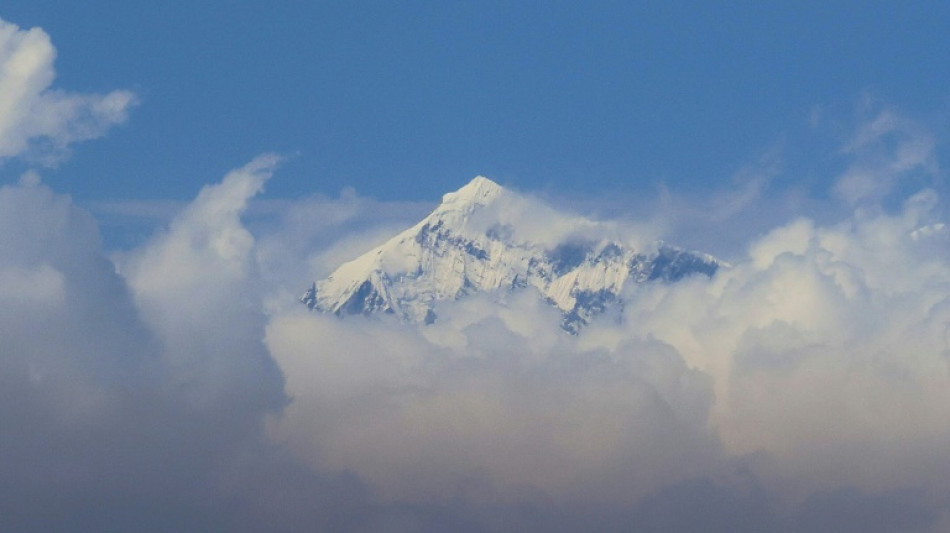
Deadly dreams: record Everest season among most dangerous / Photo: Sebastien BERGER - AFP

 Stocks drop as Warsh fans US rate hike bets, crude up on US-Iran strikes
 Injuries cloud tennis as US Open gets under way

 Iran retaliates after first US strikes in a month

 Itauma says 'I'll be back' after bruising heavyweight title loss

 Brilliant Palou clinches fourth straight IndyCar crown
 US strikes Iran for first time in a month, Tehran retaliates
 Yin holds off Kim to win sixth LPGA title, end title drought

 Top-ranked Scheffler storms to PGA Tour Championship win

 Root urges England to be 'grown-ups' after Pakistan series win

 Google Maps renames Lake Ontario 'Lake America' in US -- but not Canada

 Aaron Donald ends retirement to rejoin Rams: team

 Niamey back to normal after soldiers' mutiny

 Niger mutiny suppressed, but questions remain over junta's cohesion

 Como spoil Allegri's Napoli home debut
 Cruz Beckham Performs at Leeds Festival Following Family Support at Reading

 Fernandes hat-trick inspires Man Utd rout of Ipswich

 Suzuki sends 'perfect' Freiburg past Bremen, Schalke lose

 Instagram offers three routes to two-factor authentication

 September smartphone calendar spans Apple, Poco, Vivo and Xiaomi
 Forest defender Tyler Bindon joins Charlton on loan

 Google Maps adopts Lake America label for US users

 WIRED tests label makers for home organisation

 CERN creates quark-gluon plasma with smaller atomic nuclei
 South West Water ranks worst in environmental comparison

 Russell Hobbs dual air fryer discounted to £99

Scaling Everest is always dangerous, but expedition organisers have warned that a combination of extreme weather, corner-cutting on safety, and inexperienced and "impatient" foreign climbers has resulted in one of the peak's deadliest mountaineering seasons.
As the last search and rescue teams hang up their boots and the tent city at base camp packs up for the year, expert climbers say several of the 17 people killed or missing and presumed dead this season could have avoided disaster.
"This season was very bad overall," said expedition organiser Mingma Gyalje Sherpa, of Imagine Nepal Trek and Expedition, whose team was responsible for opening the route to the summit.
"The main reason is that the weather was extremely cold... but there was also carelessness."
Higher death numbers were recorded in past seasons, but those tolls included several killed in single large-scale disasters.
In 2014, 16 Nepali guides were killed by an avalanche, with climbing closed for the season thereafter.
The deadliest season was in 2015, when at least 18 people died in an earthquake that also killed nearly 9,000 people across Nepal.
This season, 12 people died and five others are missing.
Ten of them were foreigners, the highest such toll on record, as well as seven Nepalis: guides, mountain workers and a climber.
Around five climbers die each year on the oxygen-starved paths to the 8,849-metre (29,032-foot) icy peak.
Some say too many of the foreign mountaineers are ill-prepared for what remains a major test of body and soul.
Nepal issued a record 478 permits for foreign clients this season, with around 600 climbers and guides reaching the top, prompting some to suggest there is a need to cut numbers.
- Minus 40 degrees -
The tough guides say the mountain was the coldest they have ever experienced, with freezing temperatures far lower than usual adding to the danger.
"It should already have been warm, around minus 28 degrees Celsius (-18.4 degrees Fahrenheit)," said Mingma Gyalje Sherpa.
"This year it was even down to minus 40 degrees."
Climate change is dramatically altering weather patterns and causing extreme fluctuations in temperature, but scientists caution against linking individual events directly to global heating without evidence.
Three of Mingma Gyalje Sherpa's route-opening team -- Dawa Tseri, Pemba Tenzing and Lakpa Rita Sherpa -- died after dropping off ropes at Camp 2 when a serac ice block fell and buried them in the Khumbu icefall.
As the season progressed, more climbers died or were reported missing in the icy heights.
Several others suffered frostbite and infections related to high-altitude pulmonary edema, when liquid accumulates in air spaces of the lungs.
Mingma Gyalje Sherpa said the freezing weather and high winds meant many Nepali guides and porters suffered frostbite early in the season.
That had a knock-on impact, especially for equipping higher altitude camps.
"It meant that Camp 4 was not prepared enough and not all supplies reached there... but clients were impatient and climbing began," he said.
"I think some of the casualties could have been prevented if all the supplies were there."
The rapid growth of the climbing industry has created fierce competition among companies for business, also raising fears that some are cutting corners on safety.
Lukas Furtenbach, of Austria-based Furtenbach Adventures, said that a majority of the deaths could have been avoided "with mandatory safety standards".
"These accidents do all have a similar pattern," Furtenbach said.
"This, in combination with the fact that oxygen cylinders have been stolen from several teams, including ours, shows one of the main problems this season -- oxygen logistics and safety standards."
- 'Overworked' -
Many climbers dropped out this season, even after paying a non-refundable $11,000 for a permit and at least $30,000 more for the expedition.
"It shook people's confidence. When you keep seeing people getting sick, having to be rescued, or bodies being brought down, even the fittest climber has doubts," said Dawa Steven Sherpa of expedition organiser Asian Trekking.
But the season took a heavier toll on Nepali guides, usually ethnic Sherpas from the valleys around Everest, who are considered the backbone of the climbing industry and bear huge risks to carry equipment and food, fix ropes and repair ladders.
The increased need for rescues also demanded more staffing.
Mountain guide Gelje Sherpa, 30, made headlines after he abandoned his client's Everest bid to rescue a Malaysian climber from the "death zone" above 8,000 metres, carrying him down on his back when he couldn't be dragged.
"It has been an emotionally and physically draining year for the Sherpas," Dawa Steven Sherpa said.
"Some left, many were injured, which meant that those still on the mountain were overworked. Everyone was exhausted."
G.AbuGhazaleh--SF-PST