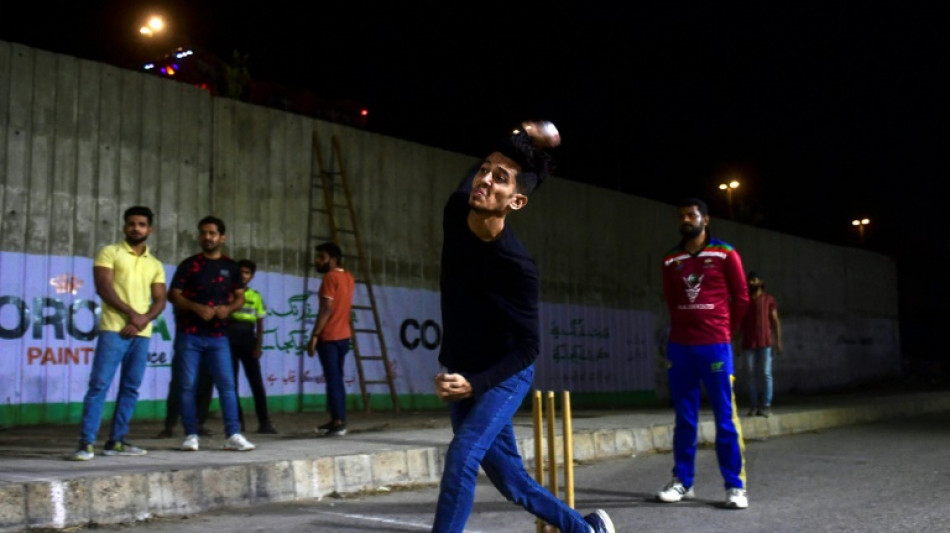
Pakistan street cricket comes to life after dark during Ramadan / Photo: Asif HASSAN - AFP

 In war-split Myanmar 'spirit consorts' commune across divide
 Leaders of Russia, China, Iran to attend summit in Kyrgyzstan

 Hovland and Gerard share lead at Tour Championship

 Maresca salutes 'unbelievable' Cherki after Man City star sinks Palace

 Marquinhos rescues last-gasp draw for PSG at Lille in Ligue 1

 ICE detains British far-right activist Milo Yiannopoulos in Louisiana

 Milo Yiannopoulos held by ICE after missing immigration hearing

 Six Flags closes X2 rollercoaster after reports of severe brain injuries

 Jury ends second day without verdict in Lindsay Clancy murder trial

 Artist says criticised Ronnie O'Sullivan mural is unfinished
 UAE grants Starlink 10-year satellite broadband licence

 US says Hormuz mines cleared as diplomacy and military deployments continue

 Nepal-Tibet flood toll reaches 584 as more than 2,400 remain missing

 Cherki makes his point to Maresca as Man City sparkle in Palace rout

 Odisha faces very heavy rain as Sri Ganganagar reaches 41.4C

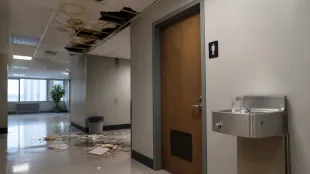 GSA employees report mice, ceiling damage and cloudy water after Washington office move

 REI Labor Day sale runs through September 7 with outdoor gear discounts

 Meta tests robots for cabling, server resets and maintenance inside data centers

 Nepal-Tibet flood rescue resumes after overflowing debris lake forces temporary withdrawal

 Extreme heat exposes vulnerabilities across Britain's rail network

 Dollar rallies after Fed chief lifts rate expectations

 Slumping Sabalenka 'confident' ahead of US Open three-peat bid
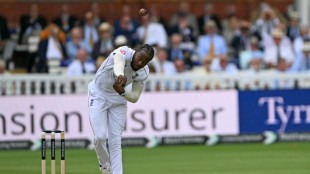
 Aston Villa seal swoop for Chelsea striker Jackson

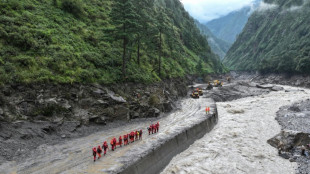 Number of missing in deadly Nepal, China floods jumps past 2,400
 Birmingham City Seek First Championship Win Against Wrexham

After midnight during Ramadan, makeshift floodlights transform a central Karachi basketball court into an urban cricket arena, where dozens of young Pakistani men chase taped-up tennis balls zipping through the night air.
Donkeys watch on from the outfield and goats rummage through nearby piles of rubbish, breaking occasionally for a pitch invasion.
"After the Taraweeh (special Ramadan prayers), people crave entertainment so that is why many play cricket," batsman Waqas Danish told AFP. "They play all night, because some people can't wake up for breakfast if they sleep."
Tape-ball games are ubiquitous across Karachi's streets throughout the year, but Ramadan sees night tournaments pop up in most neighbourhoods.
The uninitiated may struggle to unravel the mayhem of multiple overlapping matches in a cramped space, but for Karachi's street cricketers, there is method in the madness.
The frenetic matches of between four and six overs per innings are concluded before sehri, the meal consumed ahead of daytime fasting.
They range from pick-up games on improvised concrete pitches to professional competitions on dusty ovals.
"The kids and youths can't afford kits and all the accessories for playing hard-ball cricket, but they can easily afford the tape ball," competition organiser Taqdeer Afridi told AFP in Karachi.
Money is often involved -- even though gambling is illegal in Pakistan -- and big-hitting mercenaries are occasionally lured from surrounding neighbourhoods to play under lights that craftily tap into overhead power lines.
A tennis ball is tightly bound with electrical tape, giving it extra weight so it swings much like a cricket ball, yet is less damaging if it hits a spectator, window -- or even a passing rickshaw.
- 'Amazing' speed -
Matches played in the poorest neighbourhoods can draw hundreds of spectators, with many onlookers admitting that watching cricket all night helps with the day's fast.
"All day they are sleeping. Maybe they go to their jobs for four or five hours," 19-year-old spectator Rahman Khan said.
After Partition in 1947, cricket was considered the domain of the upper class, played at Karachi's posh clubs and elite schools.
But as the population boomed through the 1960s, cricket adapted to the sprawling metropolis and tennis balls emerged as a substitute to the hard ball.
The cheaper alternative -- which also removes the need for costly equipment like batting pads -- took on several experimental forms in the following decades, and is credited with bringing the sport to the everyday Pakistani.
There is no consensus on when the first tape ball delivery was bowled or by who, but legends abound -- and the one thing historians and fans agree on is that it originated in Karachi.
"The tennis ball without tape lacked speed," said veteran Nasir Ali, who recalls the 1980s as the formative years for the tape-ball game.
"On an experimental basis we wrapped the ball with red tape and when it was bowled the speed was amazing," said the 64-year-old, who hosts an annual competition in his apartment block's courtyard.
- 'Watch the ball' -
From legendary all-rounder Wasim Akram to modern-day pace star Shaheen Shah Afridi, many of Pakistan's top players credit street cricket as a positive influence on their techniques.
"In cricket there is a saying: 'watch the ball' -- it doesn't matter if it is a tennis ball or a taped ball or a hard ball," Pakistan national youth coach Mohammad Masroor told AFP.
"If a batsman can hit any ball, he can play cricket."
Watching young cricketers at a street pitch wedged between an elevated expressway and an apartment block in central Karachi, Masroor said rules adapted to the urban landscape hone a batsman's skills.
A hit back over the bowler's head and beyond the residential area on the full is six runs, but only one run if the ball rebounds off the apartment building.
Players must also beware of the "grumpy uncle or aunty" who is unwilling to return a ball hit into their home. A shot like that can cost a batsman more than just his wicket: they need to go buy a new ball, too.
"Nothing stops them," said Masroor, grinning.
V.Said--SF-PST