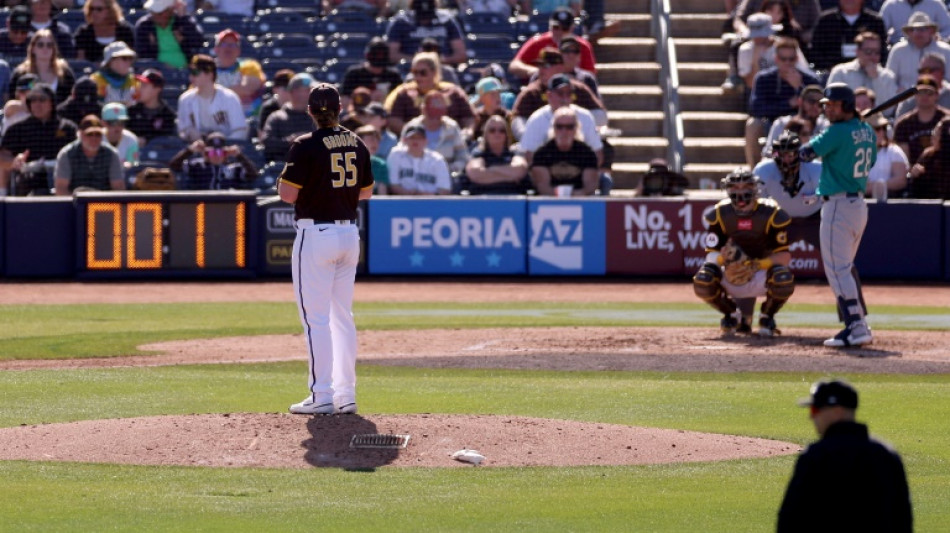
Baseball rule changes divide opinion as season looms / Photo: Steph Chambers - GETTY IMAGES NORTH AMERICA/AFP

 Yayoi Kusama: Japan's kaleidoscopic, troubled 'polka dot queen'

 Euro champ Hunt 'on her toes' against world's best in Zurich 100m

 Asian chip firms lifted by Nvidia forecast but broader markets struggle
 Search for missing after Nepal-Tibet floods kill 165

 Qantas says profits slump as fuel costs surge
 Lofty bond yields, Bessent's intervention pose challenge to Fed's Warsh

 The foreigners missing in Nepal's flash floods

 Bond yields are surging: Here's why that could spell trouble

 Fed's Cook rejects Trump mortgage fraud claims
 Police probe 'assault allegations' after Carse's nightclub incident

 How we might hear new Dolly Parton music in the future

 Nvidia doubles revenue, forecasts even more AI spending

 Canada renews push to boycott US products

 Savio scores on debut as Spurs set-up League Cup tie with Liverpool

 Brazil sues Discord over child safety measures, demands $100 mln in damages

 Alberta NDP Urges Smith to Postpone Separation Vote Amid Trade War

 Fenerbahce stun Lyon in Champions League as AEK crush Levski

 Why Global Finance Still Relies on Wall Street Despite Diversification Trends

 Bethlehem Father Seeks Aid for Special Needs Children Amid Health Crisis

 LIV Golf to lay off majority of staff

 How narwhal 'scientists' track Arctic warming

 Iran says US sanctions will achieve nothing

 Essential Dolly: five key Parton songs

 Veteran promoter Warren says it's Joshua's job to agree Fury fight

 Ex-champ Wawrinka gets last-minute wildcard to US Open

After nearly 150 years of ploughing its own unapologetically somnolent furrow in an increasingly frenetic US sporting landscape, baseball is finally hitting the accelerator.
But new rules designed to make "America's pastime" a faster, more fan-friendly spectacle have divided opinion after being rolled out in pre-season games which got under way last week.
The biggest talking point has been the introduction of a pitch clock that sets fixed time limits for pitchers and batters.
Under the new rules, pitchers have 15 seconds to begin their throwing motion if the bases are empty, and 20 seconds when runners are on base.
Pitchers will be charged a ball if they are unable to get a pitch off before the clock runs out.
Batters, meanwhile, must be ready to receive a pitch by the time eight seconds are left on the countdown clock. Failure to do so will incur an automatic strike.
The pitch clock is aimed at reducing the length of a typical MLB game -- and early signs are that the innovation is working.
In the 2022 season, nine-inning games took an average of 3 hours 3 minutes and 44 seconds to complete.
But in the opening days of the 2023 pre-season, games have routinely finished well under the three-hour mark, averaging at around 2hrs 37mins.
"I think it definitely speeds up the game," New York Yankees slugger Aaron Judge said. "I think this pitch clock is going be a good thing for everybody."
There have been hiccups, however.
Baseball purists grimaced at the ending to Saturday's game between Atlanta and Boston when Braves slugger Cal Conley was called out for failing to get into the batter's box on time in the bottom of the ninth inning with bases loaded.
The anti-climactic ending -- akin to a tennis match being settled by a foot fault -- drew boos from fans and general bafflement from Conley, who initially thought he had drawn a walk to win the game until being informed of his strikeout.
- 'Angry, pissed off' -
Yet, so far, the innovation has been broadly welcomed by coaches and players across baseball as the sport bids to arrest long-term declines in attendance and television viewership.
"The whole purpose is to speed up the game and it was good," said Boston manager Alex Cora, who believes players will swiftly adapt to the faster pace.
"As players, you're going to get used to it. I watched a lot of bullpen the first few weeks with the clock.
"At the beginning, it felt rushed but then after that, I was like, 'It's okay.'
Minnesota Twins manager Rocco Baldelli also signalled his approval.
"The goal is to keep things flowing," Baldelli said. "Just keep the game going. I think it's probably the pace and the time you're hoping for when you're playing a Major League Baseball game."
San Diego Padres shortstop Manny Machado meanwhile -- who became the first player in pre-season to incur a strike for a pitch clock violation -- believes the new rules could lead to "crazy shit".
"You're going to have some players who are going to be freakin' angry and pissed off," Machado USA Today.
"You're going to have players pissed off at the umpires who are just following the rules. We're going to be seeing some crazy shit for sure."
Some pitchers, however, believe the introduction of the clock has handed them a weapon they can use to unsettle batters.
"I can completely dictate pace," said New York Mets ace Max Scherzer.
"I love it... I can work extremely quickly or I can work extremely slow. There is another layer here to be able to mess with the hitter's timing."
Other rule changes introduced this season will see larger bases, which aims to reduce injuries from collisions while increasing offense by encouraging more steals.
Another change aims to restrict teams from setting up ultra-defensive fielding formations, again with the goal of boosting offense.
"Hopefully these rule changes kind of implement a little bit more action and entertainment for the casual fan and not just always the diehard baseball fan," Minnesota outfielder Joey Gallo said on the "Baseball Isn't Boring" podcast recently.
"I think, for baseball, you're trying to attract a bigger, grander audience. And it's hard to do that if it's just not exciting to watch and slow-paced games."
M.AbuKhalil--SF-PST